

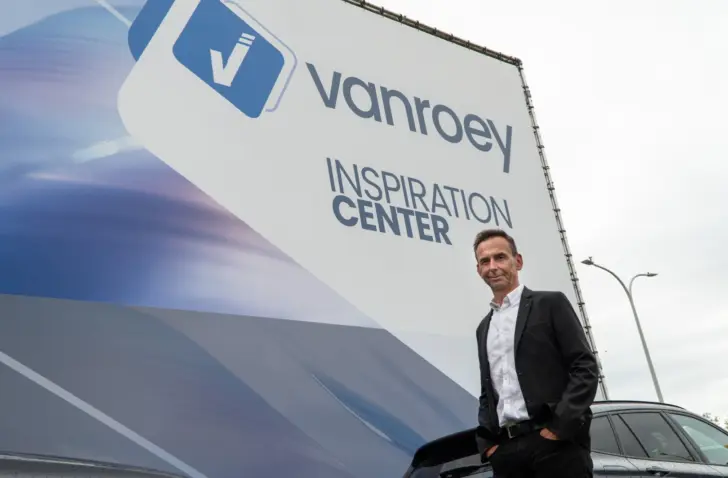
VanRoey is increasing its footprint in Flanders province by province and acquisition by acquisition. From its roots in security, the company has grown into a full-service IT provider.
VanRoey has shot out of the blocks like a rocket in 2026. In just two months, the Turnhout-based company announced two acquisitions and plans for a merger with Dynamate. Every move VanRoey makes is done with a clear goal in mind: becoming a leading IT player in Flanders.
Joachim Lauwers has been leading the VanRoey team as frontman since September 2024. He is the first CEO who does not bear the company’s surname. “I have always been attracted to companies that are on the side of the ‘challengers’. Starting from a local perspective and then building the company in a sustainable way is what I see as an interesting challenge.”
Grown from security
You can certainly call VanRoey a ‘challenger’. The company has been around for thirty years, but since Lauwers took over the torch, VanRoey has been on a rapid conquest of Flanders. The core remains the same: “Deep technical expertise is where we want to differentiate ourselves. Many of our people have obtained the highest certifications. We are no-nonsense, very pragmatic, and stay close to the customer,” says Lauwers.
“The portfolio is based on two major pillars,” the CEO continues. “We employ about sixty consultants specialized in applications (ERP/CRM) within the Microsoft ecosystem. But above all, we want to be a broader service provider that completely unburdens companies of their IT. We further divide the second pillar into three areas: hybrid infrastructure and networking, modern workplace, and security.”
That third component still forms the foundation of what VanRoey does today. Lauwers: “SaaS and AI are changing how you have to look at security as an organization. You can no longer see it as a standalone part. We recently launched our own SOC service: not virtual, but with our own people. Where a normal SOC only sends alerts and the customer has to solve it themselves, we also handle the remediation. This makes us unique in the market.”
The ‘m’ in SME
When asked what type of organizations VanRoey wants to appeal to, Lauwers has a quick answer ready. “The ‘m’ in SME: medium-sized organizations with 20 to 300 employees. This is our ‘sweet spot’. Horizontal specialization allows us to go very broad. This type of company also needs that broad support. Technology is evolving so fast today that many companies no longer have the knowledge or resources in-house because IT is not a core activity.”
“But large companies can’t do everything themselves either. For companies that have their own IT department, we function as an extension of their own IT team, supplementing specialized knowledge where it is lacking internally.” According to Lauwers, one of the biggest challenges in the market remains the war for talent. There is a scarcity of people with deep expertise.
VanRoey feels that problem itself, but also sees it very clearly with large customers. Lauwers: “We notice that we are increasingly fishing in the same scarce talent pool as our customers in the higher market segment. As a broad IT player, we often have an attractive offer because those profiles have many career opportunities with us in different domains and roles. And as a result, you see that the higher market segment is also evolving more and more towards outsourcing.”
“Look at security: that is often the first thing companies outsource. You simply can’t get people excited about following up on alerts all day anymore. Automating this requires knowledge that you can no longer build up yourself as a non-IT company. That’s why we want to be big enough to be able to invest in new technology, but at the same time ‘small’ enough to remain agile,” Lauwers adds.
We want to be big enough to invest in new technology, but also small enough to remain agile.
Joachim Lauwers, CEO VanRoey
From east to west
VanRoey is not sitting still. In January, it acquired two companies: Sonical and The Collective. It is no coincidence that these two companies come from West and East Flanders. With targeted acquisitions, VanRoey wants to further grow both its geographical footprint and its expertise. Lauwers: “Our ambition is to become a leading managed IT player in Flanders. Local acquisitions strengthen our regional presence. We were already strong in Antwerp and Limburg, and now we have a branch in every province.”
That remains a major asset in the IT world, especially in the Belgian market, Lauwers emphasizes. “Belgium is a more traditional country. Companies still like you to visit them physically. We can answer every question personally. You miss that local touch with the large international players. There, you end up in a different department for every question. While we are fully automated at the core of our operations, the human approach remains important.”
Dynamate
The next big step for VanRoey is the announced intent to merge with Dynamate. Lauwers explains: “AI is developing rapidly: you can’t open a newspaper without reading about it. We are only at the beginning of how we will deal with this and how we will manage and control it. You hear high ambitions from Silicon Valley, but some people already can’t keep up. The merger fits into that broad and rapid evolution. Belgian companies are increasingly looking for an IT partner who can guide them in terms of data infrastructure, smart automation, and security.”
“Unlike us, Dynamate started in business applications, digital platforms, and web solutions and then expanded into infrastructure. To roll out AI successfully, you need knowledge of business processes. By merging our knowledge, expertise, and offering, we create a service provider that can answer every IT question and guide customers in a rapidly evolving and uncertain world,” he adds. “Moreover, we are also geographically complementary, which brings us even closer to our customers, and we share the same corporate culture.”
According to Lauwers, uncertainty is the third major trend characterizing the current IT landscape, alongside AI and security. “I fear we are dealing with a new reality where major AI players dominate the market. This causes hardware prices to rise, which in turn puts pressure on the supply chain. This creates a vicious circle: investments are becoming increasingly expensive. And the longer you wait, the worse it gets. That will undeniably have a major impact on the sector.”
Investments are becoming increasingly expensive. The longer you wait, the worse it gets.
Joachim Lauwers, VanRoey
In the ‘ICT in Belgium’ series, we focus on local, Belgian players in the sector. Do you want to discover more Belgian specialists? Here you will find all the interviews from the series.