

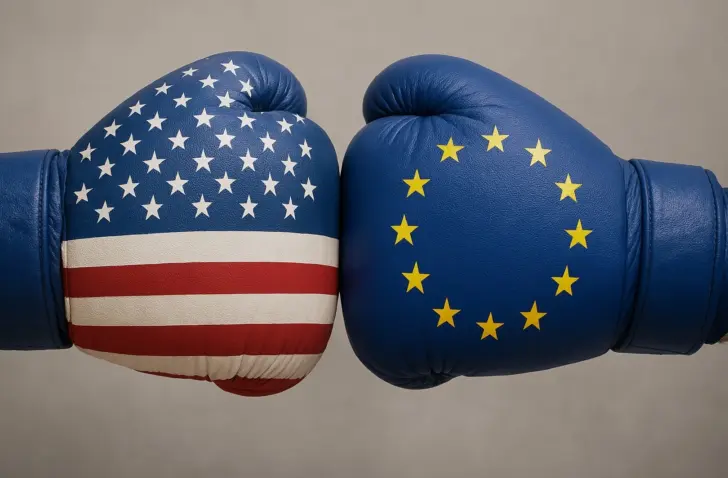
Privacy activist Max Schrems is embarking on a third attempt to curb European data flows to America.
Transatlantic agreements on data transfers between the EU and the US are under pressure once again, ten years after privacy activist Max Schrems made the first breach. While his complaints previously brought down Safe Harbor and Privacy Shield, the 2023 EU-US Data Privacy Framework is now also on shaky ground.
A recent ruling by the US Supreme Court calls into question the independence of the regulator, the FTC (Federal Trade Commission), while French MP Philippe Latombe and Schrems himself are pursuing new legal proceedings. Even Microsoft is joining the fray, but in this case to prevent a third framework from biting the dust. The Austrian Schrems succeeded twice; will he manage a third time?
Schrems I ruling
Schrems’ influence dates back to 2015 when the Austrian filed a complaint against Facebook. According to him, the company sent his personal data from Europe to servers in the United States. Schrems argued that the US offered insufficient protection against mass surveillance by intelligence services, which came to light through the revelations of whistleblower Edward Snowden.
The European Court of Justice followed that reasoning and, in October 2015, declared the so-called Safe Harbor agreement invalid. That agreement had regulated data transfers between the EU and the US for years but, according to the Court, did not offer an adequate level of protection for European citizens.
Privacy Shield
After the collapse of Safe Harbor, a new framework emerged, the Privacy Shield, and companies also continued to use so-called Standard Contractual Clauses to send data legally.
Schrems went to court again, and in July 2020, the European Court of Justice also declared the Privacy Shield invalid, once again due to the excessive access of US government services to European data (Schrems II ruling). Even Biden’s efforts were to no avail at the time. A new agreement was introduced: the EU-US Data Privacy Framework (DPF).
(Not so) independent regulator
Those 2023 regulations are now also on shifting sands. The European Commission ruled that the US had to provide a level of protection equivalent to that of the EU. Crucial to this is that the US has an independent regulator, namely the consumer watchdog FTC (Federal Trade Commission).
That independence is now being questioned. The US Supreme Court (Trump v. Slaughter) recently ruled that the US President has the authority to dismiss FTC commissioners. This raises new questions regarding political independence.
Schrems III?
It was French MP Philippe Latombe who questioned this independence. He has already approached the Court to have the DPF annulled, as he believes it violates the rules of Article 45(2) of the GDPR. Latombe has doubts about the true independence of the courts in the US. The complaint was initially rejected by the General Court of the European Union, after which Latombe appealed.
Schrems has surfaced again with the same concerns. He wrote a letter to the European Commission requesting an ‘orderly withdrawal’ from the data agreements with the US. In addition, he has announced a new legal procedure before the Court of Justice.
Microsoft intervention
Meanwhile, the EU-US Data Privacy Framework has enabled transatlantic data transfers since 2023, which large US companies say is necessary to do business with European countries. This also applies to Microsoft. Furthermore, the American tech giant has been granted permission to assist the European Commission in the Latombe case.
Microsoft will therefore intervene as an interested party on the side of the European Commission in defense of the DPF agreement. The tech giant wants to prevent this framework from being swept off the table as well. US companies active in Europe are not keen to see a third death blow.