

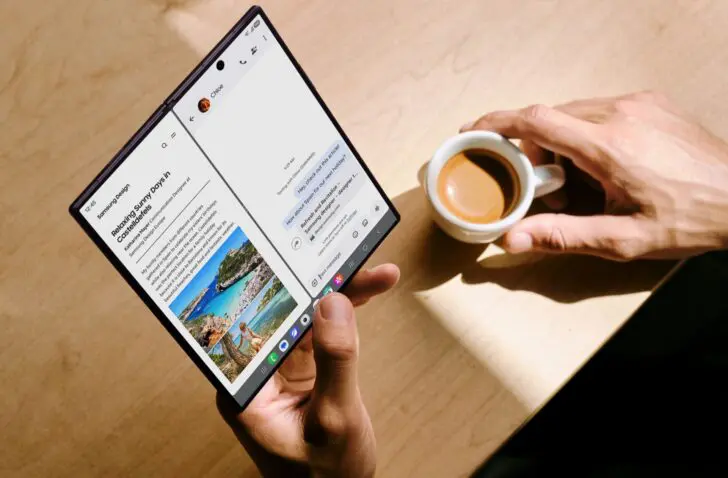
The Samsung Galaxy Z Fold 8 Ultra is mechanically the best large foldable phone at the moment. Fortunately so, because otherwise, this device hardly rises above the mid-range despite its price.
The mechanical geniuses at Samsung’s phone department deserve credit: with the Samsung Galaxy Z Fold 8 Ultra, they seem to have almost perfected the physical component of a foldable smartphone. The phone feels like a delicate yet robust gem in the hand. Opening and closing it happens with a subtly palpable click, where the device indicates it has fully opened or closed in the correct mode.
Pleasant folding
Furthermore, the design is clearly well-thought-out. The combination of edges and corners ensures that the smartphone feels like a single unit in its closed mode, and not, well, like a double-folded device. Its main competitor, Motorola, could learn a thing or two from this with the Motorola Razr Fold, although that is also a very well-built phone.
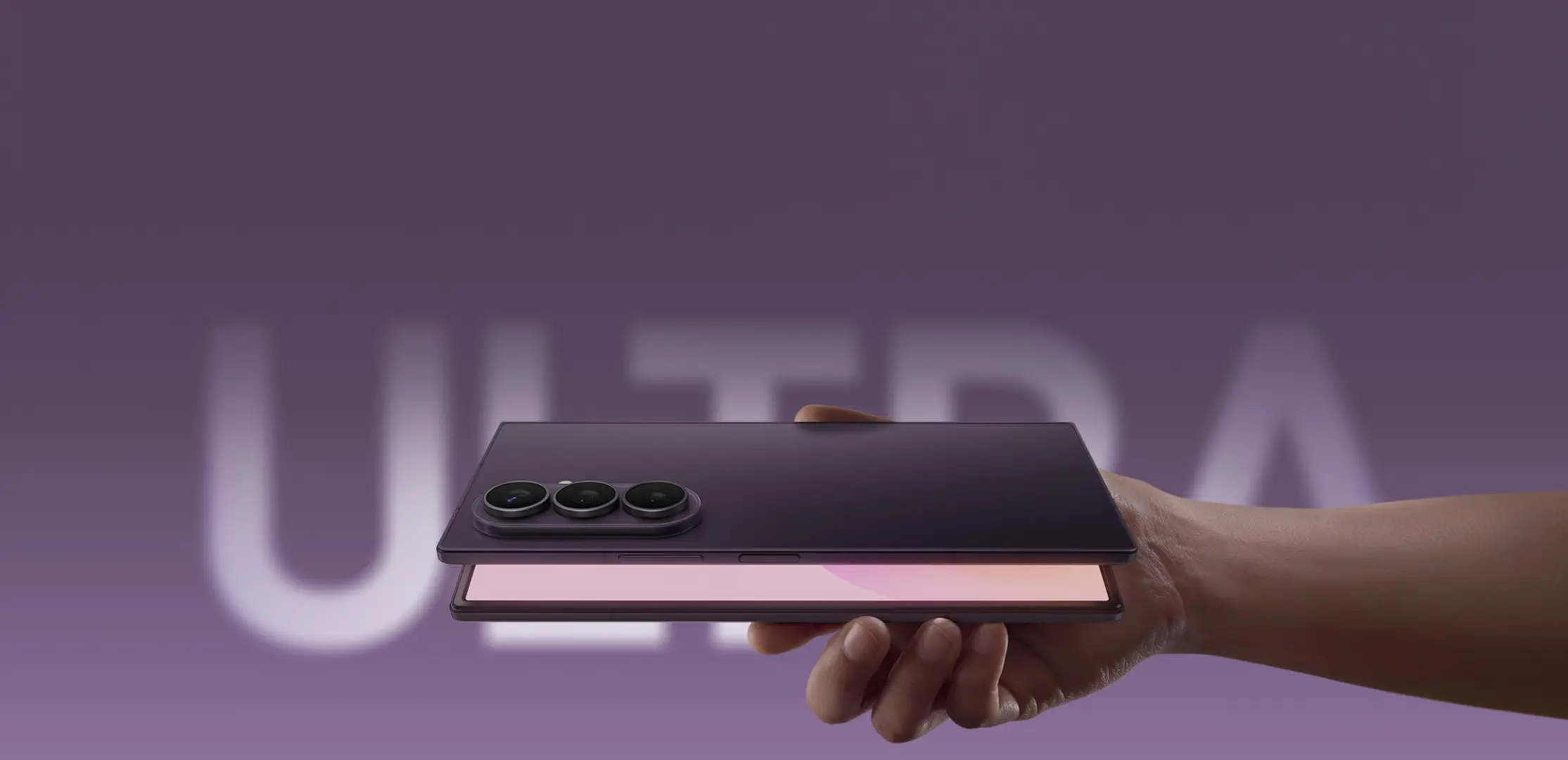
This summarizes the essence of the Samsung Galaxy Z Fold 8 Ultra, at least for prospective buyers with a substantial budget looking for the best-folding foldable phone in this format right now. If other factors play a role, such as the convenience of the chosen aspect ratio, the performance you get for your money, battery life, or even the selection of cameras, then you had better read on. Spoiler: the story becomes a bit less positive from here.
Awkwardly narrow…
To start, we must examine the form factor. Samsung once again chooses to market a foldable device that, when closed, has a very long and very narrow screen, and when opened, approaches a square aspect ratio. No one is forcing the Korean manufacturer to do this, so we are entitled to judge the company for it. After all, by the eighth generation of such smartphones, Samsung still hasn’t managed to explain why they are a good idea.
When closed, you work on a 6.5-inch screen with 1,080 by 2,520 pixels. The beautiful color reproduction of the AMOLED screen does not change the fact that it is too tall and too narrow. It is unpleasant to work in this ratio: everything is too cramped on the vertical axis, while horizontally you have needlessly much (hardly reachable) space.
Typing messages is possible, but not very pleasant. For those with large hands, it is even a struggle. The ratio of a classic phone is much more pleasant here. The logical solution: unfold the device.
…or awkwardly square
As mentioned, that feels smooth. Unfolded, we have an 8-inch screen in our hands with 2,256 x 2,504 pixels. It looks spectacularly beautiful again, with a crease that we quickly lose sight of. Time to comfortably consume all that square content.
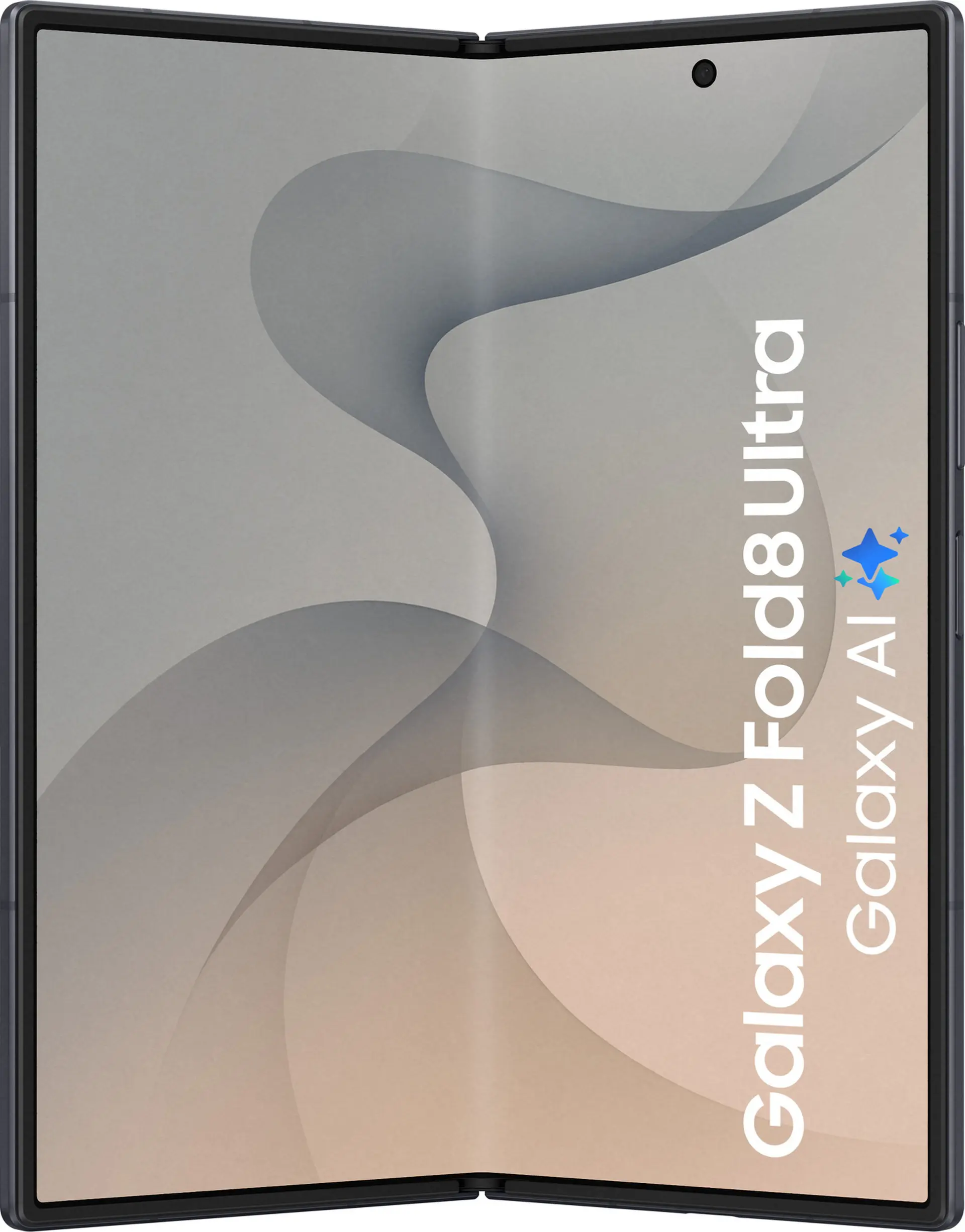
Emails, WhatsApp, and Signal effectively work neatly on this device in tablet mode, utilizing the entire screen in a useful way. Other very rare responsive websites or applications can do that too. Typing is better (with two hands) than in closed mode, so those who need to send many messages or emails are not poorly off here.
That is pretty much where it stops. All common video aspect ratios, horizontal or vertical, fit poorly and lead to black bars. Social media apps look clumsy, with excessively large photos. Most websites render in mobile mode with too much white space. Multitasking is terrible, because you once again get two far too narrow windows side by side…
Self-taken photos approach the square ratio more closely. This allows you to show holiday snaps to more than one bystander at a time, which genuinely makes the experience a lot more fun and social.
No real added value
Still, it is not worth the trouble. After extensive testing, we still find no real daily added value in using a phone that is too narrow and can also become a square. However technically impressive this foldable device may be, Samsung still cannot convince us that it is a good idea. After several weeks of testing, we found it a relief to pick up our classic smartphone again.
We are starting to suspect that the penny is starting to drop at Samsung too. After all, the Samsung Galaxy Z Fold 8 Ultra has a smaller sibling in the regular Fold 8. That one has a much more exciting aspect ratio, with a screen that is shorter and wider when closed. This allows you to easily reply to messages without unfolding the thing.
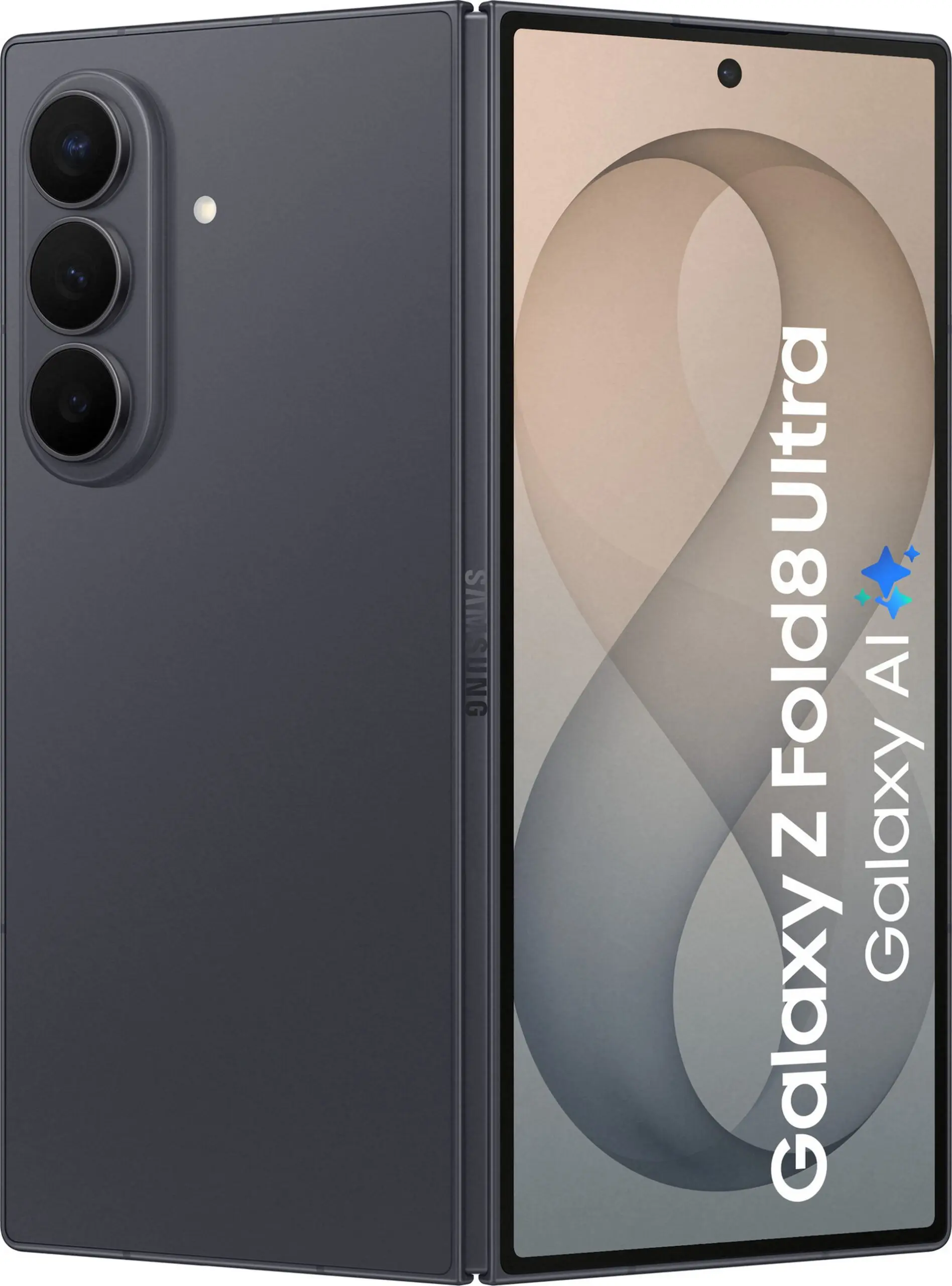
If you open the regular Fold 8, you get a screen that is elongated. Horizontally, that is perfect for enjoying multimedia; vertically, websites and apps scale in a much finer way. Next to the regular Fold 8, it is even more noticeable how strange and unnatural the shape of the Fold 8 Ultra is.
Ultra in price
The name is also a mystery. Nothing about the Galaxy Z Fold 8 Ultra is actually Ultra, except for the truly exorbitant price tag. Samsung does little to justify that price, apart from the excellent physical finish of the device discussed above.
Inside, there is solid hardware. A Snapdragon 8 Elite Gen 5 powers the phone, flanked by 12 GB of RAM. The CPU is identical to the one in the Motorola Razr Fold, but the latter has 16 GB of RAM. In daily use, we notice no difference, but it makes it all the more striking that Samsung asks for more money for its version of the foldable square. Furthermore, Motorola finds room for 512 GB of storage, while Samsung only offers 256 GB.
Slower than the competition
Furthermore, we must conclude that Samsung is able to squeeze less computing power out of the chip than the direct competition. The slim chassis likely results in less thermal margin, with all the associated consequences.
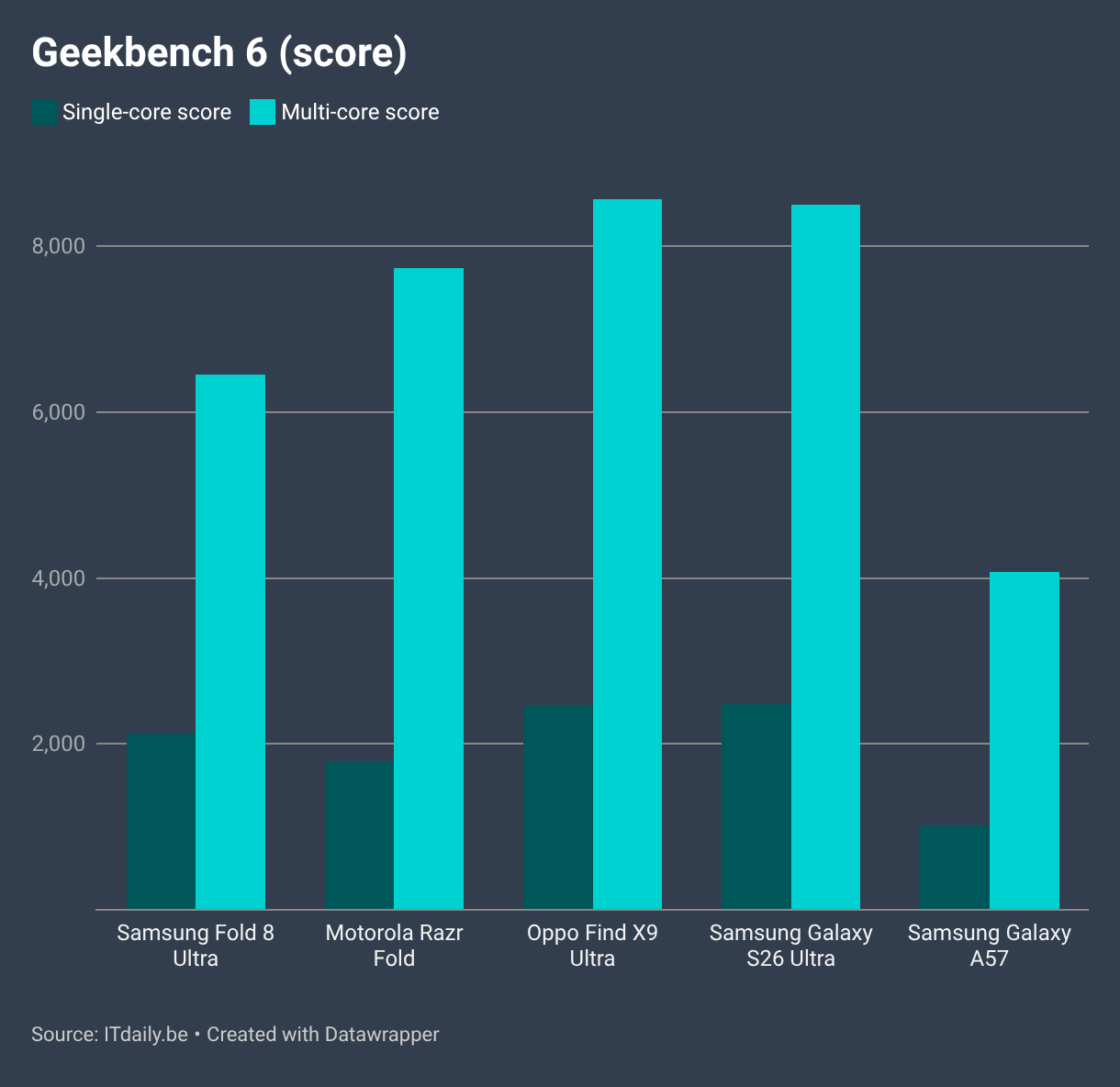
The comparison with the Oppo Find X9 Ultra, which does deserve its name, is staggering. The same Qualcomm chip performs significantly better in that classic phone, which is nearly 800 euros cheaper.
Graphically acceptable
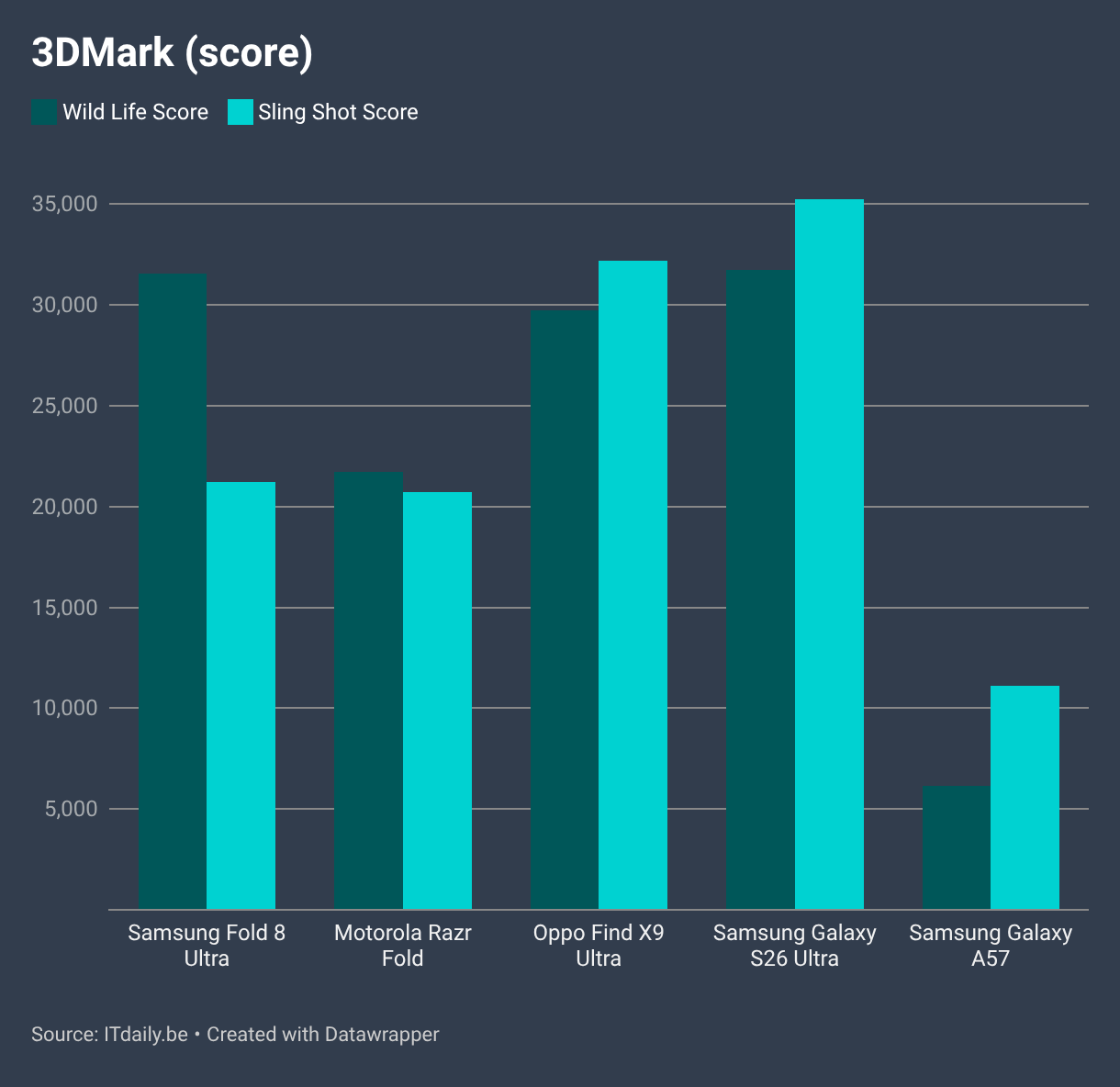
Graphically, the Samsung Galaxy Z Fold 8 Ultra fares better (the manufacturer integrates a slightly better GPU), although the high score below relates to the lighter of the two tests where the difference is not really noticeable. Note especially how much better classic devices perform here.
Battery too small
Just because performance is lower than in classic devices doesn't mean the battery lasts longer. Samsung ensures this by putting a too-small 5,000 mAh battery in the phone. Admittedly, it is larger than the 4,400 mAh in the predecessor, but that mainly says something about that predecessor. As expected, the battery does not last very long. Motorola shows with the Razr Fold that there is room for 6,000 mAh in this type of foldable, with better results.
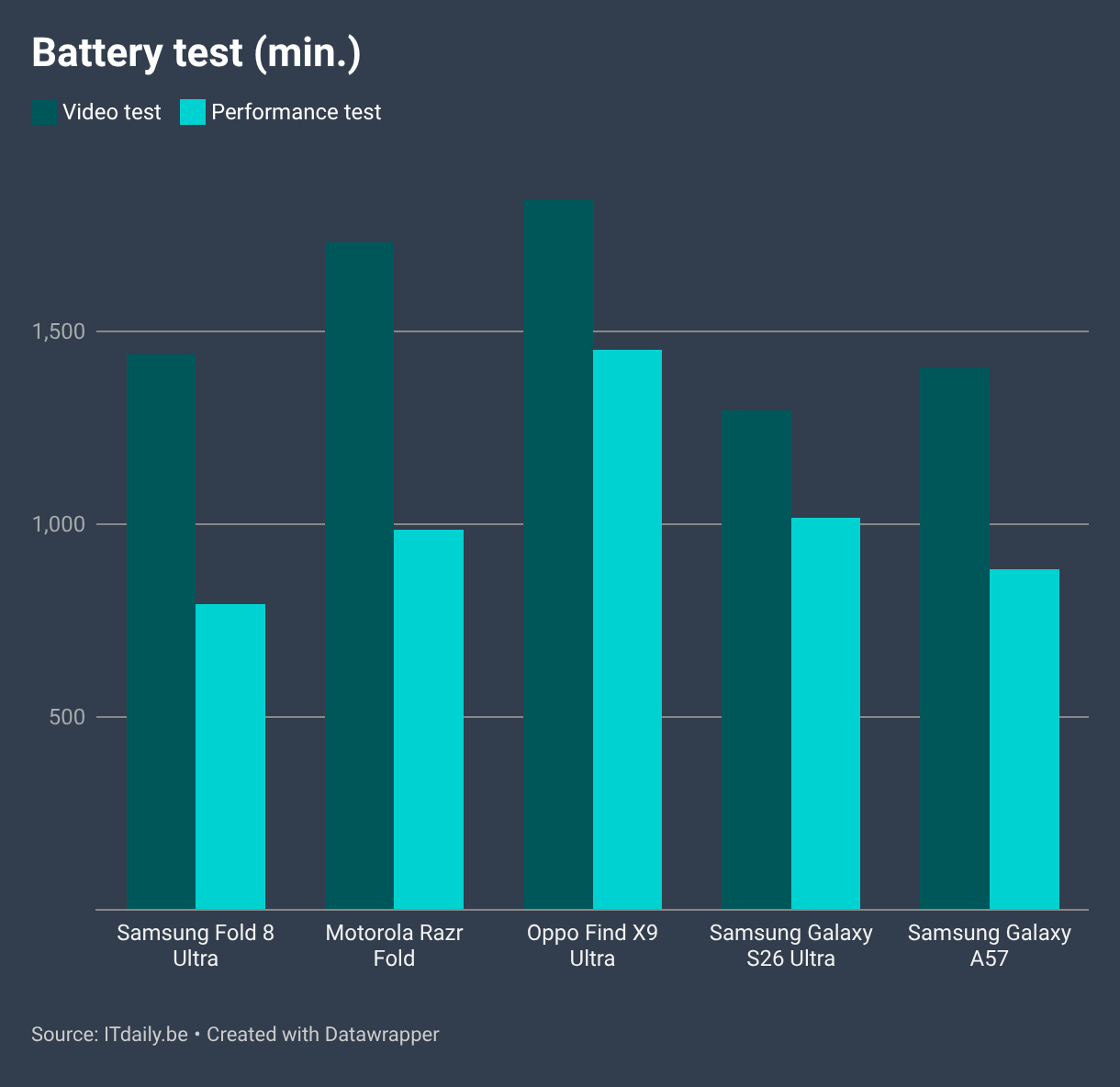
When we measure with the screen unfolded, the difference with the Motorola becomes even greater. Initially, we do make it through the day with average use, but with degradation in mind, and the fact that this device is built for intense use, we are seriously concerned about its future-proofing.
Charging is relatively faster, but that has nothing to do with the meager 45-watt charger provided. The only reason the tank fills up quickly is its modest size.
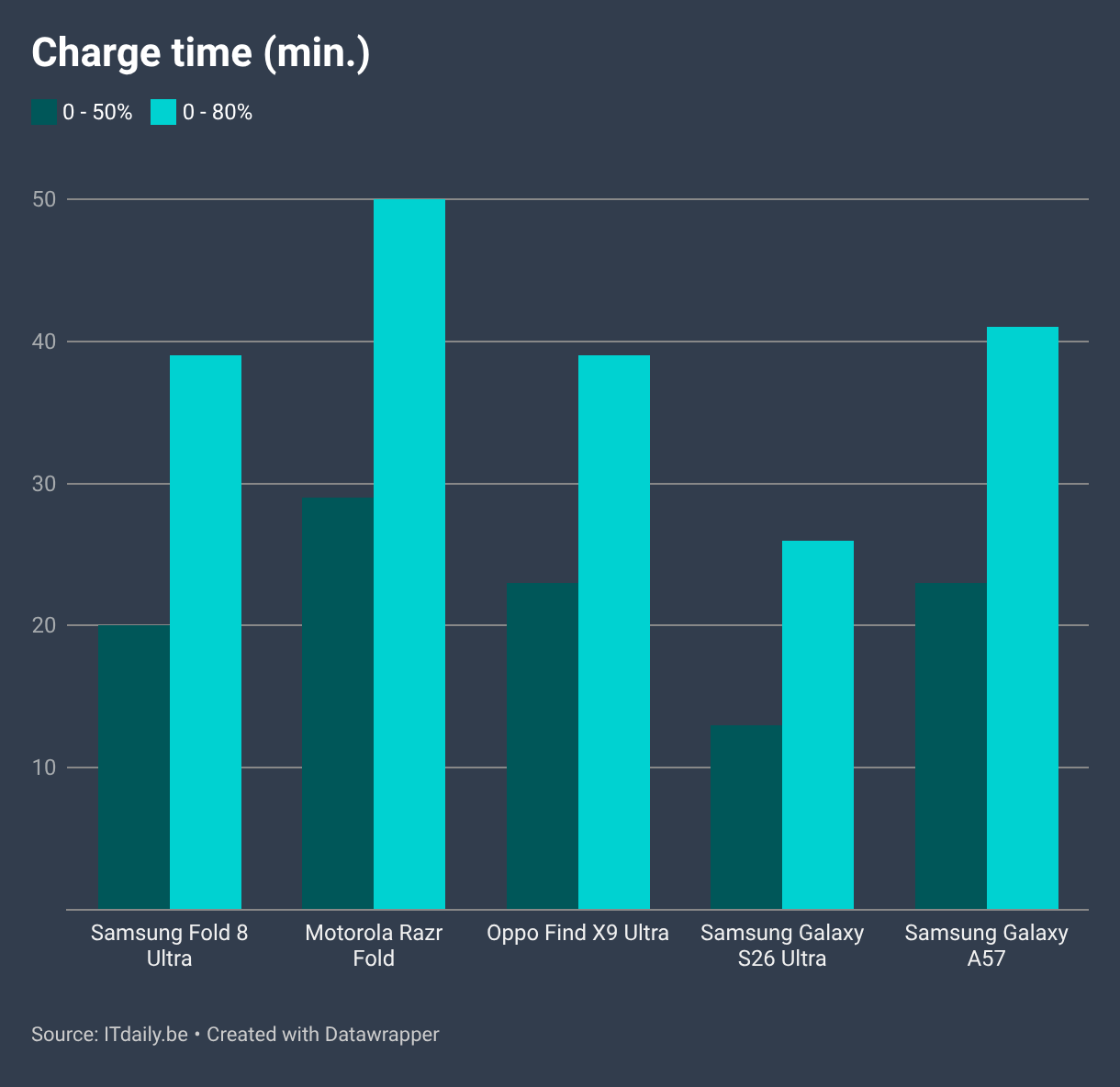
The battery drains quickly, after which you can recharge it at an acceptable rate. That is not the experience you are entitled to when you pay 2,199 euros, folding or not. The fact that performance is somewhat lower than other devices is less serious: we notice little of that in daily use.
Poor camera selection
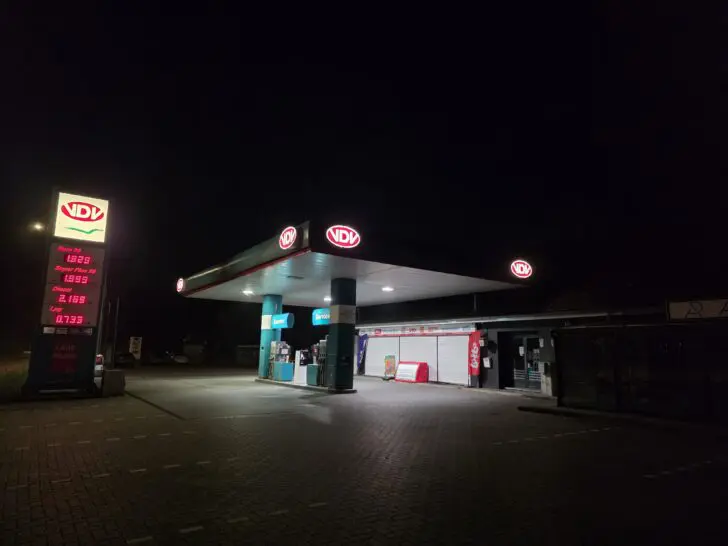
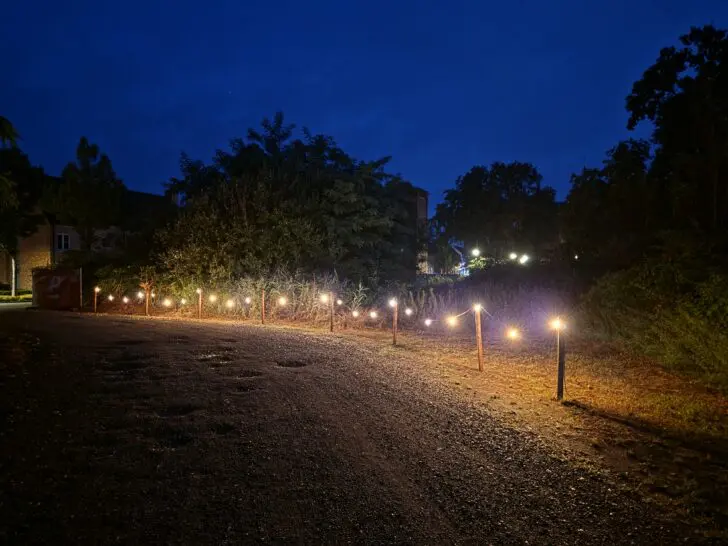
The trend of heavy compromises in the name of foldability continues with the camera selection. The 200 MP main camera behind a classic wide-angle lens is top-tier. It performs excellently in all lighting conditions and delivers beautiful snaps, which nonetheless still look very much like smartphone photos.



In good lighting conditions, the results with the main camera are beautiful. You also get atmospheric images from the Samsung Galaxy Z Fold 8 at night.


To take photos with a more natural ratio, a different focal length is necessary. Premium smartphones therefore include a 2x or 3x optical zoom lens in their devices. Samsung chooses 3x. Such a camera system is theoretically ideal for portrait photos.



Unfortunately, Samsung chooses a third-rate camera here. The periscope lens that is gradually becoming the norm in the premium segment is nowhere to be found here. Motorola does install one on the Razr Fold. Worse is the sensor behind the lens: 10 MP, which is simply sad. This camera doesn't even come close to competing with the alternatives in this price range.


Samsung still has a 50 MP sensor to spare. That one goes behind an ultra-wide-angle lens. This allows you to capture just a bit more than with the regular wide-angle lens, which in practice brings very few extra creative possibilities. The selfie camera is also not good.

The main camera has to save the day, but it faces an impossible task. Anyone wanting to take photos with the Samsung Galaxy Z Fold 8 will find themselves outclassed in quality and possibilities by a neighbor with a device costing less than half the price. The Motorola Razr Fold, with its three full 50 MP systems and periscope lens for the 3x zoom, also performs a lot better on average.
Android 17 and updates
Samsung does better with the operating system. Android 17 is present, while Motorola delivers its phone with Android 16. Furthermore, you get seven years of updates from Samsung. By the time the software is dated in 2033, the poor battery will have long since ensured that you have traded in this device. There is a good chance that scratches on the screen will prompt you to do so even sooner, because remember that the foldable display is not dust or sand resistant.
Furthermore, Samsung knows what it's doing with its One UI. This phone feels like a Samsung device through and through, which is generally a compliment. We do find the Samsung ecosystem itself to be intrusive, with the biggest culprit being the redundant Samsung account that isn't really necessary for anything. Why is it so difficult for manufacturers to leave their customers alone without shoving extra proprietary services down their throats?
Not convincing
In our opinion, given its shape, the Samsung Galaxy Z Fold 8 can never be a good smartphone. If we ignore that for a moment and look at the Z Fold 8 as its own type of device, we must conclude that Samsung has truly mastered the mechanical side of things.
A beautifully finished design with a fantastic hinge gives a very premium feel. Closed and unfolded, this smartphone is quite beautiful. As far as opening and folding is concerned, you won't find a more pleasant device on the market.
But do not be misled: even within its own category, Samsung is not the champion. The internals are too poor for that. The urge to make a very thin device takes its toll on both battery and performance. That, in turn, is bad news for the durability of this device.
The price tag is completely absurd. Samsung cannot justify 2,199 euros. The Motorola Razr Fold may fold slightly less smoothly, but the internals, the battery, and the cameras are a lot better.
Anyone looking for a smartphone with these ratios, and who wants the version that folds most pleasantly, will find a device tailored to them here. However, as soon as other considerations come into play, it is difficult to recommend the Samsung Galaxy Z Fold 8.
Tested: Samsung Galaxy Z Fold 8 Ultra SM-F976B, Qualcomm Snapdragon Elite Gen 5, 12 GB RAM, 256 GB storage, 5,000 mAh battery, Android 17, 7 years of updates – 2,199 euros incl. VAT.
Pros
- Impressively slim design
- Excellent hinge
- Beautiful screens
Cons
- Very expensive for little practical added value
- Substandard camera selection
- Battery capacity not future-proof
- Not dust resistant