

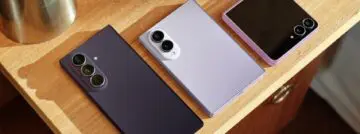
Samsung announces three new foldable smartphones: the Galaxy Z Fold8, Fold8 Ultra and Flip8. The new devices are a step forward compared to their predecessors, but pain points compared to rigid smartphones remain.
Samsung has introduced three new foldable smartphones: the Galaxy Z Fold8, Galaxy Z Fold8 Ultra and Galaxy Z Flip8. The new Galaxy Z series builds on seven generations of foldable smartphones.
Samsung positions the Fold8 models for users who need a larger work and viewing surface, while the compact form factor is a key selling point for the Flip8.
Samsung’s foldable smartphones are no longer an experiment. With the eighth generation, Samsung wants to demonstrate that the segment has matured. According to the manufacturer, there is also a growing interest in premium phones, a category these devices certainly belong to based on price.
The new foldable smartphones are thinner than their predecessors and come with better specifications. However, a comparison with rigid models in terms of specs and especially battery remains difficult.
Galaxy Z Fold8
The Galaxy Z Fold8 is the face of the new series. When folded, Fold devices are comparable to (thick) classic phones, and they transform into a small tablet when unfolded. This new model has a foldable main screen with a 7.6-inch diagonal (1,848 x 2,448 pixels).

When closed, you can work on a 5.5-inch display (1,248 x 1,972 pixels). That screen is intended for messaging, social media, browsing and short videos.
Weighing 201 grams, the Fold8 is the lightest Galaxy Z Fold to date, according to Samsung. When folded, the phone is just under a centimeter thick (9.7 mm).
The Samsung Galaxy Z Fold8 is equipped with a Qualcomm Snapdragon 8 Elite Gen 5 processor between its screens. The battery has a capacity of 4,800 mAh. That is more than the previous Fold, but still very little compared to traditional high-end phones. The main screen reaches a brightness of up to 3,000 nits.


Samsung provides two cameras with 50-megapixel sensors. Samsung opts for wide-angle lenses twice, one even wider than the other. With Dual Recording, the device can capture images from both sides simultaneously. Additionally, we find two more 10 MP cameras on the device: a selfie camera and an alternative main camera.
The device is available with 1 TB of storage, flanked by 16 GB of RAM, or 512 GB or 256 GB of storage, with 12 GB of RAM.
Galaxy Z Fold8 Ultra
The Galaxy Z Fold8 Ultra features a slightly larger 8-inch main screen with 2,504 x 2,256 pixels. Unfolded, the device measures 4.1 mm in thickness and weighs 215 grams. When closed, you can work on a 6.5-inch screen with 1,080 x 2,520 pixels.
A Qualcomm Snapdragon 8 Elite Gen 5 again forms the basis, along with a 5,000 mAh battery. Charging happens at a rather sluggish 45 watts, just like the regular Fold8, so why Samsung speaks of fast charging is unclear. 60 watts is not uncommon for budget phones, and premium devices today fill up 6,000 mAh batteries and more at 100 watts.

The cameras must justify the Ultra label for this device. The Galaxy Z Fold8 is equipped with a 200-megapixel main camera with HDR support and a 50-megapixel ultra-wide-angle camera. Several extra cameras with 10 MP sensors are also present here (selfie, extra main camera and telephoto). The device can record video in 8K and supports the APV codec for video editing.


Samsung provides variants with 1 TB of memory and 16 GB of RAM on one hand, or 12 GB of RAM and 256 or 512 GB of storage on the other.
Galaxy Z Flip8
The Galaxy Z Flip8 succeeds the Galaxy Z Flip7. The smartphone has a 6.9-inch screen (1,080 x 2,520 pixels) in the aspect ratio of a classic phone. The Flip becomes more compact when folded. A 4.1-inch screen with 948 x 1,048 pixels then displays the most important notifications. Samsung calls this ‘FlexWindow’.
Unfolded, the phone is 6.1 mm thick; when closed, you can tuck a 7.54 x 8.57 x 1.31 cm block into your pocket or handbag. Inside is an Exynos 2600 processor from Samsung itself.
Samsung gives one camera on the Flip8 some love: a system with a wide-angle lens and a 50-megapixel sensor. A selfie camera is also present (10 MP) along with an even wider wide-angle lens for a 12 MP sensor.
Charging happens at a medieval 25 watts. Samsung points out that the battery does fill up quickly (55 percent in half an hour), but that is because the 4,300 mAh capacity is very small for a smartphone in this price range.


Samsung says it has adapted Galaxy AI for every device and screen size. The company also mentions security via Samsung Knox, encrypted storage and settings that allow users to maintain control over the processing of personal data. One UI 9.0 also gets a dashboard for AI activities.
Price and compromise
The Galaxy Z Fold8 Ultra is available from 2,199 euros, the Fold8 from 1,999 euros and the Flip8 from 1,299 euros. In this generation of Fold devices, foldability remains a premium that you pay for, not only with money but also with capabilities. Although these devices are all in the premium segment in terms of price, the camera systems and batteries are, on paper at least, significantly less than what you can expect from traditional rigid smartphones in this price range.