

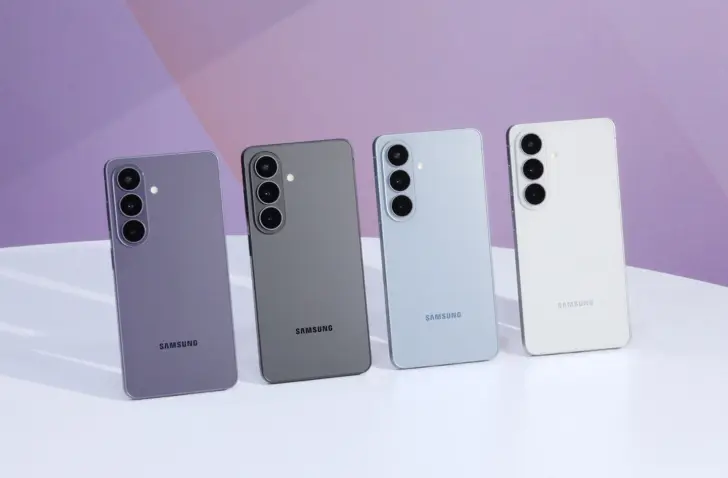
The middle child of the S26 series is once again caught between its smaller and larger siblings. The S26+ is a more than decent smartphone, but who is it actually for?
Pity the Samsung Galaxy S+. For several years now, the second device in Samsung’s premium line has suffered from ‘middle child syndrome.’ The Ultra model is the flagship of the series, while the base model distinguishes itself through its compactness. The Plus version adopts features from both models, leaving it with little to call its own.
Can the S26+ break the cycle and step out of the shadow? Samsung plays it too safe for that, just as they did with the base model.
A size larger
The design of the Samsung Galaxy S26+ is easy to describe: take an S26 and stretch it to 6.7 inches. Or take the S25 and change the color of the housing. The S26+ has hardly changed in terms of appearance: the rounded corners and vertically aligned cameras are now very recognizable. The smartphone is neatly finished, though the cameras protrude just a bit too much from the back.
The S26+ distinguishes itself from its smaller brother with its larger screen. A larger screen means more pixels: the resolution is identical to the Ultra model, which distributes 1,440 x 3,120 pixels over a 6.9-inch screen. You could say the S26+ achieves the optimal ratio between pixels and screen size, though we are talking about differences you can’t see with the naked eye. At 1,320 nits, the screen brightness is a tad lower than the other models, but this too is negligible.
Bigger isn’t better…
As much as Samsung clings to visual consistency, it is equally fickle with the internals of the S26 models. This year, the S26 and S26+ reappear with Exynos processors from Samsung’s own chip factories. In the past, Samsung chips haven’t always managed to impress, but the Exynos 2600 proves to be a very capable processor.
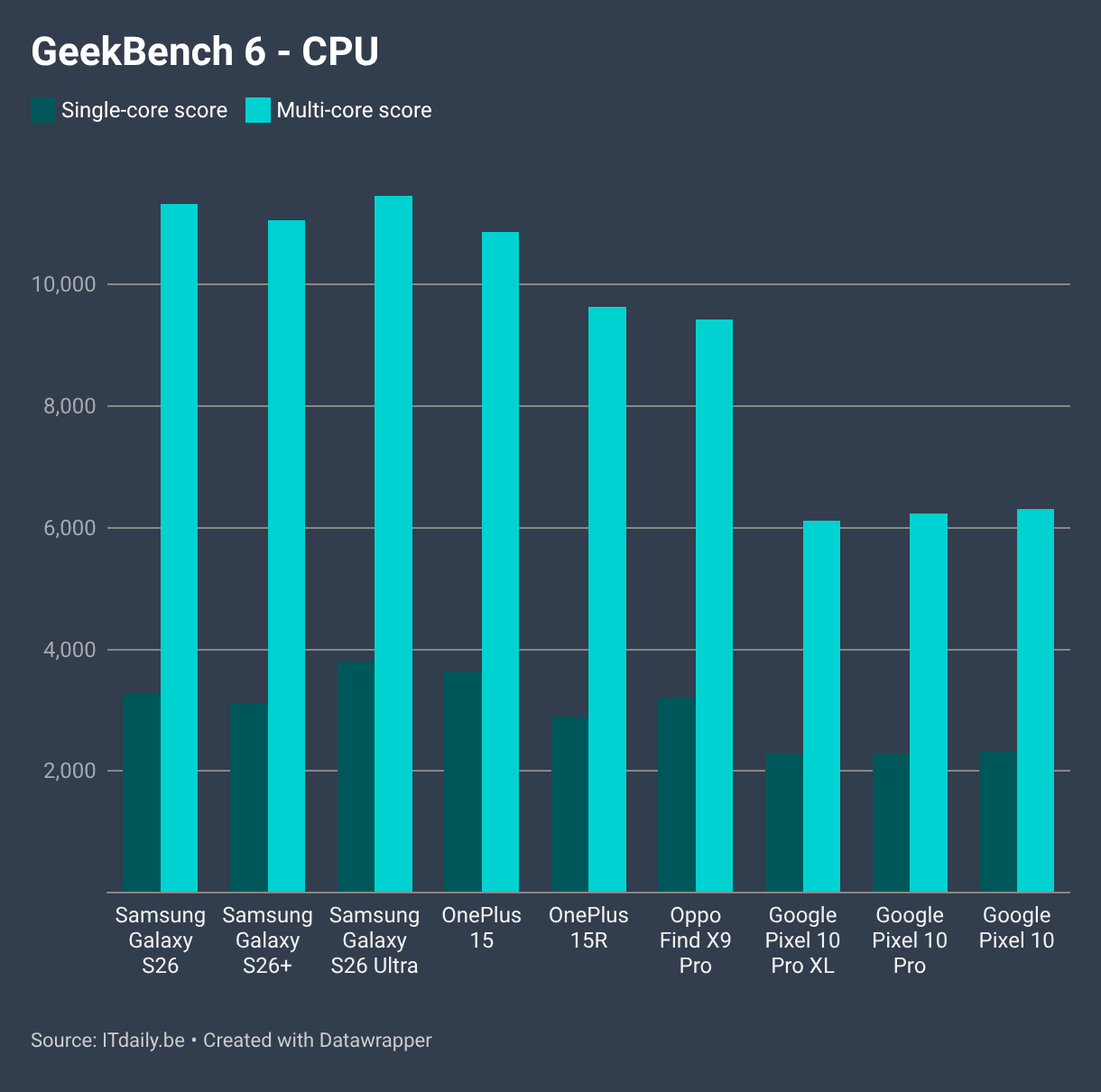
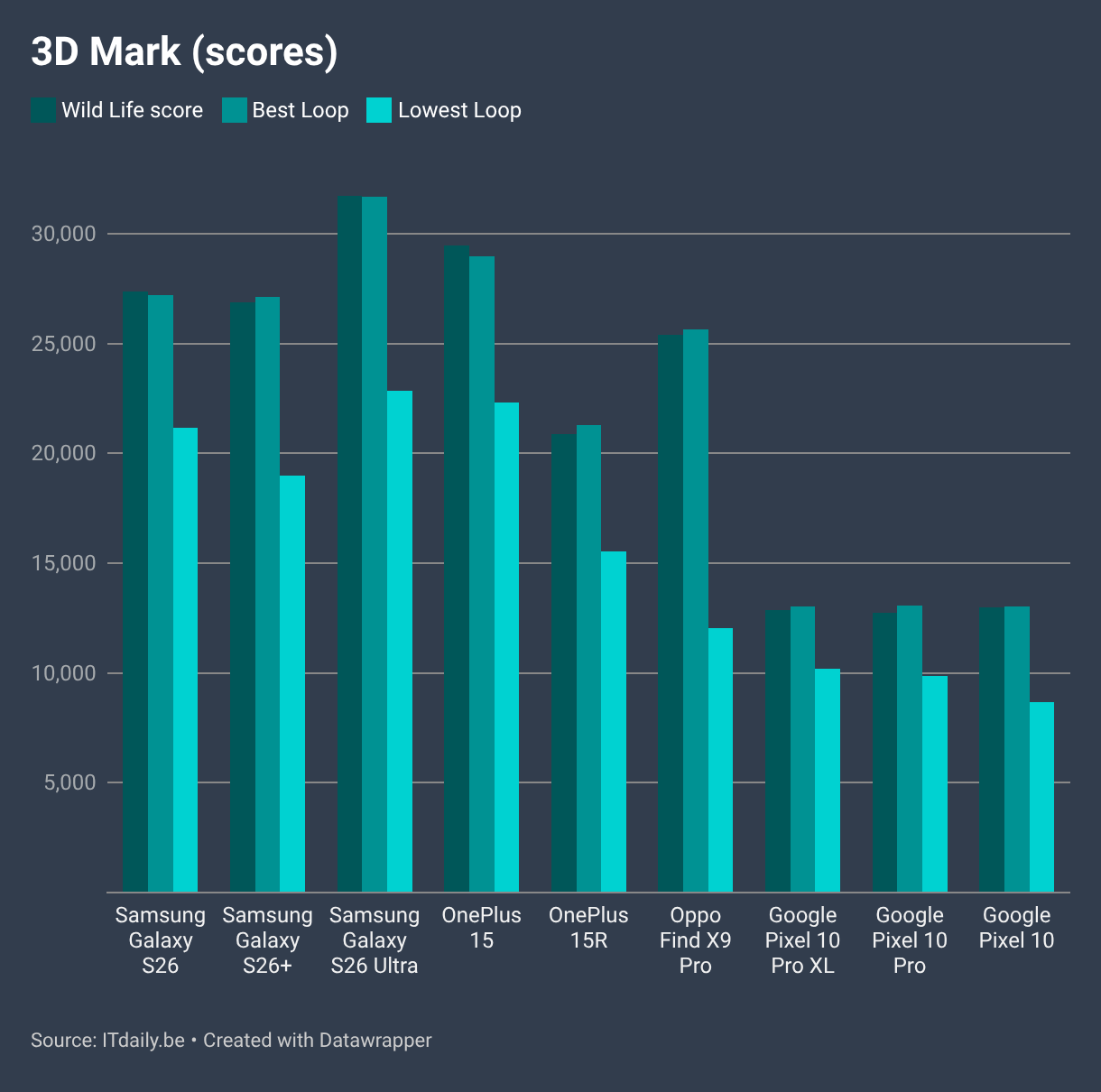
You don't need to choose the S26+ over the S26 for extra computing power. The internals are identical, so the performance is too. The Ultra delivers just a bit more via the Snapdragon 8 Elite Gen 5, but the S26 and S26+ hold their own well compared to their price-point rivals. This applies to both CPU and GPU power.
...not for the battery either
However, the S26+ fails to distinguish itself from its smaller brother in terms of battery life. This should be a strength for the S26+, which features a large battery (4,900 mAh). You would expect it to perform better in a battery test, but the opposite is true. It goes to show that the processor ultimately has a major impact on battery life, and this is where Samsung excels slightly less.
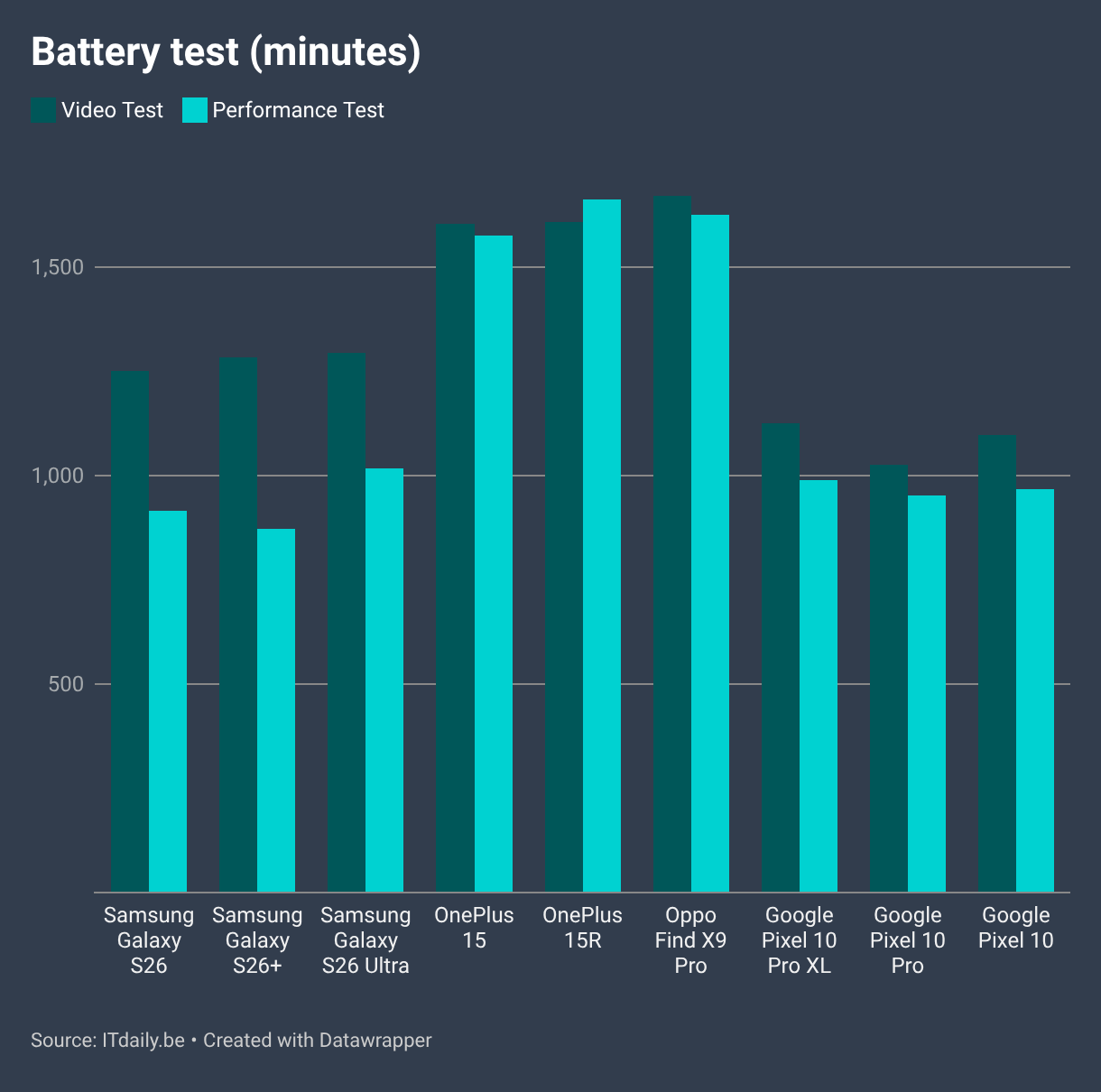
The S26+ battery can easily last a day on a full charge, but if you push the device throughout the day, it can get tight. Within its price range, it performs the worst on the performance test. A direct comparison between the S26 and S26+ seems to illustrate above all that bigger isn't necessarily better.
Slightly less slow charging
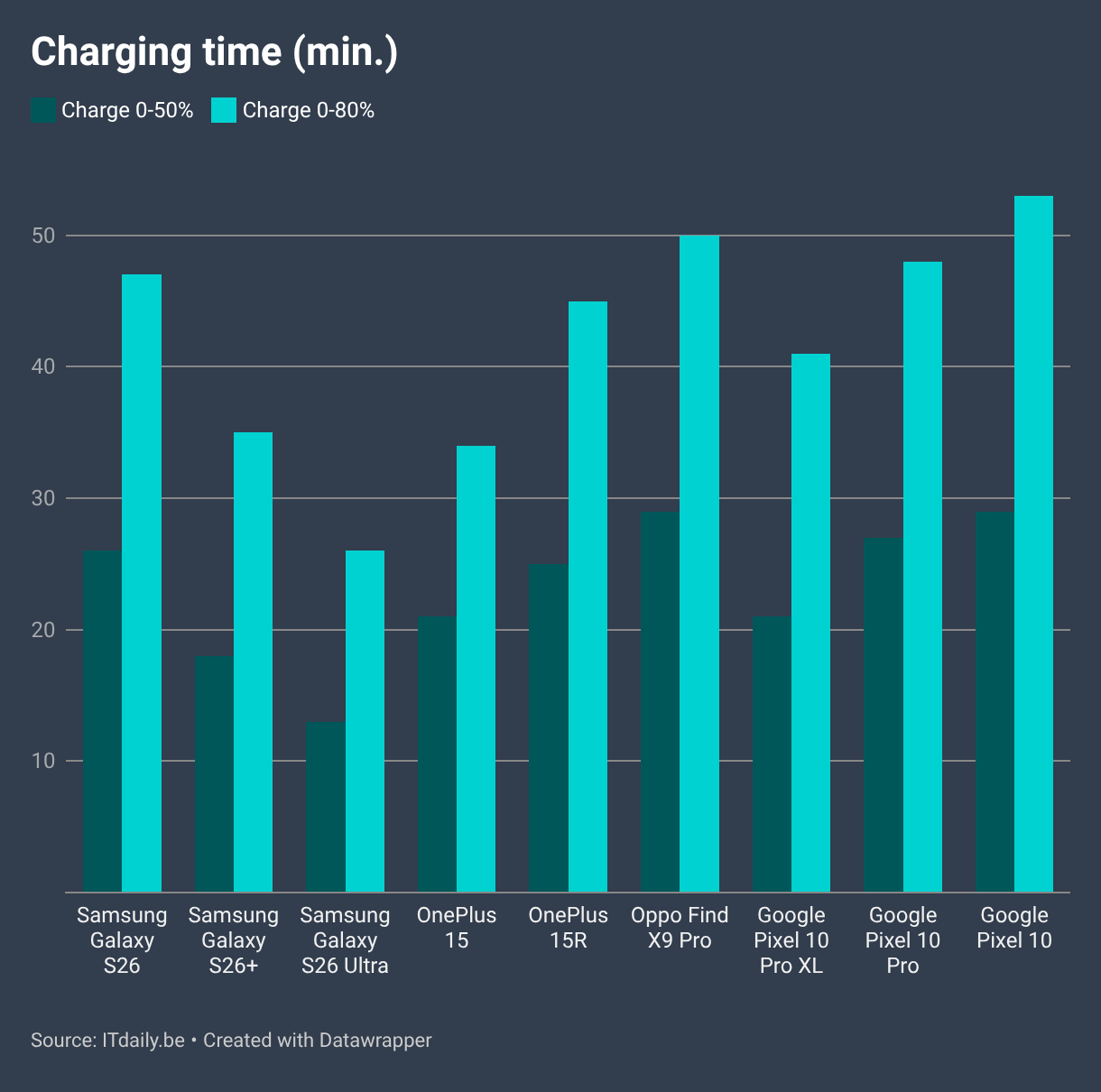
The S26+ does perform better than the S26 when connected to a charging cable. To say the S26+ charges quickly would be a slight exaggeration, but it is at least less slow. The 4,900 mAh battery is half full after 18 minutes, and you reach eighty percent after 35 minutes.
That seems faster than the OnePlus 15 and Oppo Find X9 Pro, even though we often praise these manufacturers for their fast charging times. However, the figures require some nuance: those devices have much larger batteries to fill, and OnePlus and Oppo have the annoying habit of prioritizing their own charging standards. If the S26 fails the charging exam, the S26+ gets a narrow pass.
Cameras lagging behind
Innovation is also long overdue for the cameras. The camera setup has hardly changed since the Galaxy S22. Vertically stacked, you get a 50 MP main camera, 10 MP telephoto camera, and 12 MP wide-angle camera, with a 12 MP camera on the front. Back in 2022, these were good cameras, but four years later they feel outdated.
The main camera can still produce good results under the right lighting conditions, although green areas like grass fields appear blurry. Samsung really can't get away with these wide-angle and telephoto cameras at this price level anymore, especially when compared to what other devices can do—even cheaper models like the Nothing Phone 4a. Samsung treats the S26+ like a mid-range phone when it comes to cameras.














Smarter Bixby
Samsung is once again betting big on AI under the 'Galaxy AI' and Now Brief banners. Support for Dutch remains limited to non-existent for many functions, meaning the grand promises are only half-fulfilled in our region. Furthermore, photo editing features continue to yield inconsistent results.
Samsung's own AI assistant, Bixby, receives the biggest upgrade. With Galaxy AI, it seemed Bixby was being pushed toward the exit. The AI assistant can now adjust settings for you and is more context-aware. If you tell Bixby your eyes hurt, it should see that as a signal to adjust the screen brightness. Whether you actually need AI assistance for such simple tasks is another question.
Conclusion: an unnecessary middle step
The Samsung Galaxy S26+ will once again have to settle for a role in the shadows. There is too little distinction in specifications compared to the base model. And if you find the S26 too small, why wouldn't you just go for the S26 Ultra? The device is overshadowed not only within Samsung's own portfolio: flagship devices from other brands offer more for the same money.
Samsung must have its reasons for sticking with the S26+. For us, that reason becomes less clear year after year.
Tested: Samsung Galaxy S26+, 12 GB RAM, 256 GB storage, seven years of support, eco-label A, 1,249 euros incl. VAT VAT.
Pros
- High image resolution
- Surprisingly good Exynos processor
- Improved Bixby
Cons
- Unclear positioning
- Disappointing cameras