


The Xiaomi Redmi Note 17 Pro excels in battery life, but offers little else. The mediocre processor and cameras and the abundance of bloatware will annoy you faster than the battery drains.
When Xiaomi launches a midrange smartphone, it pulls out all the stops. In August, the Chinese brand killed four birds with one stone with the Redmi Note 17 series, not to be confused with the Redmi 17 models launched shortly before. The Redmi Note 17 Pro (5G) that we examine in this review sits in the series just below the Redmi Note 17 Pro Max (5G).
The large battery capacity of the devices stood out to us right at the announcement. The Redmi Note 17 Pro comes with an 8,340 mAh battery. The Max version even boasts 9,210 mAh. With a price tag of 499 euros, the device stays below the limit of what most IT professionals are willing to pay for a new smartphone.
On paper, the Xiaomi Redmi Note 17 Pro is therefore potentially an interesting device. During testing, however, we quickly noticed that Xiaomi gives up ground elsewhere in exchange for more battery.
Pink sheen
The Redmi Note 17 devices won’t stand out on shop shelves. Xiaomi has a habit of experimenting with designs, with mixed results, but this time it keeps things strikingly “boring”, despite the pink glass on the test device. The vertically stacked lenses are reminiscent of a Samsung smartphone.
With a 6.83-inch screen and a thickness of almost 9 mm, this is a remarkably large device. A OnePlus 15 (6.78 inch) looks small when placed next to the Redmi Note 17 Pro. It is a solid slab in your hands. The camera lenses protrude slightly from the back, but the device doesn’t “wobble” too much when lying on a table.

A large screen has room for plenty of pixels, and at 1,280 x 2,772 you get a more than decent resolution. The refresh rate goes up to 120 Hz, although the chip doesn’t seem to handle that very well, so the image doesn’t run as smoothly as it should. Brightness is good: even on sunny days you can read the screen well. The speaker quality is poor, but it will do for watching a video or listening to some music during your commute.
Marathon runner
We first look at where the Redmi Note 17 Pro excels under the hood: the battery. The switch from traditional lithium-ion to silicon-carbon makes larger batteries in smartphones possible, even for cheaper devices. Consumers can only benefit: smartphones will need to be charged far less often.
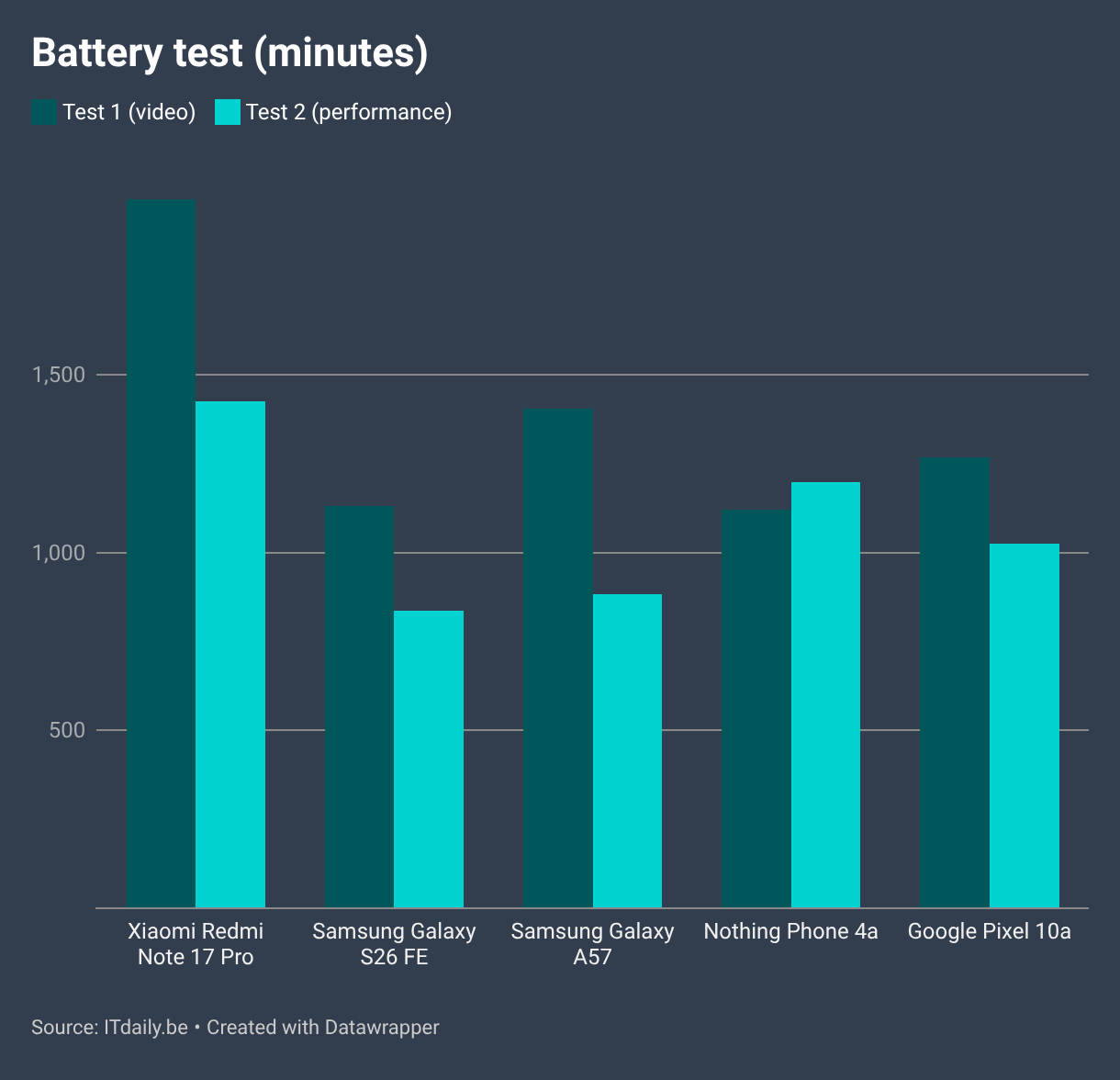
The Redmi Note 17 Pro shows the added value. Even when we push the device to its limits, the battery lasts almost a full day. With light use, you easily get two days. The Redmi Note 17 Pro Max should even last three days, although we were unable to test this manufacturer claim independently. If you forget to charge once, that need not be a problem with this device.
Weak processor
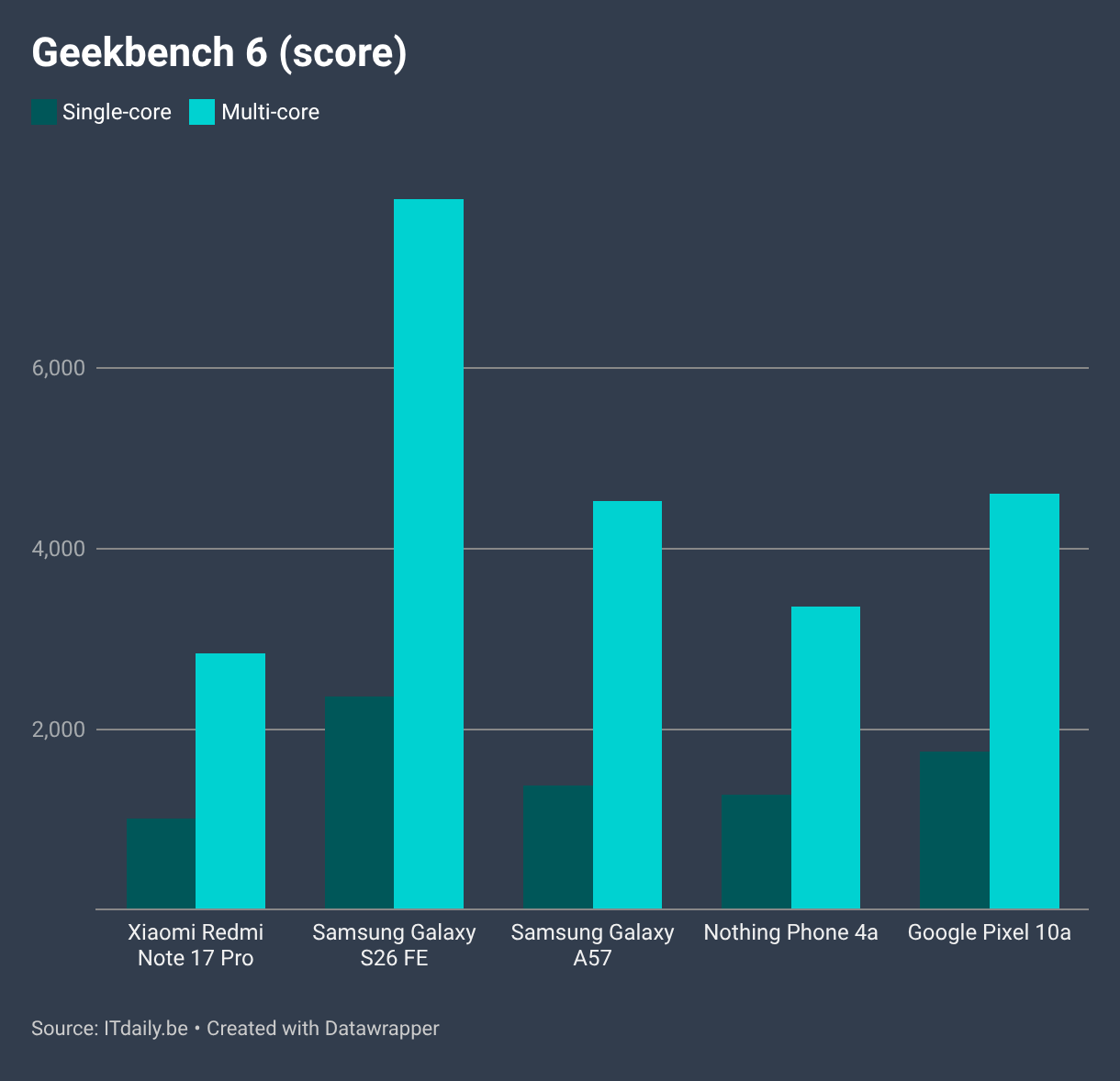
The Redmi Note 17 Pro has put in many hours on the treadmill, but clearly skipped the weight room. Xiaomi opts for a Snapdragon 6s Gen 4, a processor at the bottom of Qualcomm's portfolio. The manufacturer mainly saves on RAM: the devices are configurable up to 8 GB, but as standard they contain only 6 GB, or even 4 GB for the entry-level version.
These specifications are modest even in lower price ranges, and in practice they don't lie. Our test device with 8 GB RAM is also anything but a powerhouse. In tests, the device scores worse than direct price competitors from Samsung, Nothing and Google. With light, everyday use, the processor does get the job done, but you simply need a bit more patience. You notice that with routine tasks such as taking photos, where the processor needs time to process the picture.
Subpar GPU
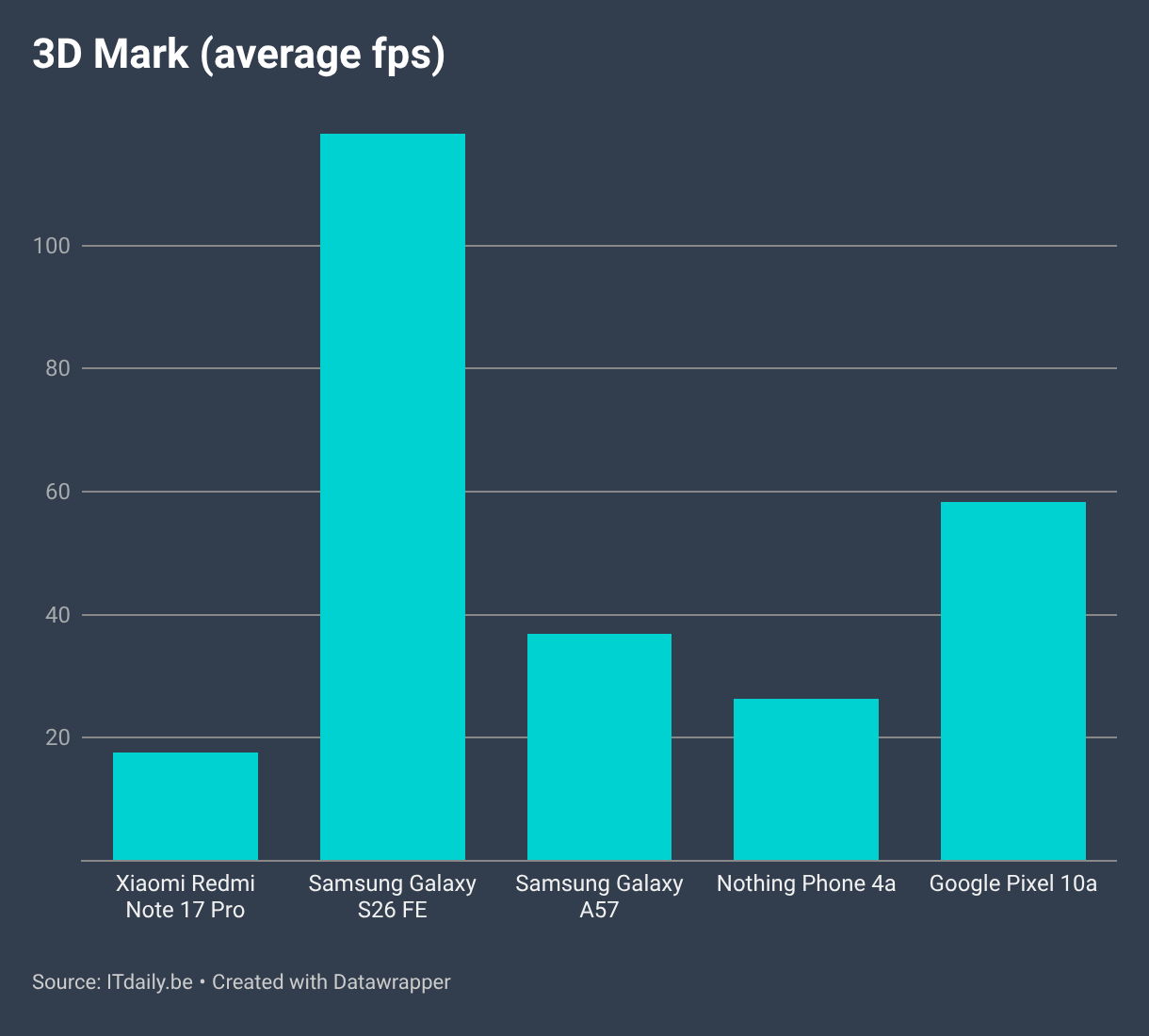
It gets downright dramatic when we look at the GPU. The fact that we have to look at average frames per second doesn't bode well. 30 fps is roughly the lower limit for a smooth mobile gaming experience, but the Xiaomi Redmi Note 17 doesn't reach it. It performs worse than the Nothing 3a, which is 130 euros cheaper. Normally only the very cheapest devices (200-250 euros) fall below this minimum.
Charging
Xiaomi caps the charging capacity of the Redmi Note 17 Pro at 67 W; only the Pro Max model can charge at 100 W. Chances are you have a universal charger at home that can reach that capacity. You certainly don't need to buy a branded charger, because none is included.
The downside of a larger battery is that it takes longer to fill completely. If you want to start the day at eighty percent, you need to allow more than an hour. Even for a half-full battery you need 45 minutes.
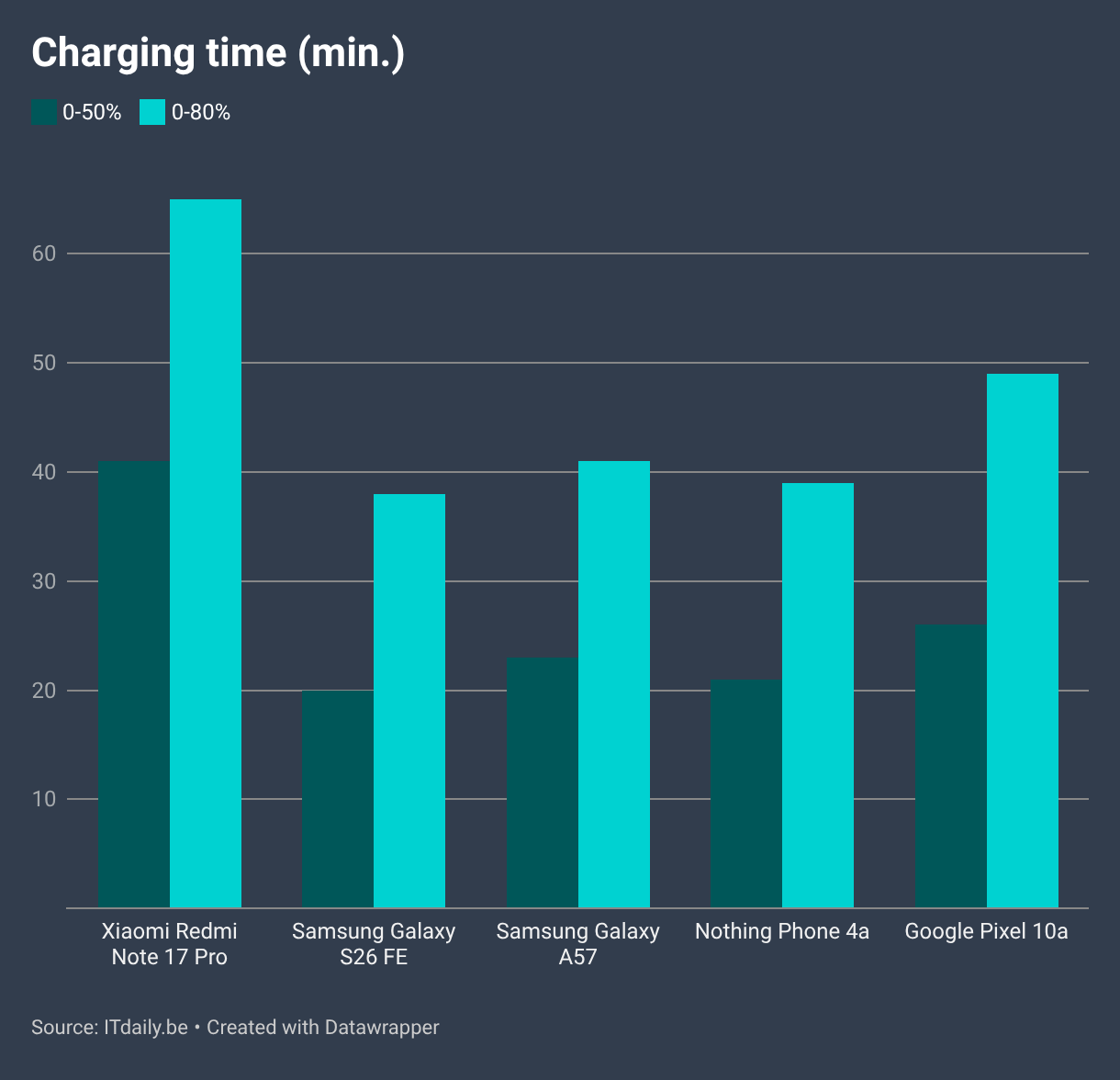
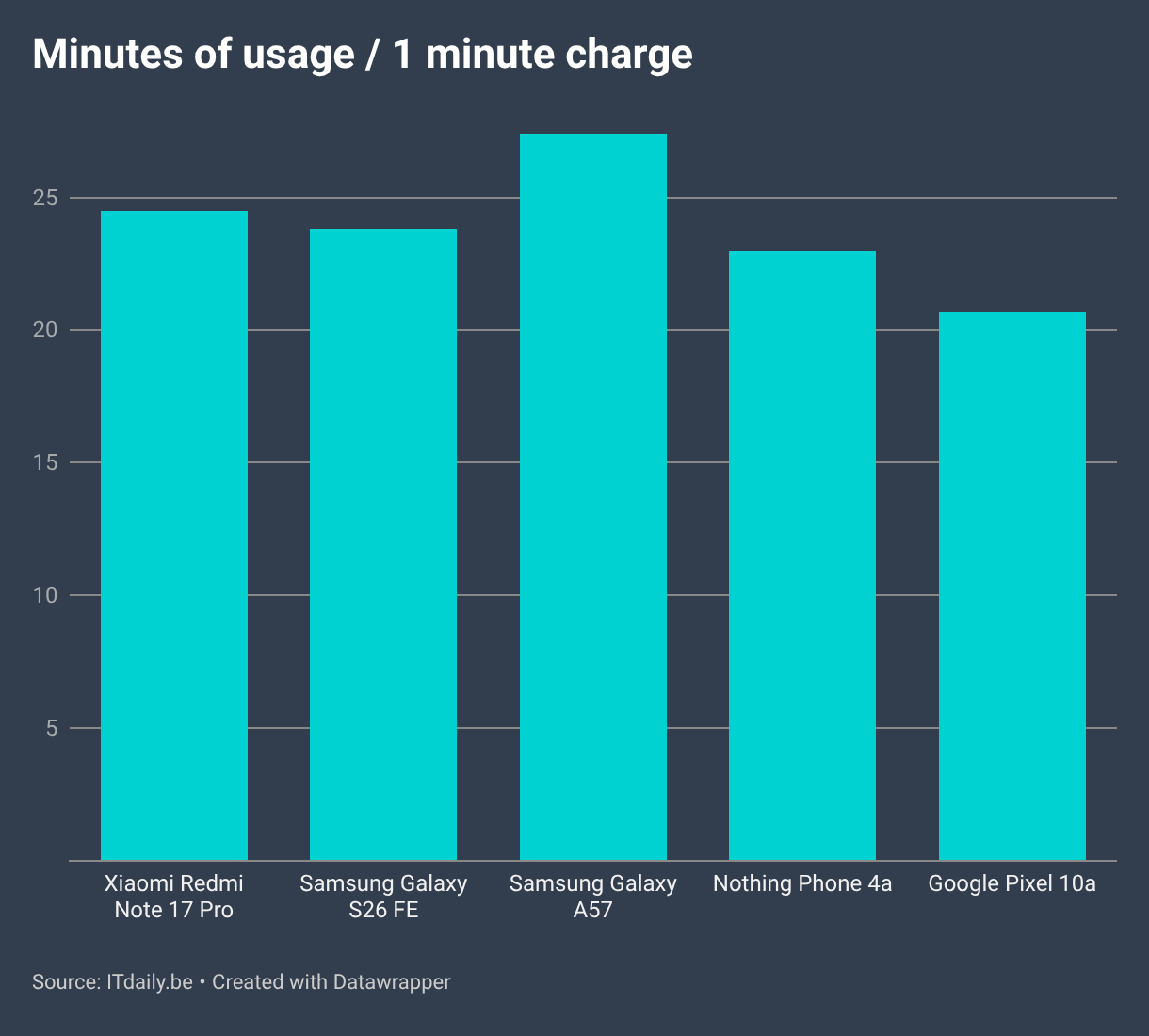
The advantage is that you don't have to charge the battery fully. That is also better for its lifespan, because wear is greatest at percentages below 20 percent or above 80 percent. If we look at how many minutes of use you get per minute of charging, the Xiaomi Redmi Note 17 Pro is far from as slow as the absolute charging time suggests. With 20 minutes of charging, you can quickly count on enough to get through an 8-hour working day.
Ecolabel B
Xiaomi counts on a thousand or so charge cycles before the battery shows signs of wear. That is a possible reason why the device doesn't get an "Ecolabel A" in Europe. The sturdiness of the device (IP68, drop resistance A) can't be the cause in any case. Google stumbles with its Pixel phones over the same hurdle to get the highest label.
Dark photos
The Redmi Note 17 Pro 5G is equipped with two cameras: a 50 MP main camera (f/1.8) is supported by an 8 MP wide-angle camera. We are somewhat glad that Xiaomi doesn't feel the urge to add a useless macro sensor just to get to three cameras. We can't say we warm to the wide-angle camera.
The Belgian autumn weather of recent weeks allowed us to test the cameras in various weather and lighting conditions. On a nice, sunny autumn day, you take decent pictures with the cameras. The main camera could use some help from the weather gods, though, because images look somewhat darker than they really are. You notice that especially when the sun or street lighting doesn't help at night.
In the absence of a dedicated zoom lens, the main camera also has to take on that role. Don't expect too much: the digital zoom does its best but quickly shows its limitations. The wide-angle camera is actually inadequate in all situations. Images are not sharp enough to the naked eye, and colour accuracy is lost as well. Click on a photo for full resolution.












Unwanted bloatware
Like every Android manufacturer, Xiaomi layers its own skin over the operating system. It is called HyperOS 3 and is for now still based on Android 16. You get four major software updates, so the step to Android 17 is coming, but we suspect that a budget device like the Redmi Note 17 Pro won't be first in line. You also get six years of security updates.
Whether you like a piece of software is a matter of personal taste. What has nothing to do with personal taste is the annoying bloatware that Xiaomi allows itself to install for you. Every Google app has its own counterpart, for the few who prefer Mi Browser or Mi Video to Chrome or YouTube, but it doesn't stop there. Temu, TikTok, Alibaba, Amazon, Booking.com, Netflix, an outdated Copilot app that you can no longer use and a heap of mediocre games: it's all already on your device.
Unfortunately, Xiaomi is not the only manufacturer guilty of this: we have also had to rap Oppo on the knuckles for it repeatedly. Manufacturers get a nice sum for it, and as a user you just have to swallow it. So start with a big clean-up.
Conclusion: battery on top
The Xiaomi Redmi Note 17 Pro relies too much on its large battery. Apart from good stamina, there is little that makes this smartphone stand out. If battery life matters more to you than performance, you only take photos to send to friends and family, and you can turn a blind eye to Chinese junk apps, then you'll find an attractively priced device here. This device will not meet many other wishes.
It looks as if Xiaomi's midrange series is a victim of the memory crisis gripping the smartphone market. The manufacturer has to make too many concessions to stay under the 500-euro limit, and the Redmi Note 17 Pro doesn't get the weapons it deserves. That is a mitigating circumstance, but no excuse. Alternatives such as the Samsung Galaxy A57 and Google Pixel 10a offer a much more balanced package.
Tested: Xiaomi Redmi Note 17 Pro 5G 2607DRA18G, Qualcomm Snapdragon 6s Gen 4, 8 GB RAM, 256 GB storage, 8,340 mAh battery, Android 16, 6 years of updates, ecolabel B – 499 euros incl. VAT
Pros
- Monsterbatterij
- Decent screen
- Affordable price
Cons
- Weak CPU
- Subpar GPU
- Too much bloatware
- Disappointing cameras
- Heavy phone