


Microsoft has announced hardware-accelerated Bitlocker functionality. This should drastically reduce the impact on CPUs, so users no longer experience issues during encryption.
Microsoft wants to close the gap between security and maximum performance now that blazing-fast NVMe SSDs are becoming increasingly common. With hardware-accelerated BitLocker, the impact on the CPU from disk encryption should drop dramatically.
Less CPU usage
BitLocker has been known as a reliable security layer for years, but with modern NVMe disks, the impact on performance started to become more apparent.
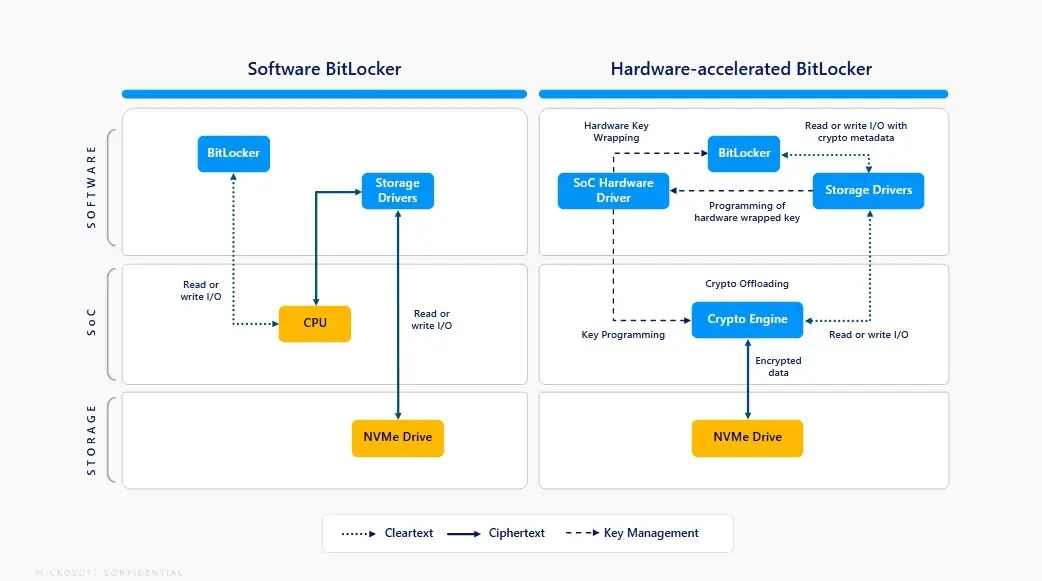
Because the encryption was done solely by the CPU, combined with the enormous I/O speeds of the new drives, processors could no longer handle the speeds. This was especially the case with intensive workloads such as video editing or software development.
‘Remarkable difference’
According to Microsoft, the storage performance with hardware-accelerated BitLocker approaches that of an NVMe disk without encryption. In internal tests, CPU usage decreased by an average of 70 percent compared to software BitLocker, which also has a positive effect on battery life.
Support starts with Intel vPro systems with Core Ultra Series 3 (Panther Lake), with expansion to other platforms later. Users can check if their system is using hardware-accelerated BitLocker via the command manage-bde -status, where this is explicitly stated.