

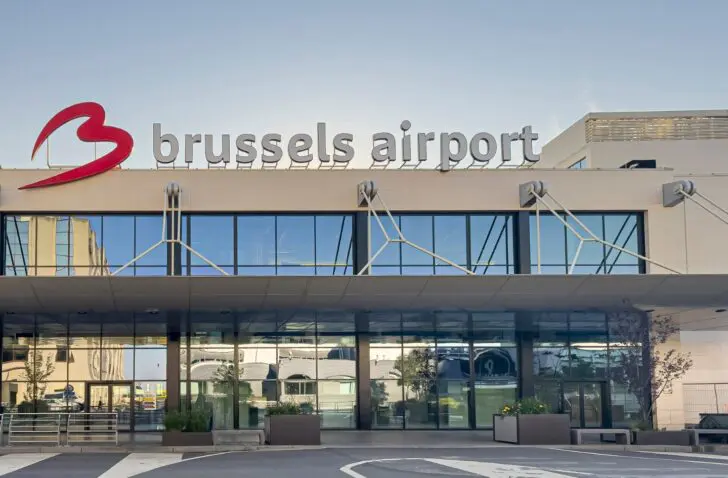
A cyberattack on the American company Collins Aerospace has been causing problems at European airports since Friday evening. The situation has not yet been resolved at Brussels Airport.
Anyone who had to travel by plane this weekend will have noticed it. Several European airports, including Brussels Airport, have been experiencing technical issues since Friday, making check-in and boarding difficult. Brussels Airport warns that delays and/or canceled flights are still possible today.
The cause was a cyberattack on the American company Collins Aerospace, which specializes in software for the aviation sector and military industry. The company confirmed to the Financial Times on Friday that it was dealing with a ‘cyber-related disruption’. The affected Muse software is used at more than a hundred airports worldwide for check-in and boarding.
Due to the technical issues, delays quickly accumulated at the affected airports, including Brussels Airport and the airports of London, Dublin, and Berlin. Staff had to resort to pen and paper to check in passengers. Over Saturday and Sunday, several dozen incoming and outgoing flights were canceled to spread the workload for the staff.
Ransom
The perpetrators behind the attack are still unknown, but it is known that the Lucky Locker ransomware was used. This is not Collins Aerospace’s first experience: the company was hacked once before in 2023. At that time, data from pilots and other personnel of partner companies was leaked.
What has been stolen in this attack is still unclear. Geert Baudewijns, cyber expert at Secutec, suspects it could be valuable passenger data. If that’s the case, the bill for the company could be high. Baudewijns estimates that the hackers could demand five to ten million dollars from Collins Aerospace.
If the company wants to reach a deal quickly, it will probably have no choice but to pay to avoid the release of that stolen data. “As a company, you’re basically backed into a corner,” says Baudewijns to vrtnws.
It could likely take several more days before Collins Aerospace’s systems are fully operational again. At most airports, the situation has been largely contained. Brussels Airport is still canceling forty departing flights and 23 arriving flights as a precaution.
Major impact
The impact is surprisingly large. Collins Aerospace serves multiple airports with its solution, which runs both on-premises and in the cloud (on AWS). The company offers check-in services to various parties on the same platform via cMUSE/vMUSE. It appears that the ransomware attack in question has affected the entire service.
This indicates an insufficiently robust infrastructure, where all users of the platform are affected when a single incident occurs at a critical point. However, Collins Aerospace, as a supplier to Brussels Airport and other airports, is subject to NIS2 regulations. These require adequate security and robustness of systems. Yet, it appears that Collins Aerospace doesn’t even have ISO27001 certification. Despite this, the company has recently signed a new contract with NATO for the supply of military software.
While the initial responsibility for an attack lies with the hackers, cyberattacks are commonplace today. Completely avoiding attacks is not realistic. However, building in robustness when an attack occurs is possible. The impact of the attack is noticeable across various airlines and airports, over several days. This strongly indicates a lack of isolation between environments and inadequate recovery capacity in the event of an incident, which is nevertheless essential in this sector.