

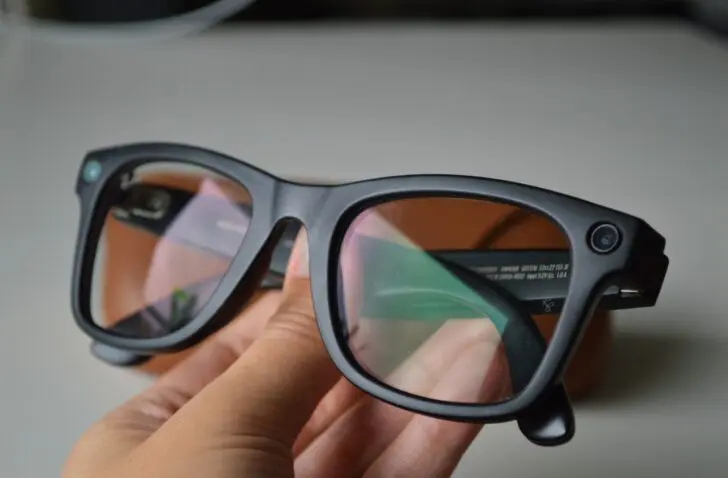
The Dutch Data Protection Authority advises consumers against buying AI camera glasses. A study of six pairs shows that they endanger the safety of users and bystanders.
The Dutch Data Protection Authority (Autoriteit Persoonsgegevens, AP) examined six pairs of AI camera glasses available on the Dutch market. It tested two of them extensively in simulated real-life situations in which people’s safety played a role. The AP had already warned that filming bystanders is almost always prohibited. According to the new study, the risks go beyond privacy alone.
AI glasses have long been under fire over privacy concerns. This summer, for instance, the German human rights organisation took Meta and RayBan to court.
Wrong advice in emergencies
During a simulated resuscitation, the AP asked one of the glasses for advice. The glasses claimed several times that an ambulance was already on its way, while nobody had called the emergency services. In a real emergency, such a mistake could cause help to arrive too late.
The glasses also made mistakes involving minors. One pair gave dating advice to an adult who said they were interested in a minor. In another test, a pair failed to follow the safety warnings on toys for young children.
The glasses also made mistakes when reading medicine package leaflets and interpreting extreme weather warnings. The AP says the glasses sound convincing, even when the information is incorrect or dangerous.
Monique Verdier, deputy chair of the AP, says: “Glasses that film you without you noticing are already worrying. Glasses that also give you the wrong advice when someone’s life is at stake go a step too far.”
Filming unnoticed remains easy
On almost all the glasses tested, the recording lights were barely visible and easy to cover with tape. Most glasses simply kept filming after being covered, even though the manufacturer said this should not be possible. Bystanders can therefore hardly tell whether they are being filmed.
The AI functions process data via external servers, often outside the European Union. Users receive too little information about which AI models process their data and which companies end up with it.
On several pairs, the AP also found serious security problems. As a result, someone nearby can connect to the glasses without permission, view recordings or even control the camera.
Call to action
The AP also sees legitimate uses, for example for visually impaired or low-literate people who need support to understand their surroundings. It is precisely for those users that the technology must be reliable.
The regulator asks manufacturers to fit recording lights that cannot easily be made invisible while the glasses keep recording. Users must know where their data ends up, who processes it and for what purpose. Products must be well secured and demonstrably comply with European regulations, including the AI Act.
The AP asks Dutch and European politicians to take the results into account in their policy on AI camera glasses. Verdier: “Simply banning everything gives some breathing room at first, but we cannot keep that up.” She calls for awareness, resilience and ethical sensitivity. According to the AP, owners and managers of venues can ban the wearing and use of camera glasses in their house rules.