

Fujitsu, in collaboration with QuTech, has developed a working prototype of a quantum computer that runs on diamond spins and photonic circuits. The system functions with less extreme cooling and is accessible via a hybrid cloud platform.
Fujitsu has built a working prototype of a quantum computer based on diamond spins, integrating so-called tin-vacancy centers into photonic circuits. The technology company has worked closely with Delft University of Technology and the research institute QuTech on this since 2020. The goal is to develop a scalable architecture that bypasses the physical limitations of traditional quantum chips.
For organizations experimenting with quantum algorithms, this architecture will lower operational barriers in the long run. While superconducting systems require temperatures of -273.13 °C, cooling to -271.6 °C is sufficient for this prototype. That temperature difference may seem minuscule, but it significantly eases the technical requirements for cooling systems in data centers. This brings practical quantum computing for the business world a step closer, Fujitsu claims.
Optical coupling and less noise
The prototype distinguishes itself by using tin atoms instead of the common nitrogen atoms in the diamond crystal. Due to the symmetrical structure of these so-called SnV centers, the qubits are less sensitive to electromagnetic noise, leading to more stable quantum states. As a result, fewer physical qubits may be needed to construct reliable logical qubits, which benefits scalability.
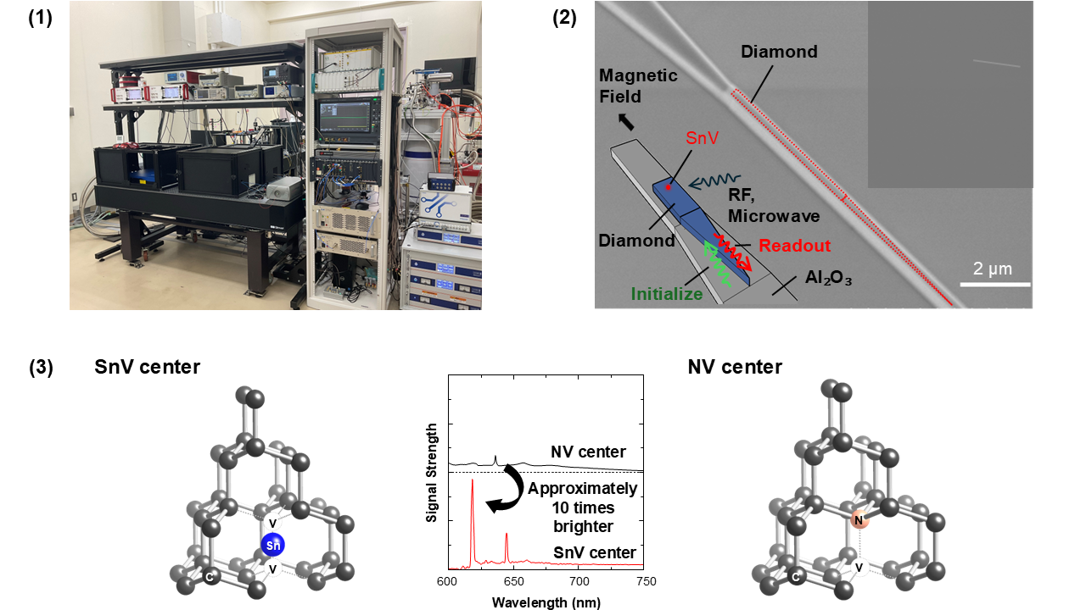
Additionally, Fujitsu developed photonic integrated circuits that make it possible to read out individual photons via optical waveguides. Because modules can be connected via light, a modular architecture is created. As a result, companies do not have to wait for giant monolithic chips, but can in theory scale computing capacity modularly by linking multiple cryostats together.
Control via the hybrid platform
For business implementations, integration with existing IT environments is particularly relevant. Fujitsu states that the quantum computer can be operated via a hybrid cloud platform without in-depth physical expertise. The platform includes a translation layer that automatically converts logical quantum gates into the required sequences of light, microwave, and radio signals.
According to the schedule, Fujitsu aims to have a multi-modular quantum computer ready by 2027. The company is also researching ways to combine diamond spins with superconducting chips, so that enterprise customers can use combined architectures without having to redevelop their algorithms.