

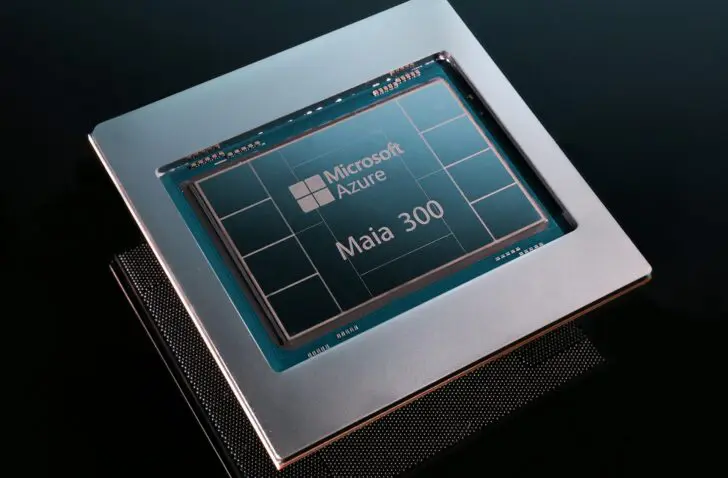
Microsoft will expand the Azure Maia system to large-scale multi-gigawatt deployments starting in 2027. The new Maia 300 chip is intended to form the primary infrastructure for AI inference.
Microsoft is further expanding its in-house Maia chip infrastructure. The current generation Maia 200 is already in production and supports key workloads such as Microsoft Copilot. This chip currently runs OpenAI models and various open-source model families in the United States, Europe, and Australia. From 2027, Maia 300 will take over.
The arrival of Maia 300
Maia 300 will go into production starting in 2027. This system is specifically designed for complex AI tasks, such as long-term reasoning and interactions that are highly sensitive to latency. The goal is to deliver more intelligence within a set energy budget.
Compared to the current generation, the Maia 300 promises a massive leap in efficiency. In a full configuration with 96 accelerators, the system delivers up to seven times the token throughput at rack scale compared to the Maia 200. Additionally, 40 percent more tokens per megawatt are expected compared to external GPU systems.
The architecture of the Maia 300 utilizes a multi-chiplet design on TSMC’s N2P process. This allows computing power, memory management, and input/output functions to be optimized separately. This increases computing power by 36 percent and offers higher memory bandwidth.
Efficiency through smart dataflow
A crucial part of the new architecture is the software-defined dataflow. Instead of focusing solely on raw computing power, the system optimizes how data moves through the chip. This reduces the energy required for data transport, which is often the biggest obstacle in large AI systems.
The system also utilizes an advanced memory hierarchy. With eight HBM4 stacks, the Maia 300 reaches a peak bandwidth of 18.0 TB/s. This helps in efficiently running large models with a long context without energy consumption becoming unsustainable.
In-house chips
At the network level, Microsoft connects the accelerators via a seamless system that extends from a single rack to a full ‘superpod’ of more than 12,000 accelerators. This ensures that AI agents performing complex tasks always have sufficient computing power and memory at their disposal.
Microsoft has relied on the Maia architecture since 2023. By investing in its own silicon, Microsoft aims to lower the cost of inference in its own data centers and reduce dependence on external chip suppliers, thereby somewhat curbing the price of AI services for customers.