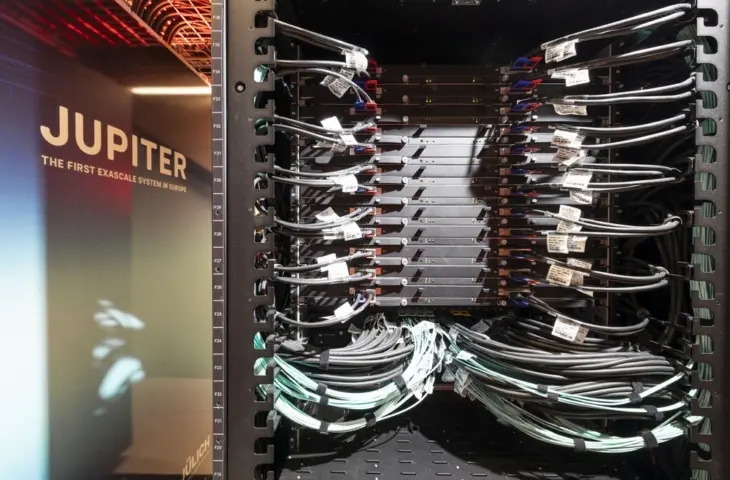
Jupiter ranks fourth in the TOP500 list of most powerful systems worldwide with a score of exactly 1,000 Exaflop/s.
The American supercomputer El Capitan remains at the top of the TOP500 list of fastest systems in the world. Europe makes its first entry into the Exascale class with the Jupiter Booster, debuting at fourth place. The
Exascale Threshold
The 66th edition of the TOP500, which ranks the most powerful supercomputers biannually, now includes four systems that exceed the Exascale threshold of one trillion calculations per second (Exaflop/s). Three of these are in the United States: El Capitan (1,809 Exaflop/s), Frontier (1,353 Exaflop/s), and Aurora (1,012 Exaflop/s). Jupiter Booster from Germany joins this list with a score of exactly 1,000 Exaflop/s.
El Capitan, developed by HPE Cray for the Lawrence Livermore National Laboratory in California, remains the fastest system. It has over 11 million cores and uses AMD’s fourth-generation EPYC processors in combination with MI300A accelerators. For network traffic, the system relies on Cray Slingshot 11. The energy efficiency is 60.9 gigaflops per watt.
read also
European Jupiter Supercomputer Inaugurated with Exascale Performance
Frontier and Aurora maintain second and third place respectively. Both systems use the HPE Cray architecture but differ in their hardware deployment. Frontier runs on AMD 3rd generation EPYC processors, while Aurora runs entirely on Intel hardware, including Xeon CPU Max and Data Center GPU Max accelerators.
Europe Joins the US
Jupiter Booster is the first Exascale system outside the US. The system was built for the EuroHPC program and is located on the campus of the Forschungszentrum Jülich in Germany. Jupiter uses Eviden’s BullSequana XH3000 architecture. The system is managed by the Jülich Supercomputing Centre.
Jupiter is designed to support scientific research, climate modeling, and large-scale AI applications.