
Salesforce expands its Data 360 portfolio with Informatica and MuleSoft to provide AI agents with the context needed to take meaningful actions based on business data.
Salesforce is building a shared data memory for AI agents together with Informatica. Informatica is an AI data specialist that has been part of the Salesforce portfolio since the acquisition was completed in November.
With this memory, Salesforce aims to eliminate what it calls the ‘context gap’. This is Salesforce’s term for the gap between AI models’ broad general knowledge on one hand, and their lack of business context on the other.
Without access to current and reliable business information, AI agents are forced to guess, they say, which increases the risk of incorrect decisions. The collaboration with Informatica and MuleSoft within the Data 360 ecosystem aims to change this.
Broad context
The integration begins with enriching Data 360 with Informatica’s metadata intelligence. This helps AI agents correctly interpret and connect business objects such as customers, products, and suppliers. Informatica provides, among other things,
MuleSoft adds real-time signals, such as inventory changes or shipping delays. These signals are brought together in Data 360 (formerly Data Cloud), which acts as shared memory. Salesforce applies the zero copy principle for this application as well: data exists in one place and is not copied.
Agentforce 360
The new approach is naturally included in Agentforce 360: Salesforce’s name for the platform that allows companies to build and manage AI agents. This platform evolves almost faster than we can write news articles (and we’re already glad that no new version is being launched).
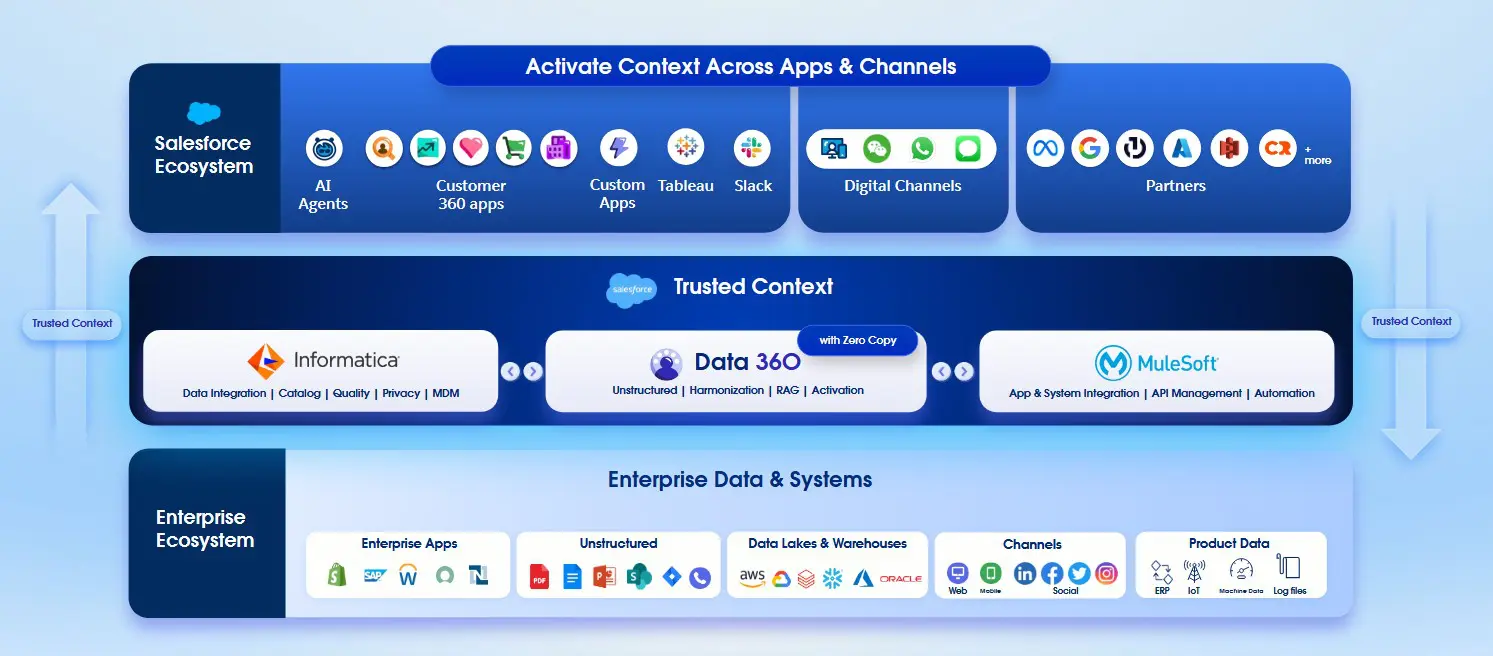
In its current iteration, according to Salesforce, it consists of four layers: data, application, agent, and experience. The data layer provides the shared memory. The application layer connects AI to existing business logic within Salesforce. In the agent layer, companies can control and orchestrate both their own AI agents and external agents. Finally, the experience layer enables the integration of agents into communication channels such as chat, phone, or Slack.