

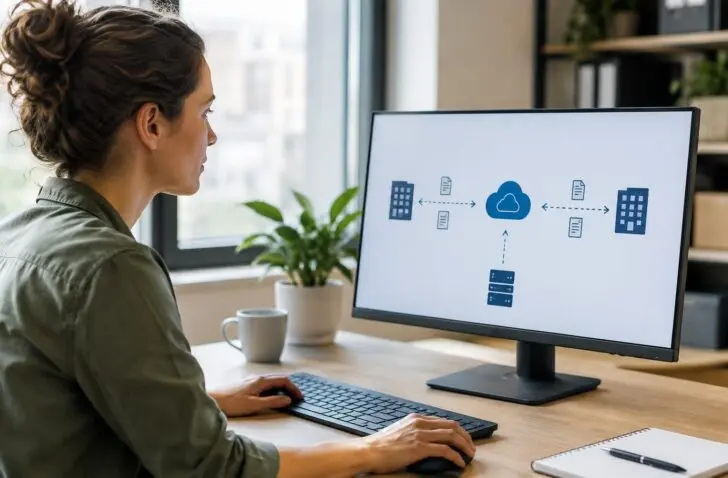
Since 1 January 2026, Belgian VAT-liable businesses have had to send their invoices to other businesses as structured electronic invoices. The channel for this is Peppol, an international network through which the supplier’s and the customer’s software exchange documents directly. A PDF in an email is no longer enough for invoices between companies. Almost a year later, the worst of the panic is over, but for many SMEs the technical side turns out to be less straightforward than expected. What actually happens under the hood, and where do companies run into trouble?
Not a file, but data
The main difference from the familiar PDF is that an e-invoice is not a document that a person reads, but a file containing structured data. It is usually an XML file in the Peppol BIS format, which follows the European standard EN 16931. Every field has a fixed meaning, from the customer’s VAT number to the amount per invoice line. This allows the recipient’s software to read the invoice automatically, without anyone having to retype amounts.
That sounds simple, but it places demands on the quality of the source data. A customer file with missing company numbers, outdated addresses or inconsistent VAT codes results, at worst, in a sloppy invoice in a PDF world. In a structured format, it can mean the invoice is rejected or not processed correctly by the recipient.
The network behind the invoice
Peppol is not a website you log in to. It works with so-called Access Points, service providers that connect a company’s software to the network. The sender delivers the invoice to its own Access Point, which forwards it to the recipient’s Access Point, which in turn delivers it to the recipient’s accounting or invoicing software. In industry jargon, this is called a four-corner model.
For most SMEs, that network is invisible. Their invoicing or accounting package handles the connection. It is still useful to know who fulfils that role, for example when an invoice does not arrive and you want to find out where the problem lies. Via Peppol Lookup, you can also check whether a company is registered to receive e-invoices.
Receiving is just as important as sending
One point that sometimes received too little attention in the run-up to 2026 is the receiving side. A company that issues few invoices itself but does make business purchases must also be able to receive structured invoices. In practice, that means an inbox in the software that picks up Peppol messages, and a process to check and approve those invoices.
This is also where the biggest gain lies. Incoming invoices that are read automatically can be linked directly to a supplier, an order or a ledger entry. Companies that set this up well save manual work in the accounting department and get faster insight into outstanding payables.
Integration determines the value
Peppol on its own solves little if the rest of the chain remains manual. The real value emerges when invoicing, accounting and banking are connected. An invoicing program that sends invoices via Peppol can at the same time pass them on to the accountant’s package and reconcile payments via a bank connection. This removes a series of exports, imports and Excel lists that are still part of the daily routine in many small businesses.
When choosing software, it pays to look beyond the Peppol connection alone. Does the package also support receiving invoices? Which links with accounting software are available? Can it retrieve customer data from the KBO (Crossroads Bank for Enterprises), so that company numbers and addresses are correct? Providers such as WeFact, for example, combine sending via Peppol with an accounting link and a KBO link, and the Belgian market has several alternatives, each with its own emphasis. Ask every supplier how the receipt of e-invoices is handled and who provides the Access Point, because this differs per package.
Where the questions lie now
For SMEs that have been working with e-invoicing for some time, the focus is shifting from connecting to optimising. How do we handle rejected invoices? Who checks incoming e-invoices before they are booked? And how do we keep the master data in order? For the tax and legal side, the FPS Finance (FOD Financiën) and your own bookkeeper or accountant remain the right point of contact. On the technical side, the main point is that good data and well-thought-out links make the difference between an obligation you tick off and a process that genuinely saves time.
This is a commercial contribution submitted by a third party. The editorial team is not responsible for the content.