


The office landscape is evolving from a dual-monitor setup to a single large monitor. What are the benefits, and when should you choose a truly wide screen?
While we currently prefer smartphone sizes to be a bit smaller again, the opposite is true for monitors. “24-inch monitors have declined sharply over the last five years,” notes Olivier Calmet, Manager Belgium & Luxembourg at Philips & AOC Monitors. “At the same time, we are seeing significant growth in 27-inch (16:9) and 34-inch (21:9) models.”
34-inch ultrawide monitors are increasingly filling traditional corporate offices. Where many offices used to be equipped with a setup of two monitors, a separate camera, and a docking station, we are seeing more clean desks emerge today, according to Calmet. “One ultrawide monitor with an integrated camera and docking, no more cables or separate peripherals,” he says.
Naturally, there is a price tag attached, although that has changed significantly in recent years according to Calmet. “Five years ago, the price of an ultrawide monitor was six times as expensive as a 24-inch screen; today, it is only twice as expensive.” He notes that Belgian companies are attaching more and more importance to office comfort, and that outweighs the price tag.
Multitasking on one screen
Most companies are standardized on two 24-inch monitors. When upgrading, the choice is then made between two 27-inch monitors or one 34-inch monitor. The latter option is gaining more and more popularity according to Calmet. “75 percent of new requests are for 34-inch or larger.”
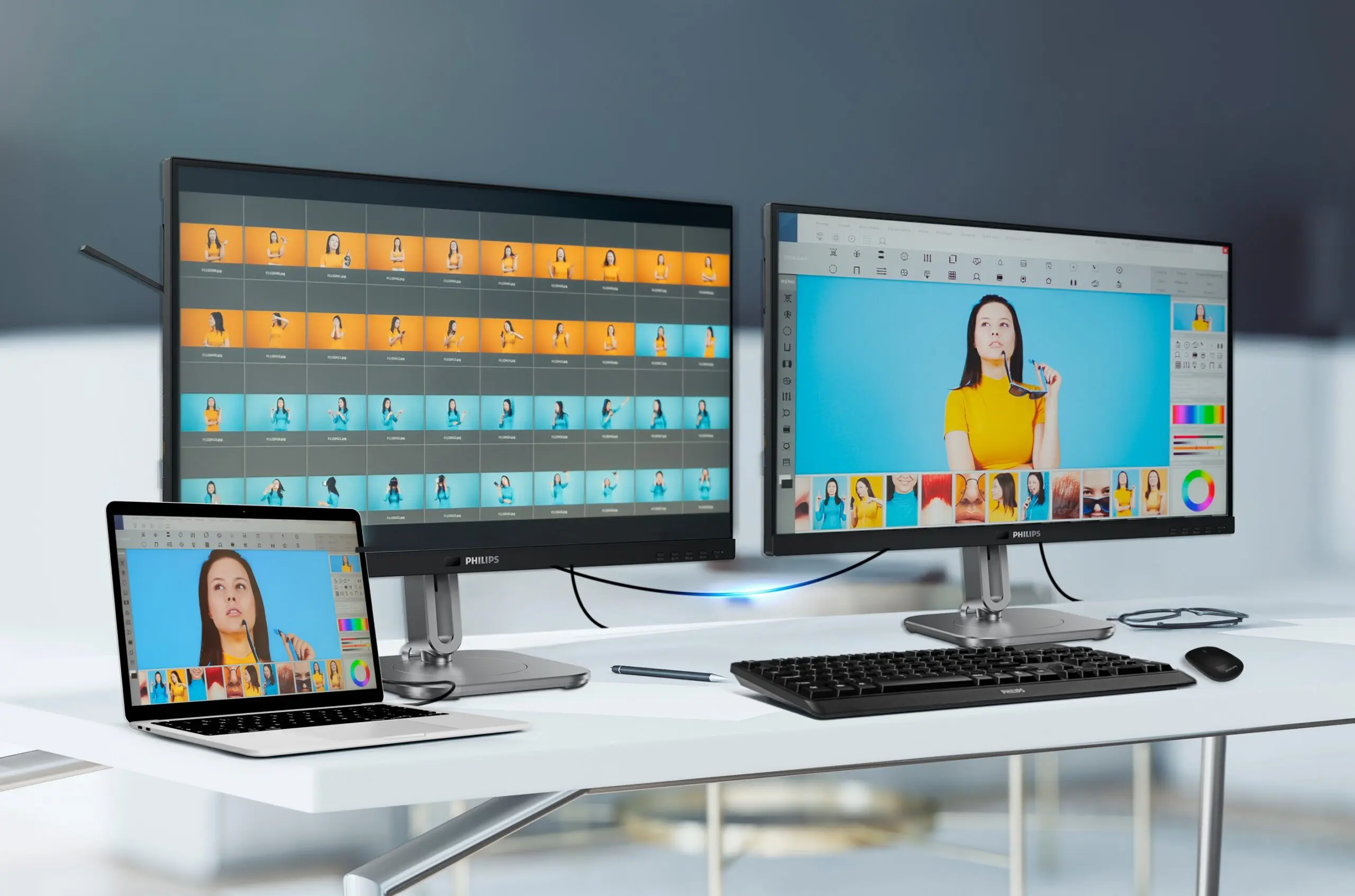
“With a 34-inch screen, you can multitask on a single display. For that, you do need at least UWQHD (3440×1440 pixels), otherwise there isn’t enough pixel density to comfortably place multiple windows side by side.”
Typically Belgian
The fact that the popularity of 34-inch monitors is increasing sharply is characteristic of Belgium, according to Calmet. He emphasizes that the aforementioned figures and trends are mainly focused on the Benelux. “Among my colleagues in countries like Portugal, Spain, and Italy, 34-inch is rather exceptional.”
“In Belgium and Luxembourg, companies increasingly understand that a good screen contributes to the comfort and motivation of employees, especially now that working from home is an alternative to the office. While colleagues in countries such as Portugal or Spain consider a larger screen an unnecessary luxury, Belgian companies see it as a sensible investment,” says Calmet.
This is reinforced by the shift in budgets: new laptops are becoming more expensive, while monitors are actually dropping in price. “Anyone who has an employee looking at a screen for eight hours a day would rather invest there.” Calmet notices that customers who test a better monitor for one month never want to give it back afterward. “A monitor is just like a mattress: we spend eight hours a day on it, so it had better be good,” he compares.
Balance between price and performance
Calmet has noticed a striking price drop in ultrawide monitors in recent years. “Five years ago, a 34-inch monitor was about six times more expensive than a 24-inch screen. After two years, that became four times as expensive, and now the price of a 34-inch monitor is about double that of a 24-inch screen.”
“The price is not only becoming more attractive, but the balance with the size and resolution of a screen also plays a role here.” Calmet refers to the Total Cost of Ownership. “People no longer look purely at the price, but also at indirect costs, such as lifespan, integrated webcams (clean desk), and integrated USB-C docks, which can easily cost 150 euros as standalone units.”
Monitors are getting larger, but consume less and less power.
Olivier Calmet, Manager Belgium & Luxembourg bij Philips & AOC Monitors
Furthermore, monitors are getting larger, yet they consume less power according to Calmet. “Today, for example, we offer monitors with a five-year warranty, whereas by law it used to be only two years. When you put all these benefits on paper, the price is no longer the primary consideration.”
Is curved the standard?
“Ultrawide screens are almost always curved,” Calmet notes. Flat 34-inch screens are very rarely purchased, often for specific purposes. “For example, an architect will be more inclined to buy a flat screen to draw their designs.”
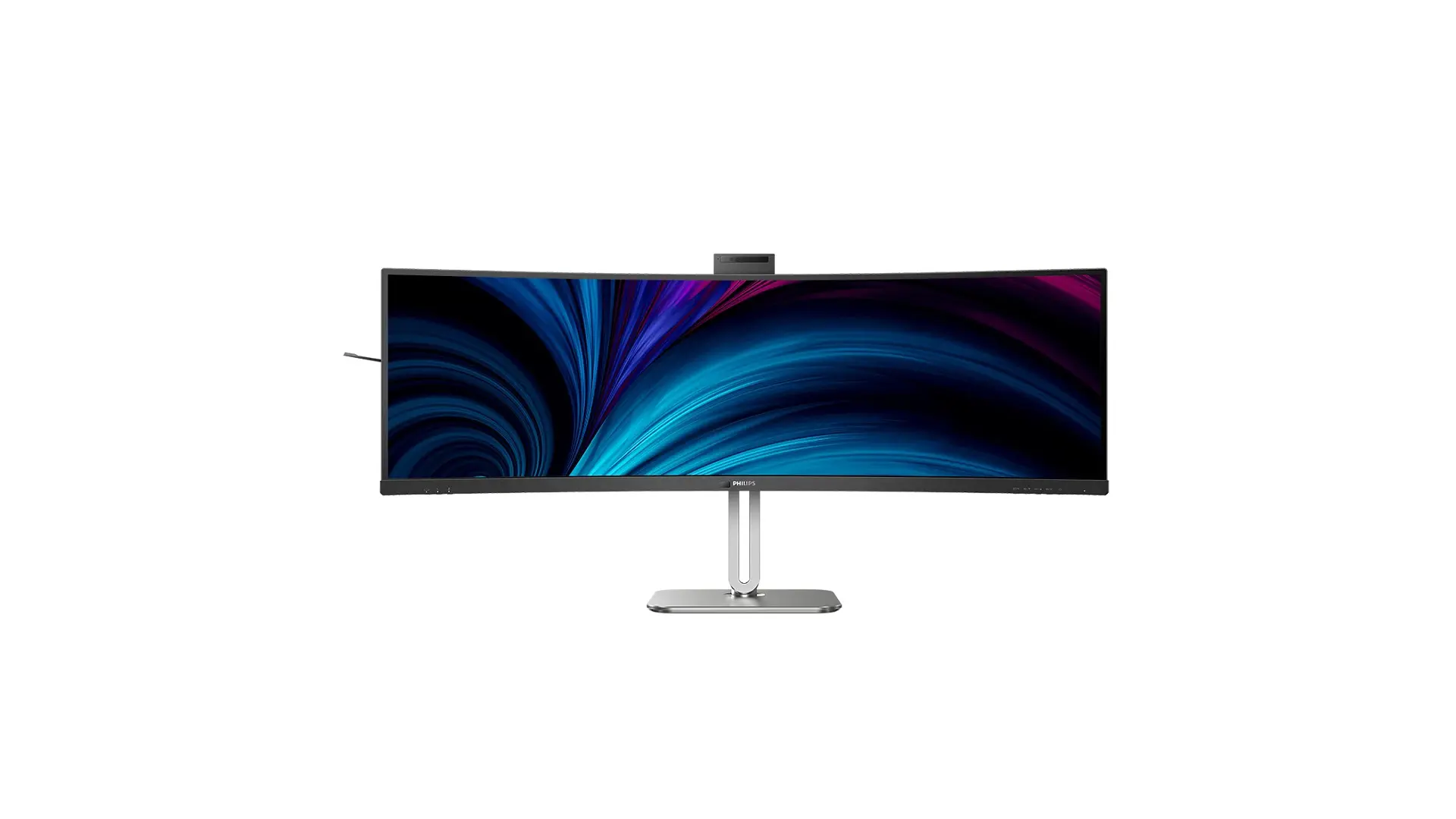
“In the B2B market, we generally see almost exclusively 34-inch curved models appearing. Curved screens only make sense from 34 inches upwards; below that, it doesn’t have much use,” he says. Moreover, a 34-inch flat screen is uncomfortable because the distance is too great. With a curved model, the distance between you and the screen is more consistent.
According to Calmet, ultrawide monitors are no longer an exception in the Belgian office environment, but the new standard. “The falling prices, combined with the increasing benefits in terms of comfort, productivity, and total cost of ownership, make the step from two small screens to one large screen increasingly logical,” he concludes.