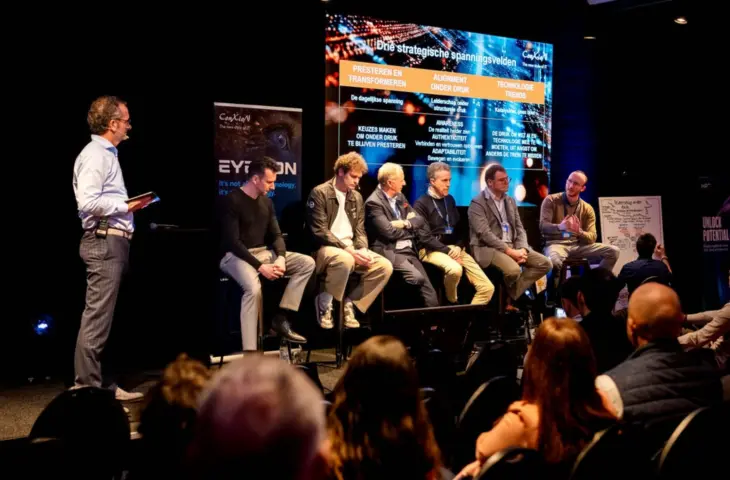
During a panel discussion at Eyes On 2026, we learn how various business leaders view transformation.
We are in an old laboratory, at the invitation of ConXioN. Experiments are no longer carried out here, but in the past, the building was already dedicated to innovation and growth, or in short: transformation. That is why we understand ConXioN’s choice to hold Eyes On 2026 here all the more. During the event, one question is central to the panel discussion: how do you continue to perform today while simultaneously preparing your company for tomorrow? Moderator Olivier Van Duüren kicks off: “The real question a company should ask itself is: can I transform?”
Yet the pressure remains high. According to him, performing is doing what you promise. Transforming is about the ability to adapt your company, culture, and business model to a changing world.
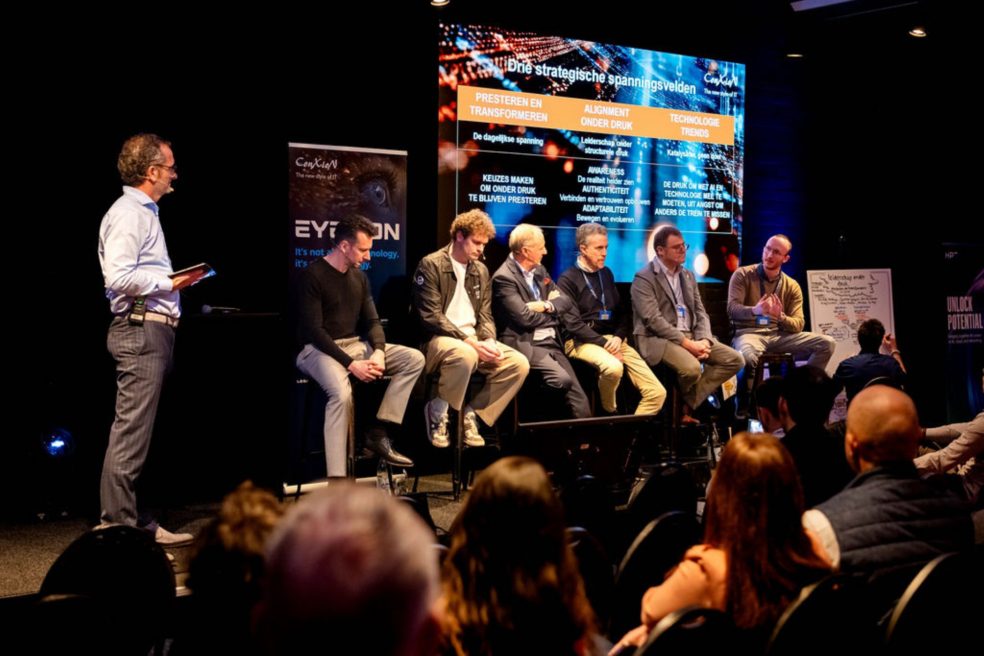
The participants are Andy Coomans (Co-founder BlackBird), Ruben Miesen (CEO Legally), Gunther Ghysels (Founder Get Driven, WERKTR, Tinrate), Kristof Wallays (Global Expansion, Innovation & Sustainability at Agristo), Philippe De Veyt (Director Lecot & Chairman VOKA), and Kris De Leeneer (CEO KDL). Their common thread: anyone who wants to grow cannot afford to stand still.
No fear, but hunger and hope
When asked the opening question of whether 2026 primarily evokes fear, hope, or hunger, the panel does not choose fear. The answers lean towards “hunger” and “hope”. Despite economic, technological, and external pressure, doomsday thinking does not prevail; instead, they are convinced that change is achievable.
The panel members believe terms like “business as usual” should disappear in 2026. Companies that continue to operate on autopilot will eventually get stuck.
Getting the right people on board
Kris De Leeneer brings it back to the essence of entrepreneurship: people. “The most important choice is to attract good people,” he stated. He looks back on his own journey, where he was once a driver, dispatcher, billing clerk, and planner all at once. He only truly grew when he could delegate tasks and gather the right profiles around him.
We set a certain course. Sail along, be on that boat, and contribute actively. Is there resistance? Then you don’t fit in this team.
Andy Coomans, Co-founder BlackBird
According to him, this remains the core even in more traditional sectors. Personality, motivation, and a willingness to learn are very important. Especially in companies that have existed for a long time, transformation is less self-evident.
Changing through communication
For Kris De Leeneer, communication is key, especially in sectors where change has a major impact on the work floor. He refers to the introduction of a fully automated warehouse. That requires more than just installing technology; employees need to understand what is changing, why it is changing, and what role they will play in it. “Involving them, communicating in advance, having them follow a training course,” he summarizes.

At the same time, he warns against change fatigue. Those who constantly change direction lose people. Once a process has been chosen and explained, consistency must follow. Only then is trust built.
Not everyone wants to come along
The panel was remarkably in agreement about resistance to change. Not everyone will want or be able to join a new story. Ruben Miesen: “If you are still resisting in one month, you will be replaced by engineers who can do it faster with AI.” Harsh, but according to him, necessary in a market where speed and adaptation are crucial.
Andy Coomans phrases it a bit more broadly: “We set a certain course. Sail along, be on that boat, and contribute actively. Is there resistance? Then you don’t fit in this team.” Sometimes it is fairer to conclude that the company and the employee are no longer a good match.
First awareness, then authenticity
The second part of the conversation is about adapting under pressure: awareness, authenticity, and adaptability. According to Andy Coomans, the loss of these often happens in exactly that order. “A leader who no longer sees it all tomorrow, who no longer receives all his information, becomes insecure.” Insecurity quickly translates into micromanagement, fake confidence, or aloofness.


His main warning is that entrepreneurs take too little time to “look over the fence.” Too many leaders are locked in day-to-day problems, while the future of their company is decided just outside those four walls. “We work sixty hours, 59.9 hours of which we are busy in operations,” he said. “But that’s not going to make your business in five years.”
Different types of leadership
Especially when a sector or company is under pressure, Philippe De Veyt finds it crucial that leaders remain visible to their people. “I think it is then crucial for the captain to be on his ship,” he states. According to him, market orientation should never mean losing sight of internal unrest.
Should a leader primarily look outward or stay close to the company? The answer ultimately doesn’t seem black and white. Both are necessary, as long as a conscious choice is made about who takes on which role.
Gunther Ghysels sees it differently. “I have the impression that we now mainly have to see as a startup that things click, and you can only do that by performing,” he states. “Then you just aim very wide and you can see what works and what doesn’t, to then transform into something else. So first perform, then transform.”
Pressure is not always negative
Next, the discussion turns to the vision of pressure. Instead of seeing pressure only as a risk, some panel members see it as a motor. “Is it possible to perform without pressure? Not in my mind,” says Ruben Miessen. According to him, healthy pressure helps to set priorities, stay sharp, and meet deadlines.
Other speakers also acknowledge that a “sense of urgency” pushes companies forward. Kristof Wallays shares his opinion: “That pressure doesn’t necessarily always have to have a negative connotation. It also helps to get things done. Without pressure, employees tend toward complacency.”
At the same time, an important distinction is made between healthy performance pressure and situations where people truly get stuck. In those cases, the context must be viewed more broadly, as causes do not always lie solely at work, but often in private life.
AI: don’t jump on everything
The final theme covers AI and technology. No one can afford to ignore AI, but blindly jumping on every hype is not smart either. Gunther Ghysels puts it soberly: “We have to look carefully at which applications actually do something.” Especially in complex operational environments, such as transport and logistics, the value lies not in gadgets but in concrete applications that improve planning, data, and decision-making.
Without pressure, employees tend toward complacency.
Kristof Wallays (Global Expansion, Innovation & Sustainability bij Agristo)
Ruben Miessen also sees how quickly reality is changing. He mentions vibe coding, AI tools that speed up software development, and the way young engineers suddenly deliver more output than senior profiles who do not use such tools. “You have to look at your own work very critically.” Not out of panic, but out of a desire to remain relevant.
Conclusion
Andy Coomans states that as a leader, you don’t necessarily always have to be present, but you do have to be visible and meaningful at the right moments. He put it this way: “Be a communicator then, and don’t just sit behind your desk tapping on your keyboard, because that’s of no use to people.” Gunther Ghysels shares this opinion: “If you’re not present, I think you’re more of a silent investor.”
In 2026, companies will have to continue to perform, under pressure, while reinventing their future. This can only be achieved with the right choices, honest communication, the right people, and enough courage to look not only inward but also outward.
read also