

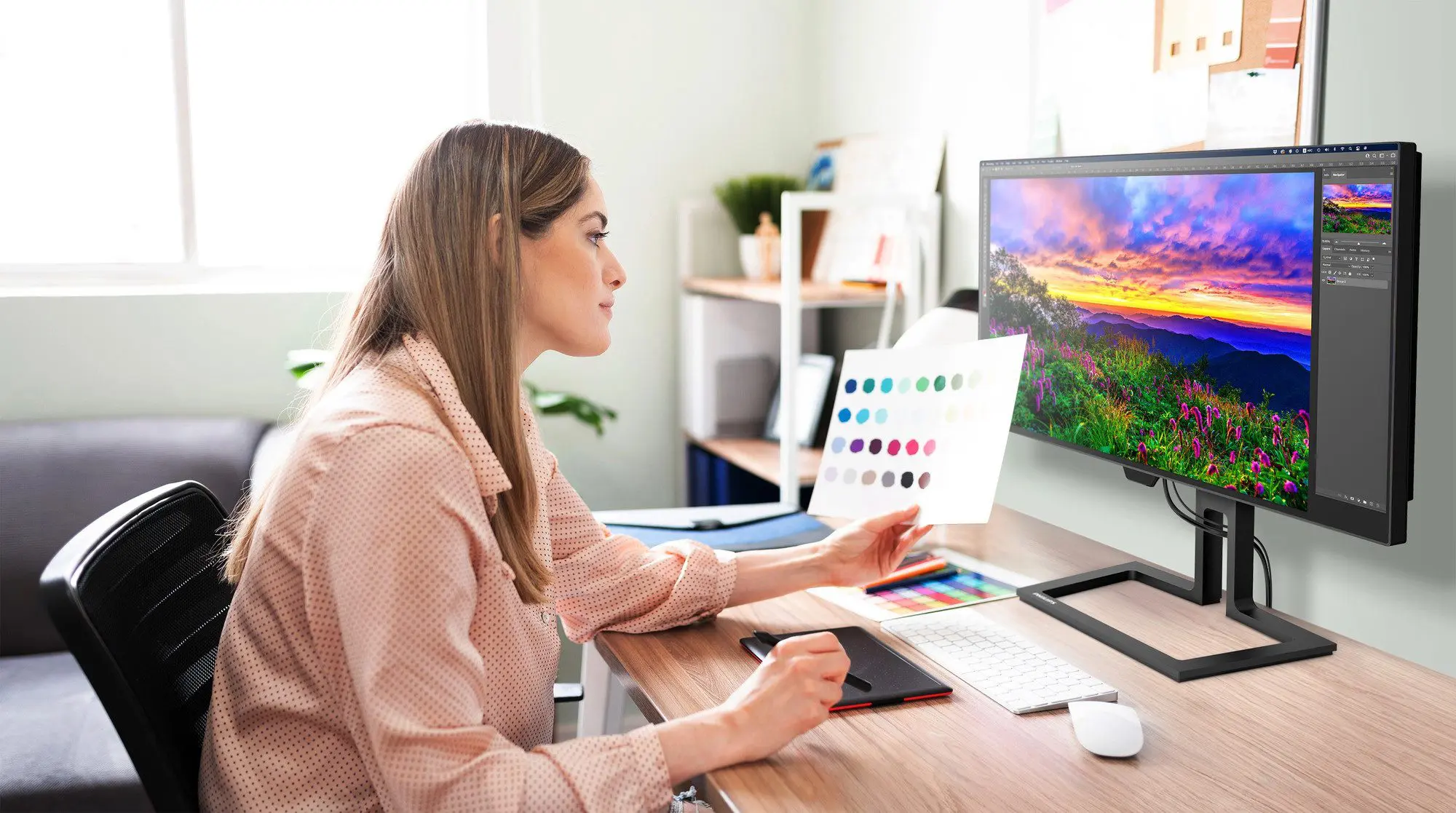
What does the monitor market look like today and what should you look for when buying a monitor?
Philips has been making monitors for decades. The company has a market share of more than 21 percent in the Benelux market, according to figures from market research firm Context (Q4 2025), together with sister brand AOC. “Philips is the ‘grandpa’ of the monitor market,” says Olivier Calmet, Manager Belgium & Luxembourg at Philips & AOC Monitors with a wink.
He explains how Philips relates to its younger sister brand AOC, and what the overall monitor market looks like today. He dives more specifically into one of the most important aspects of a monitor: the resolution.
Philips + AOC
Philips and AOC come from the same family. They both fall under the parent company TPV, via two separate subsidiaries: MMD (Philips monitors) and AOC. Calmet compares the two brands to Volkswagen and Audi or Coca-Cola and Fanta: they share the same parent company but each has its own market, image, strategy, and product range.
“When a start-up with people in their thirties is looking for new monitors, I will always put AOC forward first,” says Calmet. “The new generation doesn’t want ‘grandpa’ brands like Philips; you can’t compete with trendier brands that way.” On the other hand, the perception of Philips often works in its favor. “Philips has a better reputation in the B2B monitor market than AOC, as it is a local brand with a long history. Philips was the first brand to produce monitors,” he adds.
Calmet wants to clear up one misconception about AOC. “The majority of people think AOC is originally a Chinese brand, but that’s not correct. AOC is originally American.” Philips is a local player with roots in Eindhoven. Parent company TPV is a Chinese multinational, however, with headquarters in Hong Kong.
Monitor market
The monitor market extends beyond just ‘grandpa’ Philips and AOC. Brands such as Dell, HP, Samsung, and Lenovo also occupy a large part of the market. Calmet tells us exactly what that distribution looks like based on figures from the fourth quarter of 2025. In these, Philips and AOC as a combined brand are number one with 21.5 percent. If we take Philips as a standalone brand, you have to look at third place in the market.
Small car, small engine
Monitors can be found from multiple brands, but also in different shapes and sizes. Calmet explains one of the most important aspects of a monitor, namely the screen resolution.
“Resolution is linked to the size of a monitor.” He compares it to a car engine. “A small car doesn’t need a big engine, but a big truck requires more power.”
The same applies to monitors. “A 24-inch 4K screen makes no sense at all. You will never be able to perceive the difference with the naked eye,” Calmet points out. The reverse is also true. “A 32-inch Full HD screen results in very poor image quality.”
Resolution landscape
Not every resolution is suitable for every screen. Calmet lists what he believes are the most suitable resolutions for each format. “Full HD is the best resolution for a 24-inch screen. For 27-inch, Quad HD is the sweet spot, whereas Full HD increasingly loses quality at this size.”
“If you increase the resolution, you also increase the display area on the screen, and therefore the amount of data. More pixels means more data,” says Calmet.
In addition to resolution, panel technology also plays an important role. TN (Twisted Nematic) panels are the oldest and cheapest option, but provide poorer viewing angles and color reproduction by comparison. IPS (In-Plane Switching) panels offer better colors and wider viewing angles, making them the most common choice for office use. OLED goes a step further with deeper black levels and contrast, but comes at a higher price.
Refresh rate is also gaining importance for office monitors. While 60 Hz was the standard for a long time, screens with 100 Hz or 120 Hz are becoming increasingly common. This higher refresh rate ensures a smoother display, which makes working with large documents or multiple windows noticeably more pleasant.
Multitasking
Monitors are also tied to habits or personal preferences. One user might like a 27-inch screen combined with their laptop screen, while another prefers to close the laptop and work on a 34-inch screen.
According to Calmet, the second option has a significant advantage. “With a 34-inch screen (21:9) or larger, with sufficient resolution, you can open more windows simultaneously on your screen compared to 16:9 models. That promotes multitasking, which customers find increasingly important,” says Calmet.
Choosing the right monitor is no longer a simple task today with such a wide range available. Although certain features like resolution and size can make a difference, it still depends on your personal needs. Through this guide, you can discover which monitor best suits your needs.