


AI, seamless meetings, new workstations and commercial notebooks, and HP IQ: these were just a few of the topics covered at HP Imagine 2026.
HP is using its annual Imagine event in New York to announce a strategic shift: moving away from separate product categories toward a connected ecosystem powered by local AI, proximity connectivity, and a single common interface: HP IQ.
The tone is set by interim CEO Bruce Broussard, who positions HP at the intersection of edge, cloud, devices, and AI. His presentation inspires little confidence. The man lacks charisma; hopefully, HP can quickly appoint a permanent CEO to replace Enrique Lores.

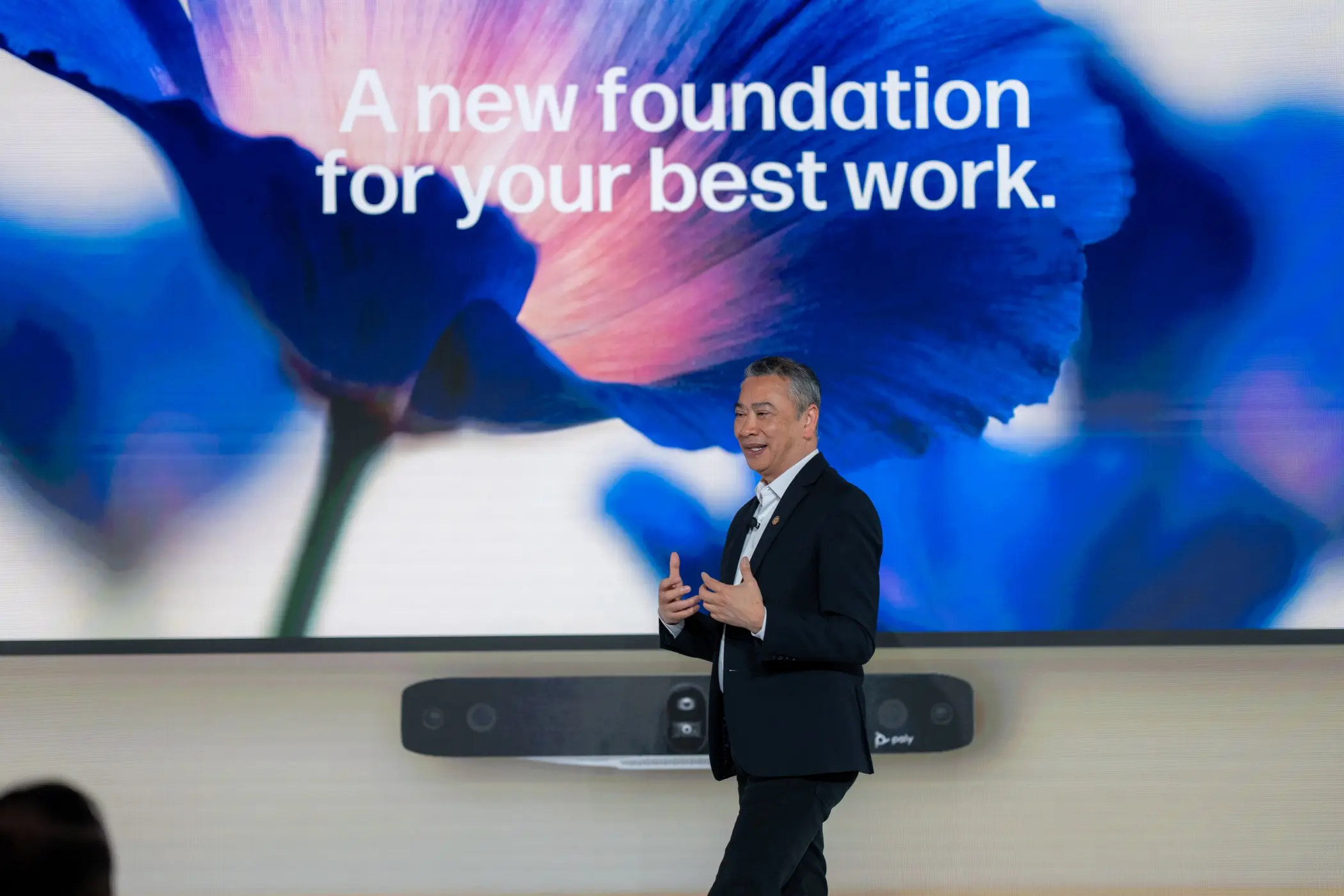
Tuan Tran, President of HP’s Technology & Innovation organization, summarizes the event in three pillars: local intelligence, seamless connectivity, and a single common interface across all HP categories. “We are shifting from devices to experiences,” Tran stated. “From a series of strong categories to a connected ecosystem. That is what the future of HP is about.” HP is thus consistent in its ambition, which remains largely unchanged compared to last year.
The economics of local AI
HP presents a strikingly data-driven case for why AI needs to move to the edge. Prakash Arunkundrum, Chief Strategy and Transformation Officer at HP, calculates: a company with 1,000 employees sending ten queries a day to the cloud already pays approximately $10,000 per year for the simplest questions. For advanced tasks (deep research, RAG workflows, agent scenarios), those costs explode. Ketan Patel, President of Personal Systems, cites savings of $700,000 per year per 1,000 employees when basic tasks are handled locally.
Additionally, latency at the edge is up to ten times lower than in the cloud, and pressure is growing from regulators and customers to keep data local. HP’s prediction: today, only five percent of AI inference takes place at the edge, but by 2030, that should be 50 percent. The technological foundation is already there: Arunkundrum demonstrated that last year’s GPT-4 now runs entirely locally on an HP ZGX workstation, and that the computing power of PCs has grown significantly in recent years (the ZBook Fury now boasts more than 1,800 TOPS).
HP IQ steals the show
The most impressive moment of the event is the live demo of HP IQ by Imran Chaudhri on stage. IQ runs on a local open-source model from OpenAI (gpt-oss-20b). The model is managed by an orchestrator that distributes tasks and calls upon specialized tools.
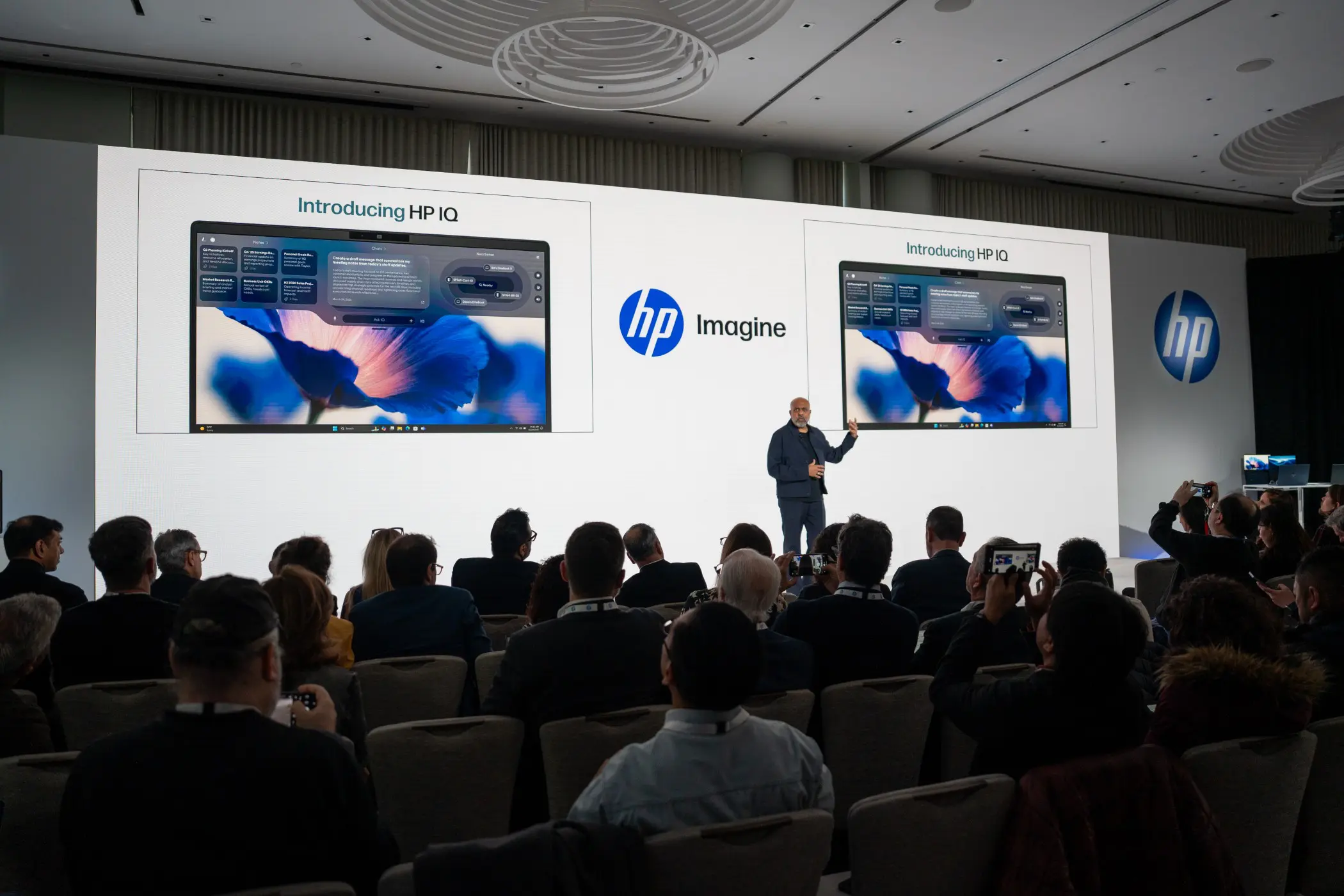
In the demo, Chaudhri drags a confidential contract into the Visor interface, the software window used to interact with HP IQ. He types: “what are the points I should push back on?” The system analyzes the document section by section and provides concrete negotiation suggestions, processed entirely locally. He then shows how IQ builds context across multiple sessions: a board deck he entered earlier is used to automatically draft an email summary for the board.
The Meeting Agent is perhaps the most impressive of all. The system records meetings locally, summarizes them with key themes and action items, and can even infer what was said ‘between the lines.’ “This is for teams that literally cannot allow this data to leave their device,” Chaudhri emphasized. “Everything runs locally. Nothing has ever ended up on anyone’s server.”
NearSense for seamless synergies
The second pillar is NearSense, a spatial awareness technology built directly into HP devices. During the demo, Chaudhri dragged a file to a colleague’s PC next to him: one click, end-to-end encrypted, no cables, no pairing procedure. It is the kind of interaction everyone expects in 2026 but which, in practice, is still frustratingly cumbersome. Such things often work better in demos than in practice: we will have to wait and see if HP can deliver on the expectations.
The bigger announcement lies in the partnership with Google. HP is adapting NearSense to Google’s Device-to-Device Infrastructure: the same technology that already powers supposedly seamless experiences within the Android ecosystem. The result: HP PCs and Android phones will soon automatically see each other, share context, and hand off work — without extra software, without a cloud intermediary layer, and without setup.
Qualcomm is adding support in current and future SoCs. HP is emphatically positioning this not as a unique HP feature, but as a new industry standard.
The future vision for NearSense goes further: room sensing (automatically recognizing when you walk into a meeting room and offering a single-click join), driverless printing, automatic headset pairing, and screen casting to nearby displays. The latter alone would elicit a sigh of relief in many an IT department.
WXP as a control layer
Manoj Leelanivas, President of HP Solutions, presents the results of the Workforce Experience Platform (WXP) after a year in production: 30 percent fewer tickets, twenty percent faster problem resolution, 30 percent less downtime, and up to 50 hours saved per employee per quarter.
WXP manages not only HP devices but also devices from other manufacturers, and has been expanded to printers in North America. Anneliese Olson, President of Imaging, Printing & Solutions, emphasized that print, PC, and collaboration are now coming together in a single management ecosystem for the first time. According to Olson, this marks the end of siloed operations.
HP IQ integrates with WXP as a control layer but does not require a WXP subscription. Configuration is also possible via Microsoft Intune. In the Q&A, Tran clarified that IQ offers a toggle allowing users or IT to enforce that data never leaves the device — even for cloud supplementation. “You have a switch: do not go outside the environment. Just in case,” he said.
31 PC launches and HP Go to Europe
The hardware announcements were as extensive as the software vision. Patel revealed 31 commercial AI PC launches across the EliteBook and ProBook ranges, from enterprise to SME. The flagship is the EliteBook 6 G2q with a Snapdragon X2 processor, 85 TOPS NPU performance, and 28 hours of battery life.


Important for the European market: HP Go 5G, the network-agnostic 5G connectivity service that automatically switches between telecom providers, will be expanded to 24 European countries this summer and is now compatible with the ProBook 4, EliteBook 6, 8, and X, and Chromebook Plus as an optional extra.
In between, HP also announced new printers within the LaserJet range, for both SMEs and enterprise, as well as new Z workstations.
Ambitious, in theory
HP Imagine 2026 is clearly more than just a product launch event this year. We are witnessing a strategic repositioning. HP truly no longer wants to be judged as a hardware company selling PCs, printers, and peripherals, but as an ecosystem company delivering AI-driven experiences across all those categories.
HP has wanted this for a long time, but with HP IQ, we see the embodiment of that ambition: a local AI layer with enterprise governance, proximity connectivity, and an interface that removes friction.
HP IQ will not be available until later this year and only on the latest devices with at least 24 GB of RAM.
At the same time, realism is needed: HP IQ will not be available until later this year and only on the latest devices with at least 24 GB of RAM. NearSense, along with HP IQ, still has to prove it can scale to busy office environments. The future scenarios of driverless printing and automatic screen pairing are currently just that: scenarios.
The coming months will show whether HP can live up to the promise. The foundation looks interesting; it remains to be seen if it is stable enough to build upon.