

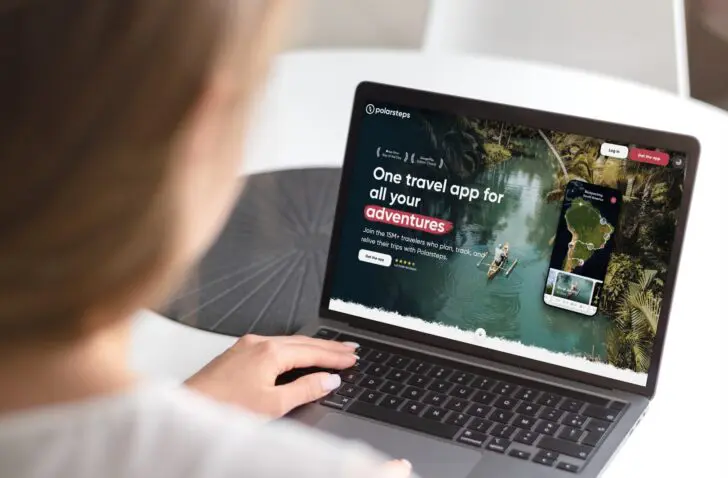
Location data and photos are easily retrieved via the travel app Polarsteps, Dutch researchers have discovered. Polarsteps was reportedly aware of this for some time but took no action.
Polarsteps is a popular app among travelers. The app allows you to keep a digital diary with photos of your journeys. This sounds like a nice way to relive your travels on gloomy days and share your foreign adventures with those back home. However, due to poor security, the app can be abused by strangers with bad intentions to track you everywhere, Follow The Money discovered.
To use the app, Polarsteps requests access to your device’s location and your photo album, among other things. If you do not grant this, you receive a notification at every login stating that this is necessary to improve the experience. You can set the app to share an approximate rather than an exact location and make trips private so that only friends and family can follow you. However, this provides only a false sense of control.
FTM collected the names of 23 million users, over a billion GPS points from nearly two million trips, and hundreds of millions of photos and videos. According to VRTNWS, the data of nearly one million Belgians has been exposed. Even trips set to ‘private’ or ‘followers only’ turned out to be accessible without anyone having to approve a follow request.
Leaky API
The cause is not an exotic zero-day, but a lack of access control on the API through which the app communicates with Polarsteps’ servers. That interface shared more fields than the app itself displayed, did not check whether the requester was authorized to access that specific trip, and did not limit the rate of requests. FTM stated it was able to scrape all data from a single IP address and supplement it over several months without any hindrance.
This is the classic recipe for a data leak: no rate limiting, no anti-bot measures, no per-object authorization check, and an API that provides too much information by default. Polarsteps initially claimed there were limitations in place, but later admitted they were far too ineffective. So-called secret sharing links also turned out to be accessible.
A second layer lies in the metadata. Polarsteps stored location data from photos and shared it via the API. Anyone who photographed their suitcase while still at home unintentionally published their home address with meter-level precision. This is not mentioned in the privacy policy.
From holiday photo to intelligence source
For users, the combination is the problem. Name, date of birth, home address, workplace, travel companions, planned travel dates, and a historical route together form a dossier suitable for stalking, targeted phishing, identity fraud, and traditional burglary: a trip that has yet to begin tells exactly when the house will be empty. Because the API also provided real-time positions, even geofencing was possible.
The fact that the risks are not theoretical was evidenced by FTM’s follow-up investigation into military personnel. Dutch, Belgian, British, American, and French soldiers could be tracked from barracks in Wezep, Havelte, and Schaarsbergen to the NATO camp in Rukla (Lithuania) and the American bases Ramstein and Spangdahlem, including their home addresses.
The Netherlands placed the app on a blacklist for military personnel. The cabinet of Belgian Minister of Defense Theo Francken responds via VRTNWS that ‘the use of applications with which location data can be shared is prohibited in the vicinity of all military installations and during military operations’.
In violation of GDPR
Polarsteps disputes that this constitutes a data leak because no passwords or account login details were leaked. However, one cannot speak of proper compliance with GDPR legislation here either. Transparency regarding which data may be visible is a key element in European privacy legislation, even as the EU threatens to weaken it. In the past, Meta was fined because user data could be scraped from Facebook profiles.
“If it is not clear to people what happens to their data in practice, Polarsteps has insufficiently explained what they do,” Floor Terra, inspector for the Dutch Data Protection Authority, told FTM. Polarsteps’ headquarters is located in Amsterdam, so in principle, the Dutch privacy watchdog is authorized to reprimand the company. This could therefore have further repercussions for Polarsteps.
Culpable negligence
The timeline does not favor Polarsteps at all. French security researcher Louis Couderc reported the problem in the autumn of 2025, after becoming acquainted with the app during a trip to Thailand. Polarsteps informed Couderc that the problem was already known internally but took no measures. “Then you are simply negligent,” says Marc Schuilenburg, Professor of Digital Surveillance at Erasmus University Rotterdam, in the investigation.
Polarsteps says it has since informed the Dutch Data Protection Authority (AP). This is six months after the first report of the leak, while the GDPR mandates a reporting obligation within 72 hours. Belgian users can file a complaint with the Data Protection Authority, but the case is handled via the Netherlands.
CEO Clare Jones limited further comment to a statement that the company is working on better security. The app has tightened rate limiting, restricted the data sent via the API, no longer shares photo locations by default, and explicitly asks for tracking permission. Anyone using the app should think twice about what they share with it.