


There seems to be consensus that the AI bubble will burst. We can even look forward to it, as it will give AI the chance to develop more steadily and, above all, more sustainably. Ideally, generative AI will then evolve into re-generative AI: a technology that benefits both humans and the planet.
“I think it will take about another year before the AI bubble bursts,” Michiel Boreel confides to us on the sidelines of the Husqvarna Living City conference in Barcelona. The CTO of Sogeti is present to explain his vision of how to proceed. He certainly looks forward to the burst with a certain enthusiasm.
I think it will take about another year before the AI bubble bursts.
Michiel Boreel, CTO Sogeti
“The situation is comparable to the dotcom bubble,” he says. “That burst, but the internet didn’t disappear. On the contrary: when the hype settled down, real development could begin.”
Nature-based Solutions
Boreel has prepared a presentation tailored to Husqvarna’s eleventh Living City conference, which this year focuses on nature-based solutions. These are solutions and innovations that don’t work alongside or against the planet, but rather incorporate the environment.
“Nature based solutions are solutions that use natural processes and ecosystems to address challenges such as climate change, water shortages, and loss of biodiversity, while simultaneously improving human well-being,” clarifies Professor Thomas Elmqvist from Stockholm University, and chairman of Husqvarna’s biodiversity council.
Satellite Data and AI
The city of Barcelona is trying to embrace this nature-based approach. Marc Montello, Director of Environment, Energy and Data at Barcelona Regional, uses satellite data to explain the state of green spaces in his city, where the pain points are, and how Barcelona is trying to integrate more parks and green spaces.
Husqvarna also uses satellite data and AI to stimulate the green development of cities. On the Hugsi.green platform, the company analyzes data from ESA’s Sentinel 2 satellites to map how green cities are. The methodology, which according to Hugo van Bijsterveldt, Director Global Core Strategy, also includes an AI component, shows statistics and a clear map, and makes it possible to compare cities and monitor how green spaces evolve.
No Need for AGI
Boreel hopes development will go in this direction. “Today, companies in Silicon Valley are working on artificial general intelligence. That’s the wrong goal for AI in my opinion.” Artificial General Intelligence or AGI is a form of AI that surpasses the flexible human brain and is as good as or better than us at everything.
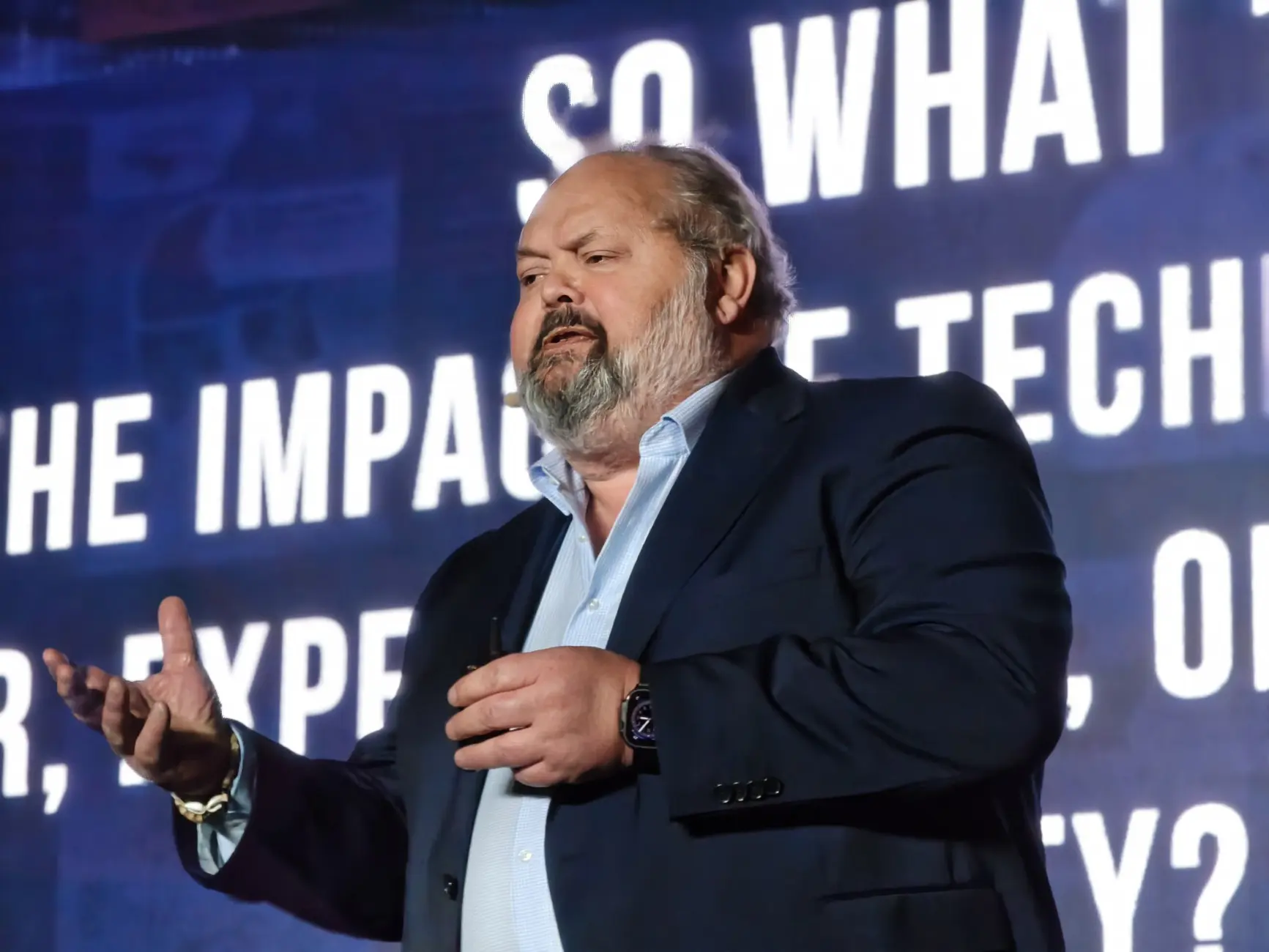
According to Boreel, machine intelligence is fundamentally different from human intelligence, which is why striving for AI that’s better than the brain isn’t a good idea. Machines work differently, and that’s where the value lies.
Regenerative AI
He advocates for regenerative AI. This is a form of AI that complements human thinking and integrates nature’s intelligence. “We need to build a synergy of intelligence that develops self-healing systems for the world’s well-being.”
Hugsi.green can be an example in this respect. In the UK, another project (unrelated to Husqvarna) is running where the River Roding gets a voice through AI. This allows the river to express how it feels, for example based on pollution data.

“Technology is not the opposite of nature, but rather our bridge to it,” says Segan Axelsson, senior director global core for Husqvarna. “Satellite data and AI help, for example, with problem identification.”
Solve it with a Lawnmower
Husqvarna also sees itself playing a role in solving these problems. Fully in line with the nature based solutions and the role that Boreel envisions for artificial intelligence, robots and AI play an important role.
Robots, in this case, are the Automower robotic lawnmowers from the Swedish company. These operate worldwide and can do much more than just keep the grass short. Starting next year, Husqvarna will offer an (optional) camera module for its Automowers. We described after an earlier visit to the company’s headquarters how that camera, together with a chip with about four TOPS, can perform image recognition.
Back then, we saw an Automower avoid a plush hedgehog on an artificial lawn in the innovation center in Jönkoping. In Barcelona, a brand new Automower 540 Epos again avoids an artificial hedgehog, but this time in realistic conditions in Parc de la Ciutadella.

That in itself is already a sustainable use of AI: blind Automowers are apparently quite deadly for baby hedgehogs. However, the potential is much greater. For instance, the camera together with AI can discover invasive plant species.
AI vs. Invasive Plants
At the Living City event, Husqvarna presents an award to a student who developed a concept around this. The student already trained a computer vision model to detect invasive plant species with high accuracy.
Robots that detect such plants can pass photos and locations to managers. They can then tackle the invasive plants and prevent their spread at an early stage, before native species are pushed out. Mowing robots in parks can play a role in this, but the technology is much more widely applicable. As long as a camera goes somewhere in nature, AI can search for unwanted plant species.
In its ‘Strix’ vision for 2033, Husqvarna, through senior director robotics Patrick Jägenstedt, explains what else is possible. Think of robots with sensors that can penetrate the ground and measure groundwater, detect crop health, and more.
Husqvarna positions itself as a player that can offer nature-based solutions through technology and wants to provide at least a (small) part of the solution. Extensive electrification of the portfolio also fits into this picture.
Paradigm Shift
AI also plays a role at the lawnmower specialist. This again fits with the hope Boreel has for the future. Nobody benefits from a lawnmower that’s smarter than a human. When AI collaborates with humans and nature to improve the entire environment, more becomes possible.
Boreel: “A paradigm shift is approaching. We need to move beyond sustainability towards restoration and regeneration. From ‘ego’ with ourselves at the center, we must evolve via ‘eco’ to ‘seva’, or serving nature.” Boreel strongly believes that AI can play a role in this, but not in the form of the hype-forced race towards AGI. So let that AI bubble burst and the hype evaporate, so that AI in the form of regenerative AI can truly serve humans and the planet.