


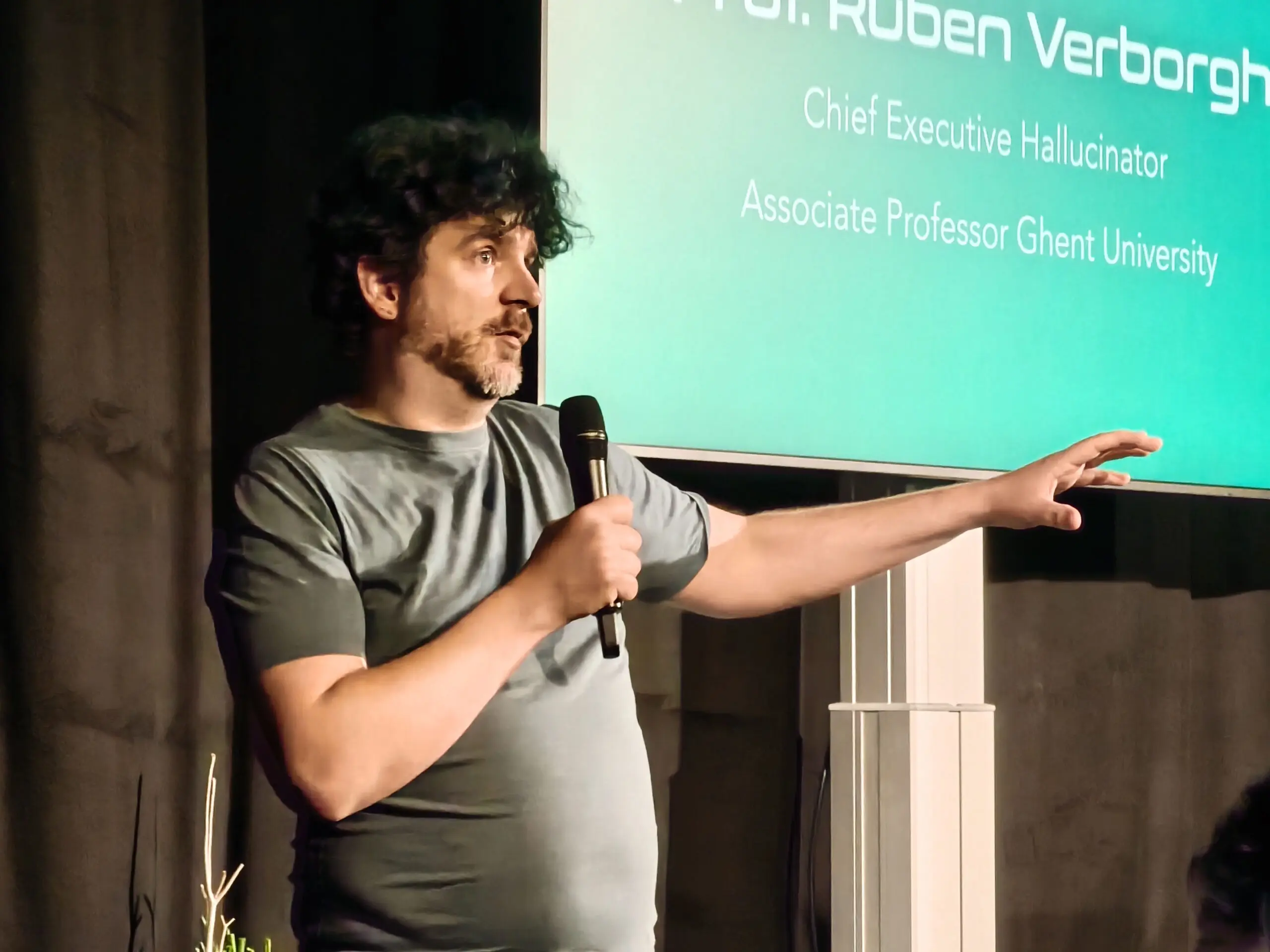
Potable water flows from the tap, 220 volts from the socket, but junk from the internet connection: Professor Ruben Verborgh of Ghent University sees how we are failing with data and AI, but has the broad outlines of a solution ready.
“Why don’t you steal a pizza from the supermarket?” Professor Ruben Verborgh of Ghent University asks the audience during his appearance at the Connect-IT event at Antwerp Expo. “Because it’s difficult. It’s much harder than just paying. It’s also not allowed, but passing through the checkout is simply easier.”
Verborgh uses the example to illustrate how we should handle data and technology. “There are people who will always do the right thing, and people who will always do the wrong thing,” he further clarifies. “You shouldn’t focus on that with regulation. There is a very large middle group that is willing to do the right thing, as long as it is simple enough.”
The failure of GDPR
The professor points to the now ten-year-old GDPR legislation as a prime example of how not to do it. “GDPR has made it harder both to handle data wrongly and correctly, but it still remains easier to do the wrong thing.” He notes that it has primarily added administrative burden for organizations. The large multinationals that GDPR aimed to target do have to pay a fine occasionally. “But for them, that is just the cost of doing business.”
GDPR has made it harder both to handle data wrongly and correctly, but it still remains easier to do the wrong thing.
Professor Ruben Verborgh, Ghent University
According to Verborgh, technology regulation can only be successful if it follows a real economic narrative. “We first need responsible technology that is economically relevant, and then we can regulate it. Regulation for the economic component—that never works.”
Priority for an economic model
Therefore, according to the professor, it is necessary to first develop a solid economic model for data and for AI. In his view, the distinction between the two is not that great. “AI is simply liquid data.”
However, things go wrong right at the starting point. “Big data still hasn’t discovered how to make money, except for advertisements,” he criticizes. “Look at the big AI companies. They are losing billions of dollars year after year, despite the investments. OpenAI has now found the solution: the company will continue to run at a loss for a few more years, and then suddenly rake in billions in profit in 2029, thanks to advertisements.”
Solid
“It’s a disaster,” he sighs. “It must and can be different, and it starts with our local companies.” Verborgh has been trying to tackle the problem for several years. He is one of the advocates for Solid: a technology co-conceived by Tim Berners-Lee, one of the fathers of the World Wide Web.
Solid is a personal data vault, where citizens maintain control over what is in the vault. They can then choose to share data from, for example, their medical vault with an external party if they wish. They always retain control over what they share and with whom. Such a system opens the doors to an economy where the owner of data can be compensated for its value.
Verborgh now thinks that the initial setup of Solid is not enough. “I thought we needed a solution to make data flow better,” he says at Connect-IT, referring to the fact that in the current model, data is mostly stuck with large players. “Now I know better. Data shouldn’t flow.”
Local data with local insights
He wants a model where people and companies don’t necessarily share their data, but rather the relevant aspects of it. Consider a supermarket chain that, in principle, would love to know if someone in your family has diabetes. Such data is relevant for tailoring promotions effectively. However, a family member’s medical data is so sensitive that no supermarket wants to store it, even if they were allowed to.
“So it would be more logical to only share that you have an interest in sugar-free products,” says Verborgh. “The supermarket doesn’t need to know why to extract economic value from it.” The customer also benefits: promotions are more relevant without personal data being exchanged.
Economic shift
Professor Verborgh advocates very specifically for a model where analysis and AI models are brought closer to the data, not for technical reasons like latency, but for economic motivation. According to him, it is much wiser to develop the economic model around AI and data this way. In that regard, Solid still seems like a healthy foundation.
Once that gets underway, regulation can follow. It must be complementary to the economic model and make good behavior easier than bad behavior. That is only possible when penalties and incentives can be linked to an economic reality.
Today you know that 220 volts comes out of the socket, and you know that the water from the tap is drinkable, but junk comes out of your internet connection.
Professor Ruben Verborgh, Ghent University
Through this path, according to the professor, it is possible to reach a point where data and AI lead to quality. “Today you know that 220 volts comes out of the socket, and you know that the water from the tap is drinkable,” he states. “But junk comes out of your internet connection. The only way to solve that is if we bring the insights on our own data close to ourselves.”