

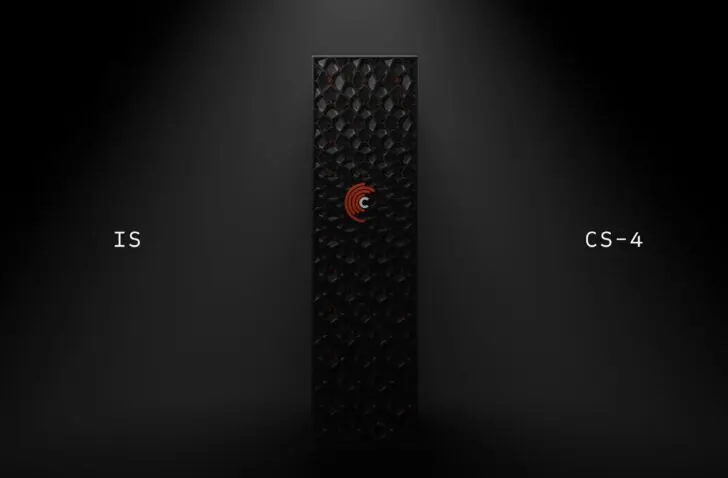
Cerebras launches the CS-4. This fourth generation of its AI accelerator system consists of three massive chips, which together form the building block for an even larger modular system.
Cerebras Systems introduces the CS-4. This is the fourth generation of its AI accelerator system, based on full-wafer chips. The massive AI accelerator does not come alone: along with the system, the manufacturer is introducing the Nexus modular rack architecture. With this, Cerebras joins a broader movement in which the entire rack takes over the role of the server.
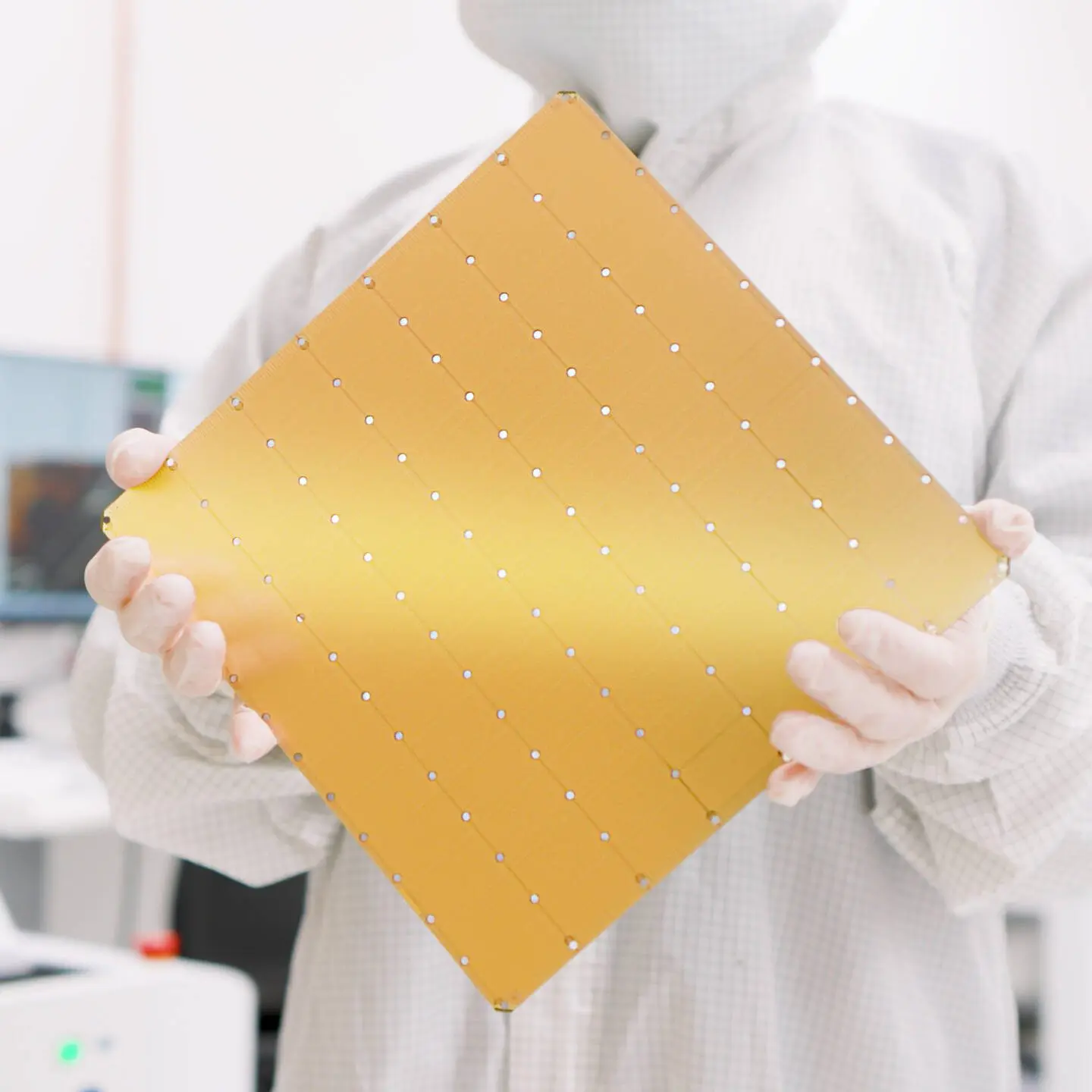
The computing power of the CS-4 comes from three linked units of the Wafer Scale Engine 3 Turbo (WSE-3 Turbo). Whereas a traditional AI accelerator is a chip cut from a wafer, Cerebras uses the entire wafer as a single processor. For the CS-4, Cerebras thus links three such massive chips together.
According to Cerebras, the WSE-3 features 900,000 cores and four trillion transistors on a surface area of 46,225 mm², providing 125 petaflops of AI computing power. The Turbo variant is not a new generation of the previously announced silicon, but a boosted version: according to Cerebras, each wafer achieves up to twice the speed of the previous generation.
More efficient power supply
This extra speed largely comes from the way the system powers the chip. Cerebras brings power conversion to within 0.5 millimeters of the processor, compared to approximately 50 millimeters for a conventional GPU. That is about a hundred times closer, eliminating board losses and allowing the system to send twice as much power to the wafer. This, in turn, allows for higher clock speeds, Cerebras explains.
A second gain lies in the communication between the wafers themselves. Cerebras reduces the latency of that wafer-to-wafer connection to two microseconds. This is relevant for large models that do not fit on a single wafer chip and must therefore be distributed across multiple WSE-3 Turbos.
The performance claims Cerebras attaches to it are substantial. The company speaks of inference that is up to thirty times faster than (unspecified) GPU systems. In its own tests, Cerebras sees processing of more than a thousand tokens per second for models of ten trillion parameters and larger, and up to ten times more tokens processed per watt compared to the CS-3.
Nexus backpack
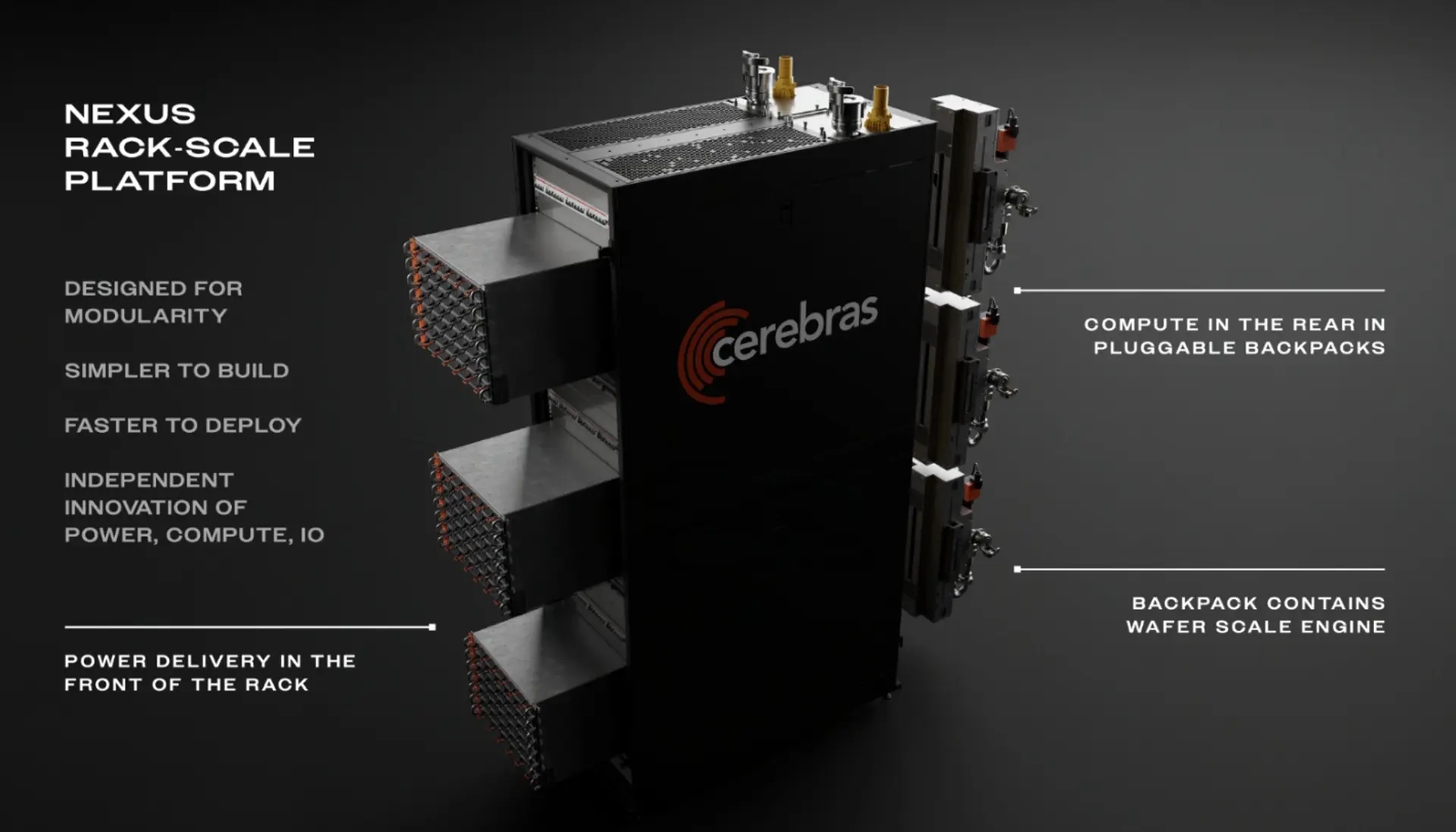
Just as striking as the chip is the packaging around it. The CS-4 is delivered within what Cerebras calls the Nexus Platform Architecture. This is a modular rack architecture consisting of three independent building blocks: compute, power, and I/O.
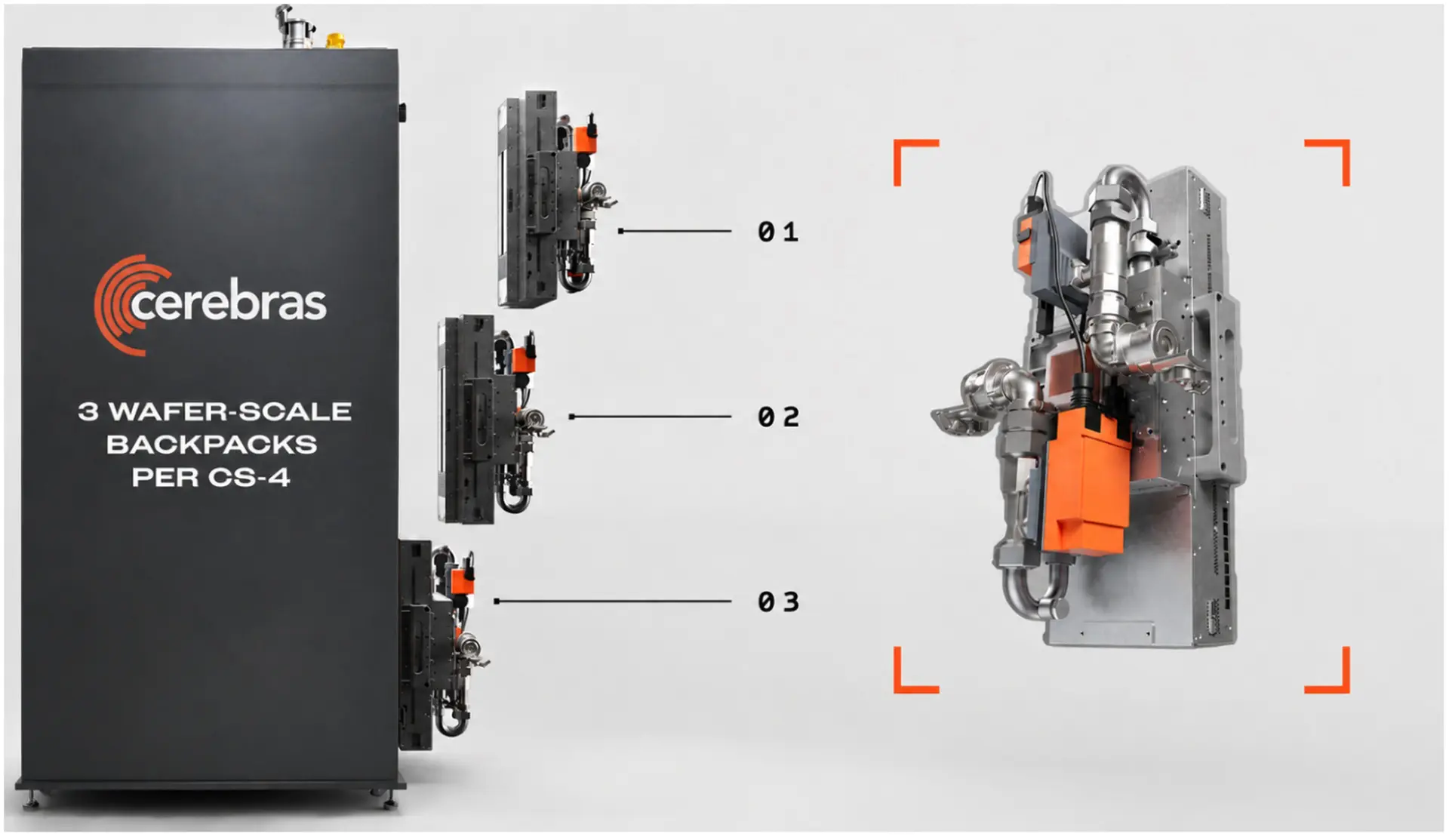
The computing section is housed in a so-called Wafer-Scale Backpack: a module that clicks vertically onto the power block at the rear and contains the power conversion, direct liquid cooling, and high-speed I/O itself.
(Relatively) fast installation
According to Cerebras, the whole consists of fifty percent fewer components than the previous generation, which simplifies production and should reduce installation time from days to hours.
This assumes that the data center where the extremely powerful installation will be located is equipped to house Nexus. Given the lack of standards regarding, for example, direct liquid cooling, this is not a given. So, expect a fast final phase of installation as the conclusion of a longer-running project.
Higher bandwidth
The I/O subsystem has also been updated and is programmable. Bandwidth doubles and latency decreases. For the connection between systems, Cerebras is focusing on two tracks: classic RoCE v2 (RDMA over Ethernet) and Direct Wafer Links, which connect systems within and between racks without a switch.
The fact that Cerebras sells a complete system instead of a separate chip is not new. As early as the CS-1 in 2019, the company delivered a ready-to-use cabinet with cooling, networking, memory, and storage. CEO Andrew Feldman summarized the logic then with an image: a Ferrari engine in a Toyota does not make a racing car. What is new is that the unit Cerebras thinks in is shifting from the cabinet to multiple racks.
Broad trend
In this, Cerebras is in good company. We previously noted that the rack takes the place of the server in AMD’s Helios: 72 Instinct MI455X GPUs, Epyc Venice processors, and Pensando network chips together form one logical system with 31 TB of shared HBM4 memory and 260 TB/s of scale-up bandwidth, with each GPU being one network hop away from every other.
“The rack becomes the new system boundary,” said AMD’s Mark Chubb. In its roadmap to 2030, AMD, by the way, promises a new rack every year, with Helios 500 in 2027 and Helios 600 in 2028.
Nvidia is doing the same. The Vera CPU and Rubin GPU were announced along with the NVL72 rack, which links 72 Rubin GPUs to 36 Vera CPUs and is expected to arrive in the second half of 2026. There, too, inference is central to communication: Nvidia speaks of a tenfold increase in throughput and a tenfold lower cost per token.
Inference as a separate market
This focus on inference is the second pattern that the CS-4 illustrates. Alongside the training infrastructure that has claimed attention in recent years, a separate category of hardware for running models is growing. OpenAI, with Broadcom, designed the Jalapeño inference accelerator, which is expected to land at data center partners on a gigawatt scale by late 2026. Google is targeting the same segment with Ironwood, and Microsoft is explicitly positioning Maia 200 as an inference chip for Azure.
Cerebras is not choosing to compete on all fronts. The CS-4 supports disaggregated inference, where the two phases of an inference task run on different hardware. GPUs or ASICs handle the prefill phase. This involves reading and processing the prompt. The CS-4 then handles the decode phase, where the answer to the prompt is generated token by token.
Cerebras explicitly mentions AMD Helios and AWS Trainium as complementary prefill platforms. Today’s competitor thus becomes a building block in the same data center. This, too, is not new: in the rapidly evolving technology world, today’s competitor is tomorrow’s partner, and vice versa.
Cerebras is taking a leap forward. The first CS-4 systems will be delivered this quarter.