


With Helios, AMD is delivering its first-ever fully proprietary rack-scale AI system: 72 Instinct MI455X GPUs, Epyc Venice processors, Pensando networking technology, and the ROCm stack in one integrated whole. The ambition is far from modest: to build the most powerful AI rack in the world, based on open standards.
“Our North Star with Helios was to build a system that utilizes the full capacity of our compute, in an open rack architecture with open standards, and that raises the bar in terms of efficiency, maintainability, and reliability. That was the team’s mission.”
This is how Andrew Dieckmann, corporate VP and GM Data Center GPU, summarizes the task AMD set for itself over a year ago. At Advancing AI 2026, the time has come: Helios is officially launched and is in production today.
Why a rack?
Traditional AI racks are essentially stacks of individual GPU servers talking to each other over a scale-out network, resulting in multiple network hops, latency, and congestion. Helios breaks with that model: the entire rack behaves as a single system. “The rack becomes the new system boundary,” says Mark Chubb, corporate VP Platform Architecture, who joined from rack builder ZT Systems.
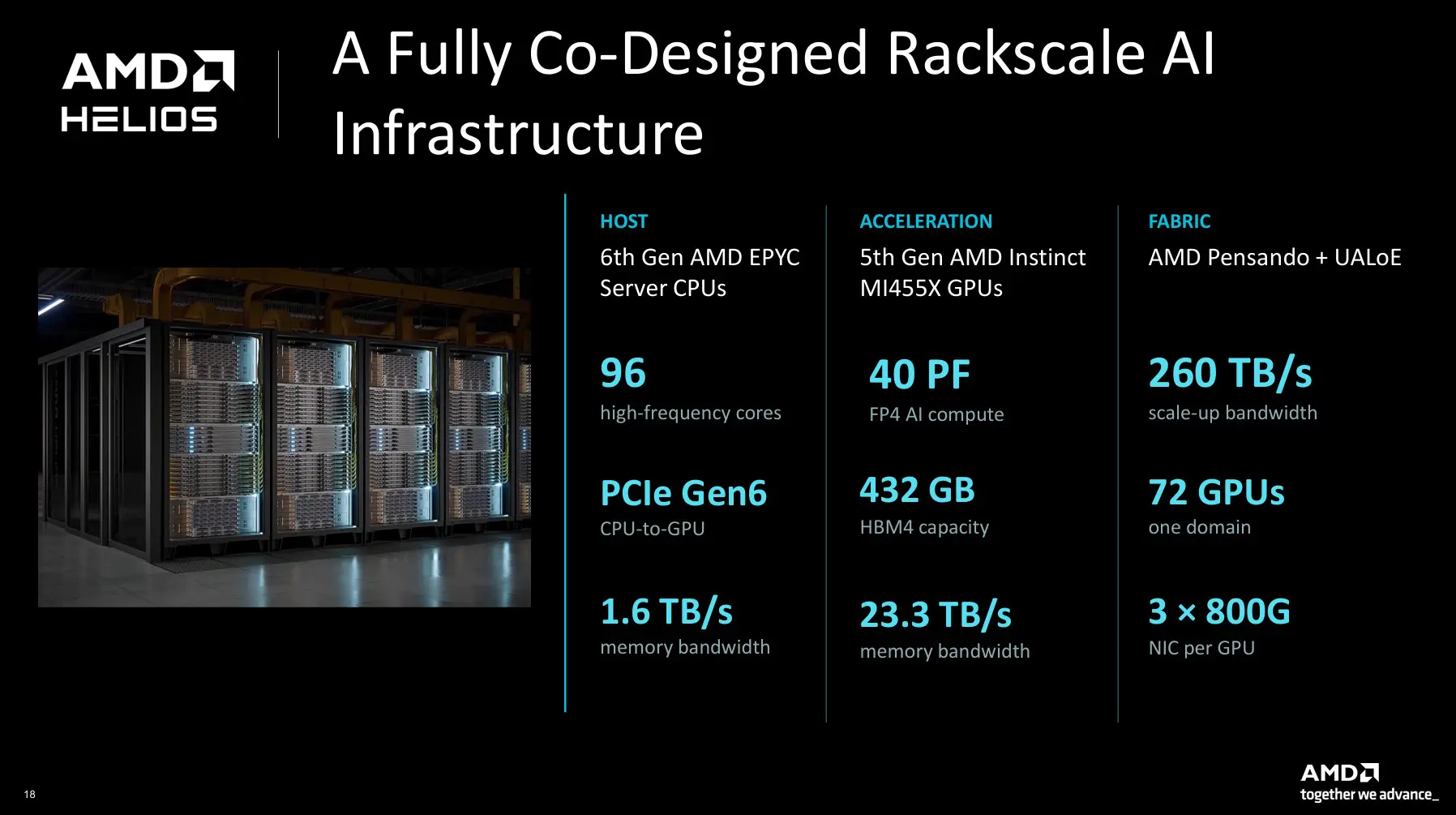
All 72 GPUs share 31 TB of HBM4 memory accessible via a single switch hop, with 260 TB/s of scale-up bandwidth. Every GPU talks to every other GPU at identical speeds, regardless of where it is in the rack, so software doesn’t have to worry about topology.
The overall figures are staggering: 2.9 exaflops of FP4 compute and 1.4 exaflops of FP8 per rack, 1.7 petabytes per second of memory bandwidth, and 43 TB/s of scale-out bandwidth to the rest of the data center.
Eighteen compute trays, six switch trays
Physically, Helios is a double-wide ORW rack (Open Rack Wide, developed with Meta) measuring 1.2 by 1.3 meters and 44OU high. It houses eighteen compute trays and six switch trays, connected at the rear via four interchangeable cassettes with all-copper cabling.

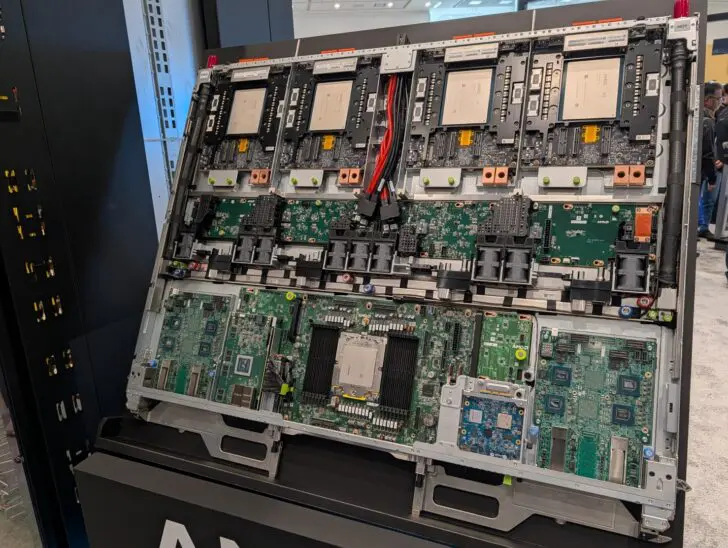
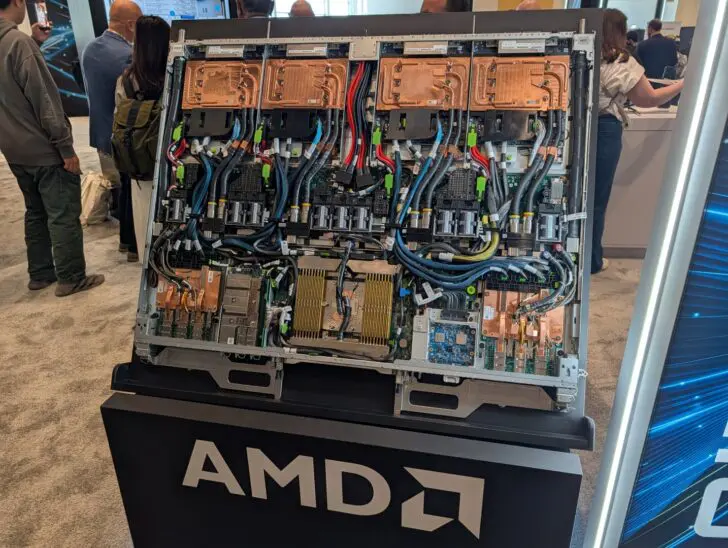
Each compute tray of just 10U contains four liquid-cooled Instinct MI455X GPUs and one Epyc Venice SP7 processor that participates directly in the memory domain via coherent Infinity Fabric connections at 256 GB/s per GPU. Such a tray weighs approximately 77 kilograms and has 576 differential connections: 120 kilograms of force is required to slide it in.
The switch tray goes even further: 1,728 connections and 310 kilograms of pushing force, hence the strikingly long handles that serve as levers. Inside are two Broadcom Tomahawk 6 switch ASICs each. Twelve switch ASICs thus connect all GPUs in a single-hop, multi-plane fabric based on UALink over Ethernet (UALoE). Notably, everything remains serviceable in-rack. Trays slide out completely for replacing DIMMs or cards, without the need for a server lift or crash cart.
Pensando ties it all together
The network is not an afterthought but a crucial part of Helios, and that’s where AMD’s Pensando division comes in. “AI scales at the speed of data transport,” says Krishna Doddapaneni, corporate VP Pensando. Three networks work together.
At the front, the Pensando Salina 400 DPU handles the front-end network: a programmable card that offloads network virtualization, firewalling, encryption, and NVMe storage services from the CPU, including a key-value interface for the increasingly important KV cache traffic of AI models. The scale-up network connects the 72 GPUs via UALoE into that single logical memory domain.

And for scale-out to thousands of GPUs, each GPU provides space for three Pensando Vulcano 800G AI NICs, together accounting for 2.4 terabits per second per GPU. In addition to standard RoCE, the programmable Vulcano also supports new transport protocols such as MRC, which AMD developed together with OpenAI.
Designed to fail
In a system of this scale, failures are not a risk but a certainty, so Helios is designed around failure. If a switch crashes or a switch tray needs to be replaced? No disaster: traffic is automatically rerouted and the training job continues with temporarily slightly less bandwidth, instead of failing.

Management is also redundant: the AMD Fabric Manager runs in triplicate on the computing power of the switch trays themselves, so that even the failure of a management instance does not affect the fabric. Furthermore, an operator can use virtual pods to divide the rack into isolated sub-clusters per tenant: if one pod crashes, the others won’t notice. The network control runs on the open-source SONiC, and everything AMD adds is upstreamed.
Customers are lining up
The strongest indicator is the customers. OpenAI signed a multi-year, six-gigawatt deal last fall, Meta followed in February with an equally large agreement regarding custom GPUs, and Microsoft announced a large-scale Helios rollout on Azure earlier this week.
At the event itself, a multi-gigawatt agreement with Anthropic is added to that, including a long-term technical collaboration. Together with Oracle and a series of neoclouds, AMD expects to roll out several gigawatts of Helios infrastructure over the coming year.

And CUDA, the eternal stumbling block? Dieckmann brushes it aside: “I used to talk to customers about CUDA regularly. Today, I have almost no conversations about it anymore. It’s a non-event. Everyone is programming at higher levels of abstraction, and AI agents help customers optimize for our platform. Software obstacles are much easier to overcome than they were a few years ago.”
When asked about the supply chain—no small detail for a system with so many components—Dieckmann replies that AMD is taking charge itself: “We don’t sell Helios as an AMD system, but we work with the entire ecosystem to ensure that all parts are available in the right quantities, at the right time, and with the right quality. We’ve been working on that for many, many months.”
Against Vera Rubin
AMD is positioning Helios head-to-head against Nvidia’s upcoming Vera Rubin NVL72, claiming 15 percent more FP4 compute, 50 percent more HBM memory, 50 percent more scale-out bandwidth, and up to 30 percent more tokens per euro.
Some nuance is appropriate here. Vera Rubin was announced at CES and, like Helios, will appear in the second half of the year: AMD is therefore comparing its measurements and models with the published specifications of a rack that is also not yet running at customer sites, while Nvidia, for its part, promises five times the inference performance of Blackwell and ten times lower token costs.
And despite Dieckmann’s “non-event”: the bulk of AI tooling and developers still live in the CUDA ecosystem, and Nvidia is sliding its new rack into a customer base that is already running on Blackwell en masse today. The burden of proof lies with the challenger.
The trend is nonetheless clear: for the first time, AMD is putting forward a complete rack that, on paper, is no less capable, with the Instinct MI455X as the engine, Epyc Venice as the conductor, and an open ecosystem as a selling point. The gigawatt signatures from OpenAI, Meta, Anthropic, and Microsoft show that the largest buyers believe in that story, if only to no longer be dependent on a single supplier.
In the second half of the year, Helios must prove in real data centers that paper specifications also translate into running tokens. Only then will we know if AMD’s rack is a full-fledged alternative, or primarily an excellent bargaining chip toward Nvidia.