


Last year, Gaia-X launched a second season for itself. Today, the focus is on attracting more viewers. Simplicity is crucial: the focus is shifting from a technical story to one in which the technology should become less visible.
Gaia-X launched its second season last year at the annual Summit in Porto. The first season ran from the founding of the international nonprofit Gaia-X in 2021 until then. In the glittering halls of the Gartenpalais Liechtenstein, we should therefore not expect a season 3. Still, there are some novelties to see: not only is the focus of the season changing, the lead role is being recast as well.
CEO Ulrich Ahle will retire at the end of 2026 after three years of service, and will be succeeded by Jérôme Léger. Léger earned his stripes as Head of Architecture & Design Authorities at the Crédit Agricole Group in France.
Changes to the script
Next to the imposing presence of Ahle, Léger looks somewhat more timid on the conference stage. Appearances can only be deceiving, though: Léger does not shy away from questioning the script for season 2 and focusing it more on what the audience wants.
At the end of his tenure, Ahle lists the successes. They are not insignificant. Under his leadership, Gaia-X has developed an architecture for sovereign ecosystems, based on a federated cloud architecture. That architecture now includes all the necessary building blocks, and they are actively used in a handful of projects.
Not simple enough
“But is everything already at the level the industry demands?”, he wonders aloud. “Is enough automated? Can you join a data space as easily as visiting a website? The answer is no.”
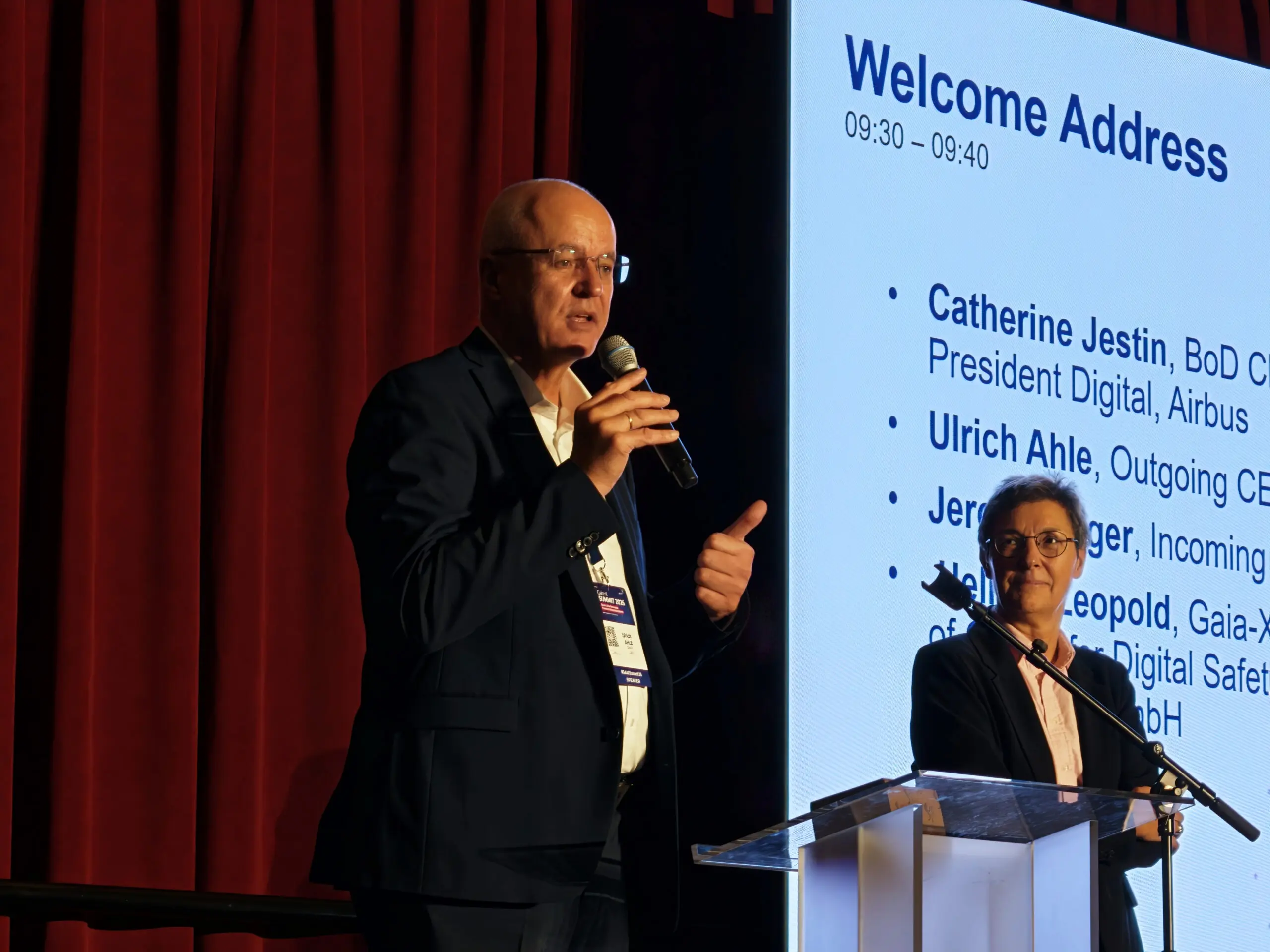
Léger does not make the transition easy for himself, and immediately opts for tight deadlines. By the 2027 Summit, that answer must be yes. The architecture is in place; now the building blocks must become enterprise-grade and then fade into the background. Simplicity takes priority. “It has to become easier to onboard SMEs.”
“The fundamental technical problem of sovereign data sharing has been solved”, adds CTO Christophe Strnadl. “As a CTO, I’m always happy when we talk about the technical side, but I’ll also be happy when we stop doing so altogether, and the technical layer simply runs in the background as a matter of course.”
No Gaia-X without data spaces
The whole concept of Gaia-X stands or falls with its participants. Even large ongoing projects, such as Data4Nuclear from France’s EDF and the data space of Airbus. In these two cases, a large player is leading the way. It wants to bring its suppliers together in a data space, where everyone can share data sovereignly, in a controlled manner and with trust, without that data being dumped into a general data lake. That is the whole point of Gaia-X: share, but remain the owner.
However, the whole network of suppliers consists of large and, above all, small players. Véronique Lacour, Group Senior Executive Vice-President, Transformation and Operational Effectiveness, EDF, makes the problem concrete. “We want to build six new nuclear reactors in 70 months. Through Data4Nuclear, we want to share data securely between all participants. Of the 2,000 companies in the nuclear sector in the EU, however, 1,600 are SMEs.”
Attention for SMEs
If such an SME has to hire a data specialist to take part in a data space, it will not be keen to do so, and the whole data project will keep sputtering on the starting line. Three clicks should be enough for a smaller company to join a data space, but that is not yet the case today.
“We have the technology, we have the people and we have the capabilities”, stresses Catherine Jestin, Chair of the Board of Gaia-X and also Executive Vice President Digital at Airbus. “Now it is time to deliver.”
We have the technology, we have the people and we have the capabilities.
Catherine Jestin, Chair of the Board of Gaia-X
That sounds good, but also a bit like a rerun of an earlier Gaia-X episode. Last year, the core message was that the technology was ready and it was time to scale up. Today, that does not yet seem to have fully succeeded.
Concrete objectives.
Enter Léger, who imposes a roadmap with a few tight deadlines on himself. “Spring, Summer, Summit”: one year, three milestones. By next year, Gaia-X must be ready not only for SMEs, but also for AI.

Léger calls his plan 48N, after the 48 degrees north latitude of Vienna and the 48 weeks Gaia-X gives itself until the next Summit. To get there, Gaia-X must move from broad ambitions to focus, from papers to products and from working groups to a community that builds along.
3 promises and a question
Léger repeats what he heard from members and advisory boards: what Gaia-X offers today is not yet a product and remains too complicated to implement, to use and to earn money from. “The industry needs a solution, and it will get one.” He splits his plan into three promises: Connect, Rely, Prove. To these he adds one question: Engage.
The first promise, Connect, is a new open source connector based on the Gaia-X principles. It must work with the connectors that data spaces already use today, and let new participants join quickly thanks to an automatic check on Gaia-X compliance. Members get early access in April, a first release follows in June and by the Summit of November 2027 the connector must be running in live data spaces.
Léger compares it to the step from HTTP to HTTPS: Gaia-X wants to build a hyper trust transfer protocol that exchanges data securely and sovereignly. According to Strnadl, access to data spaces as a service, with a connector that an SME can have hosted by a service provider of its choice, must be operational in the first quarter. Onboarding for the trust layer then takes five minutes, if you have all the information at hand.
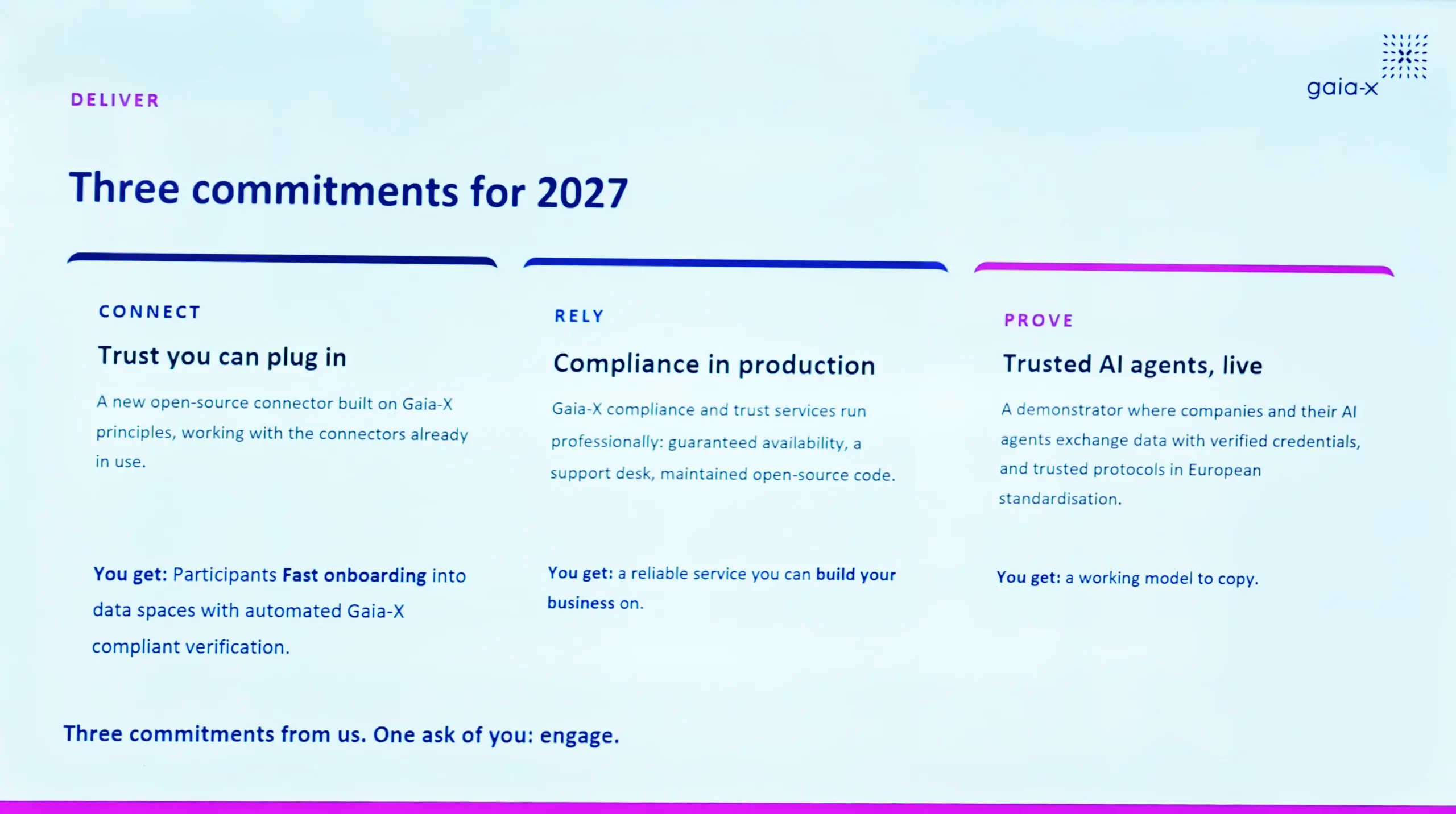
The second promise, Rely, centres on the compliance and trust services of Gaia-X. They must run professionally, with guaranteed availability, a support desk and maintained open source code. Large enterprises ask for this, according to Ahle and Léger. The service level and the open source strategy must be settled in April. By the general assembly in June, the support desk is live, and at the Summit European providers run the compliance services at production level.
Trust for AI agents
With Prove, Gaia-X wants to show that AI agents from different companies can exchange data using verified credentials. The demonstrator must be ready in April. At the 2027 Summit, AI agents must exchange data live on stage.
According to Léger, the hardest part lies in the contracts. An agent must first be identified and certified. If that agent makes a decision that leads to a dispute, it must be clear on the basis of which contract it did so. Without that contract layer, he says, companies will not share sensitive data via agents.
A fourth track, Engage, must have the ecosystems bring their participants to the Gaia-X organisation as members by summer. For that, Gaia-X looks to the participants themselves.
In search of figures
These are concrete goals that Gaia-X wants to stick to, and that we can confront the organisation with in a year. It is just a bit of a pity that we can see so little visible progress compared with last year. There is progress, but mostly behind the scenes. And clear figures to illustrate the growth of Gaia-X adoption are missing.
Léger admits that Gaia-X currently has no overview of its own impact. There is no map showing, per data space, whether it relies on the principles, the architecture or the components of Gaia-X, how many participants there are and how mature the project is. He wants to have that map made. Data spaces that say they run on Gaia-X will be asked how many participants they have, and how many of those are large companies, SMEs or non-profit organisations.
With those figures, Léger wants to measure whether adoption is rising or falling. He does not rule out that some data spaces will disappear. According to him, a data space without a business model does not get off the ground and then vanishes from the map, even if the architecture or the building blocks of Gaia-X are not to blame. In addition, indicators from its own compliance services must show where the solutions can be improved.
From cult classic to hype
By 2027, Gaia-X must be widely available. The season moves, so to speak, from HBO Max to Netflix, where it has to be more accessible to a large audience. From then on, according to the new CEO, a network effect can emerge.
“The more participants there are and the better the rules for sharing data and creating value are defined, the more participants will join”, says Léger. “The first come for the functionality. The others join because they don’t want to be left on the sidelines.” The key to all of this: an SME that can jump into the pool without hassle.