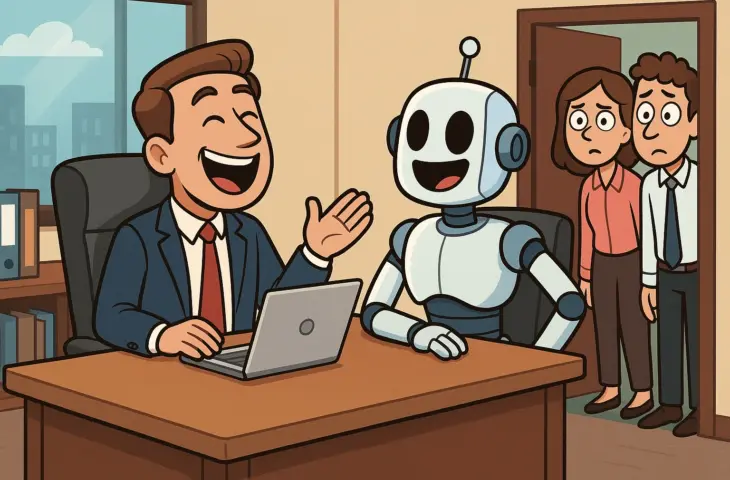
AI is receiving increasing attention in Belgian companies, but according to research by SAP and iO, the policy often does not align with what employees experience in the workplace. This leads to fragmented applications and increased risks.
Belgian organizations are investing in AI, but the impact remains limited as long as strategy and execution are not aligned. Research by SAP Belgium and research agency iO shows that there is a striking difference between how managers and employees experience AI within their organization. For example, 45 percent of managers consider themselves to be pioneers in AI policy, while only 18 percent of employees share that view.
Difference in Perception
The SAP and iO study highlights the discrepancy between managers and employees in terms of AI. 39 percent of employees believe that their organization is lagging behind with AI and urgently needs to catch up, while 45 percent of managers see themselves as pioneers in the field of AI.
These differences in perception have consequences for how AI is used effectively, safely and strategically in business processes. In many cases, its use remains limited to isolated initiatives or public tools such as ChatGPT, often out of sight of IT or compliance departments.
Training and Guidance
Opinions also differ with regard to training and guidance. While 41 percent of managers indicate that there is sufficient support, only 16 percent of employees recognize this. In addition, 31 percent of employees say that their organization does not have a clear AI strategy, compared to only 8 percent of managers.
Data Quality and Security
The research also shows shared concerns, including about privacy, liability and transparency. Both managers and employees are concerned about the reliability of AI results. According to them, one of the causes is the low quality of company data. Information is often fragmented across multiple systems, leading to incomplete or inconsistent insights.
In addition, four in ten managers fear that employees will enter sensitive company information into unapproved AI tools, which increases the risk of data leaks. Clear guidelines and the integration of AI into existing, secure systems should prevent this.
read also
What happens when an AI model has no security?
“AI brings enormous opportunities, but we must not underestimate the preconditions,” says Stijn De Beuckelaer, Managing Director at SAP BeLux. “Clear agreements, reliable data and transparency in the operation of AI are crucial. Those who invest in this will not only work more efficiently, but also with more confidence, at every level in the organization.”
The research was carried out by iO on behalf of SAP Belgium and surveyed 500 Belgian managers and 500 employees about their attitude towards the use of AI in business processes.