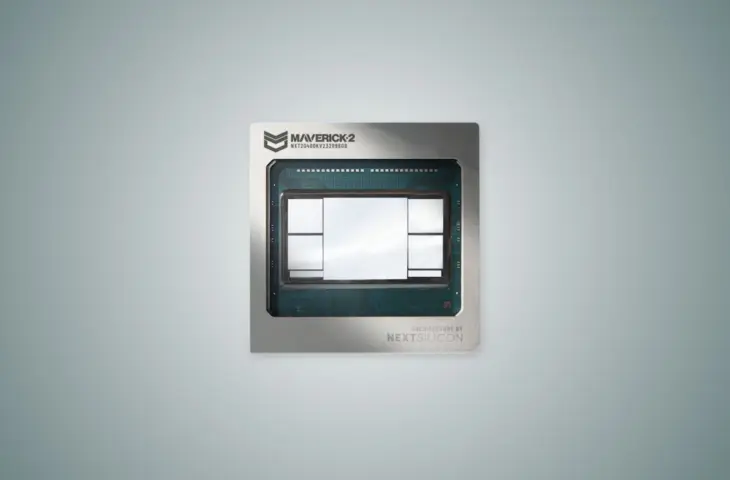
NextSilicon is launching the Maverick-2 chip. It is said to perform up to ten times better than existing GPUs, consume less energy, and can execute existing code without optimizations.
NextSilicon is launching the Maverick-2 processor. The chip is based on a dataflow architecture that automatically adapts to different types of software. As a result, according to the makers, the chip can deliver high performance, regardless of the software stack used.
The chip can handle existing code — such as for CUDA or Fortran — without the need for recoding or optimization. This lowers the barrier to implementation. The chip is currently being used by various organizations, including Sandia National Laboratories in the United States, where it is part of the Vanguard-II supercomputer.
NextSilicon also announced benchmarks that support the performance of Maverick-2. According to NextSilicon, the chip is up to ten times faster than common GPUs in complex algorithmic workloads. At the same time, it consumes up to 60 percent less power.
Risc-V core
In addition to Maverick-2, NextSilicon also introduced a new RISC-V core: Arbel. It was designed for TSMC’s 5nm process and aims for performance that competes with processors from Intel and AMD. Arbel is intended for data center applications and fits within NextSilicon’s strategy to offer both integrated solutions and a broader architecture.
The architecture of Maverick-2 is intended for data-intensive and computationally demanding applications such as AI models, scientific simulations, and analysis of unstructured data. NextSilicon wants to directly compete with Nvidia with the Maverick-2.
NextSilicon is not the only one challenging Nvidia’s dominance. It was recently announced
The biggest advantage of NextSilicon with Maverick-2 is that organizations do not have to rewrite their existing code. The chip will be available in volume in the fourth quarter of 2025.