

The German government is forcing Apple to adjust its notifications regarding data collection. Currently, Apple uses two designs, favoring itself.
Apple is going to adjust the notifications regarding data collection in iOS. The company is being forced to do so by the German government. The Bundeskartellamt found that Apple applies double standards for such notifications, consistently favoring itself.
The nice version…
Apple consistently warns users when a service or application will track the user or keep data. A prompt then gives the user the option to allow or reject that data collection. In principle, this is a good thing.
However, Apple has developed the prompt for its own services with a neutral design and positive language. The notification about, for example, personalized ads reads like a fair notice, highlighting the benefits of such ads. Apple states, for instance, that they help users discover relevant services. At the bottom, there are two equal buttons, with the option to enable them at the top.
…and the dangerous variant
When a third-party application or service tries to do exactly the same thing, the notification looks completely different. The design of the prompt suddenly becomes that of a warning. Instead of white and blue, orange appears, suggesting danger.
The text in the notification always comes from Apple, and not from the party seeking permission. The notification is short and more negative. It only states that an external company wants to track the user’s activity, without the positive framing that Apple provides for itself.
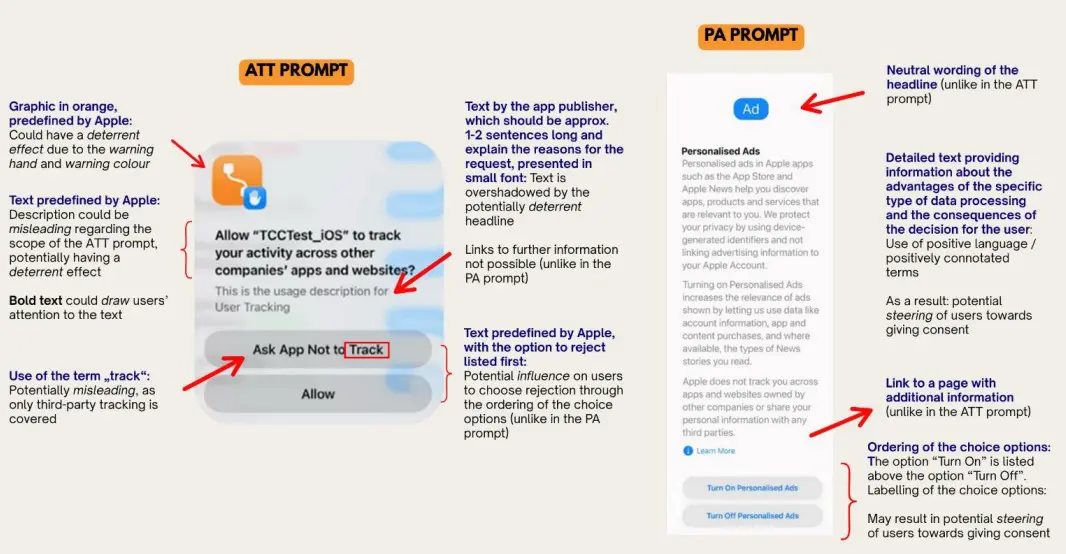
Finally, the top button is one that misleadingly indicates rejecting permission as the preferred option. The German Bundeskartellamt found that the prompt aims to steer users toward rejecting permission.
Mandatory adjustment
Apple has four months to adjust the prompt. The existing warning must be reworked into a request for permission that aligns with what Apple uses for itself. The adjustment will roll out to iOS users in European countries.
The case demonstrates how large (American) technology companies still try to cut corners in various ways despite stricter regulations. Promoting their own services remains high on the agenda. In Apple’s case, this always happens in the self-proclaimed name of privacy, where Apple presents itself as completely kosher, and third-party applications and services as security risks.