

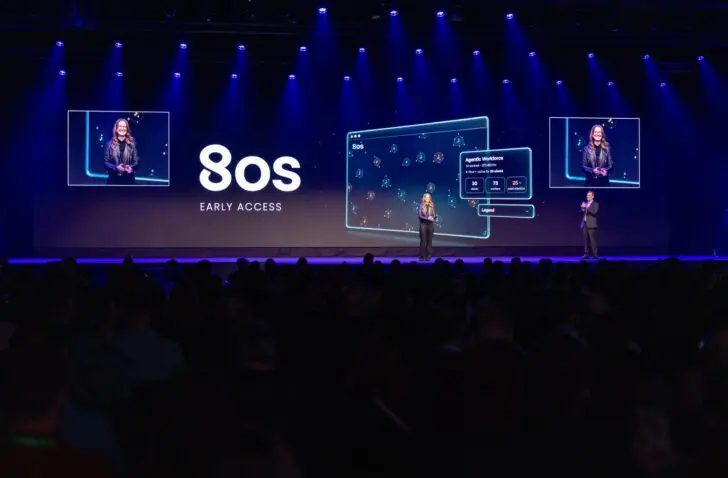
At Beyond EMEA in Copenhagen, Pax8 admitted that not every MSP will become an AI consultant. With 8bot and 8os, Pax8 is therefore providing them with an AI colleague and a platform that can roll out and bill per customer.
A year ago, Pax8 challenged its partners to lead the AI transformation for SMBs. Scott Chasin, CEO of Pax8, revisited this during his keynote in Copenhagen. “One year later, we have learned something important. AI transformation is difficult. It requires a completely new set of skills. Not every MSP becomes a business consultant or a process or automation engineer, and building those skills takes time.”
Avery Moon, CTO of Pax8 since January, provided the figures a day later. According to him, barely three percent of IT service providers are currently selling AI to customers, and 55 percent of those building AI solutions never actually sell them. According to Pax8, these figures come from their own SMB AI Pulse research.
Three pricing models for one task
According to Chasin, part of the problem lies in how AI is charged. A language model bills in tokens for what it reads, reasons, and writes. An AI agent that calls tools and uses APIs also consumes credits. Voice models that replace PBX menus cost per minute. “Tokens, credits, minutes: different inputs, different prices,” says Chasin. “One unit of work from an AI agent, with three different cost structures.”
For the SMB, this makes the invoice unpredictable. In the Q3 report, a survey of 1,150 SMB leaders in the US, UK, Germany, and Sweden, 49 percent of SMBs paying for AI had already received at least one invoice that was higher than expected. In Sweden, that figure was 65 percent. American SMBs often pay through several models simultaneously: by consumption (46%), via a fixed subscription (41%), and per user (40%).
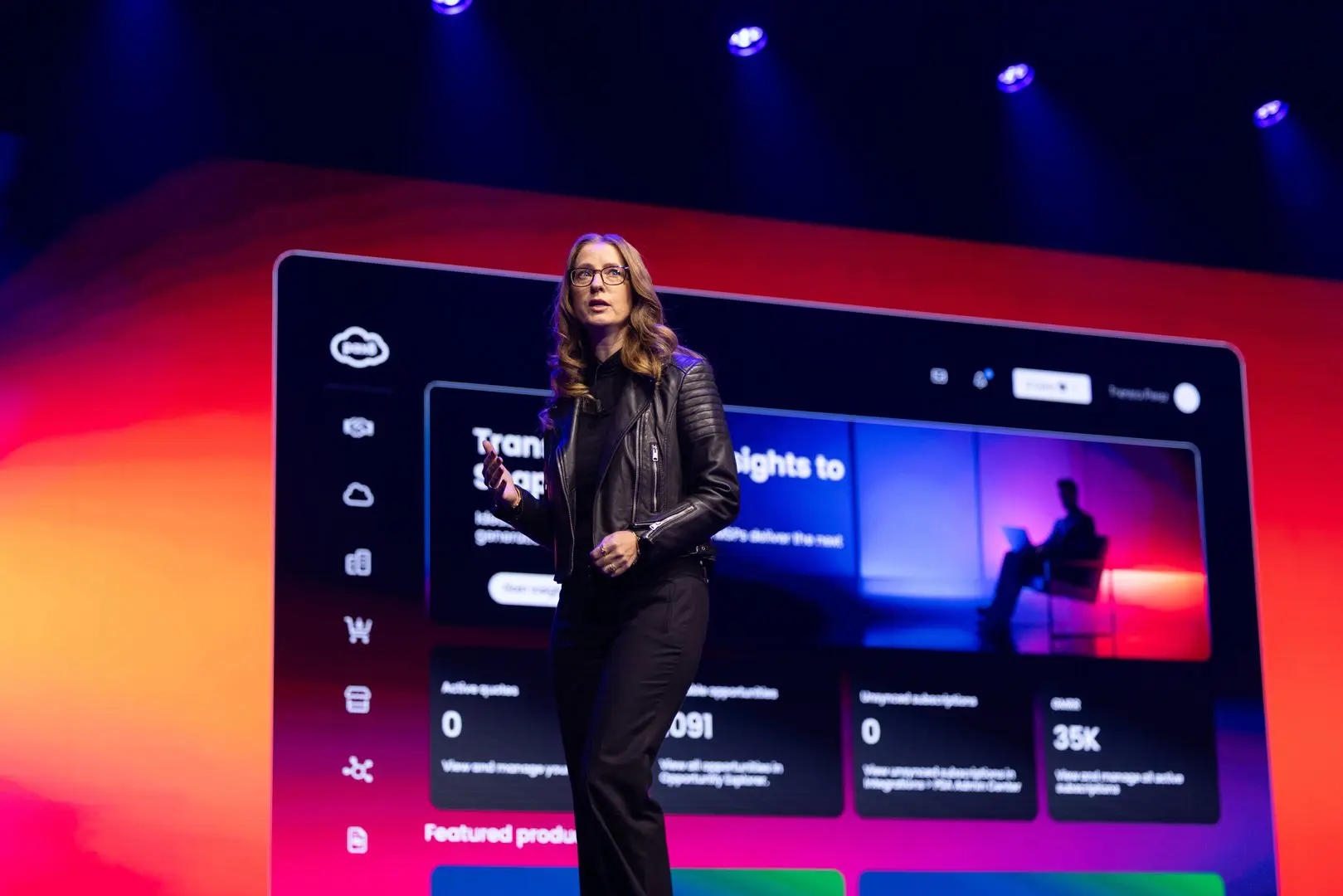
SMBs that rely on an MSP or a vendor for AI have more confidence in their measurement of what AI delivers, according to the report. However, they also receive unexpected invoices more frequently.
Marc Groetelaars, SVP Sales and Marketing Europe at Pax8, is meanwhile seeing customers source their AI elsewhere. He tells of a partner with a well-known name in his region who had completely rewritten his website and marketing around AI. One of his regular customers bought AI capacity and expertise from another MSP. When the partner called to ask why, the customer replied: “I didn’t know.”
According to Groetelaars, MSPs are still providing what SMBs need, from cloud services and security to continuity, compliance, and systems management. “We believe that traditional managed services are no longer distinctive enough,” he says.
Pax8 8bot as a ready-made service
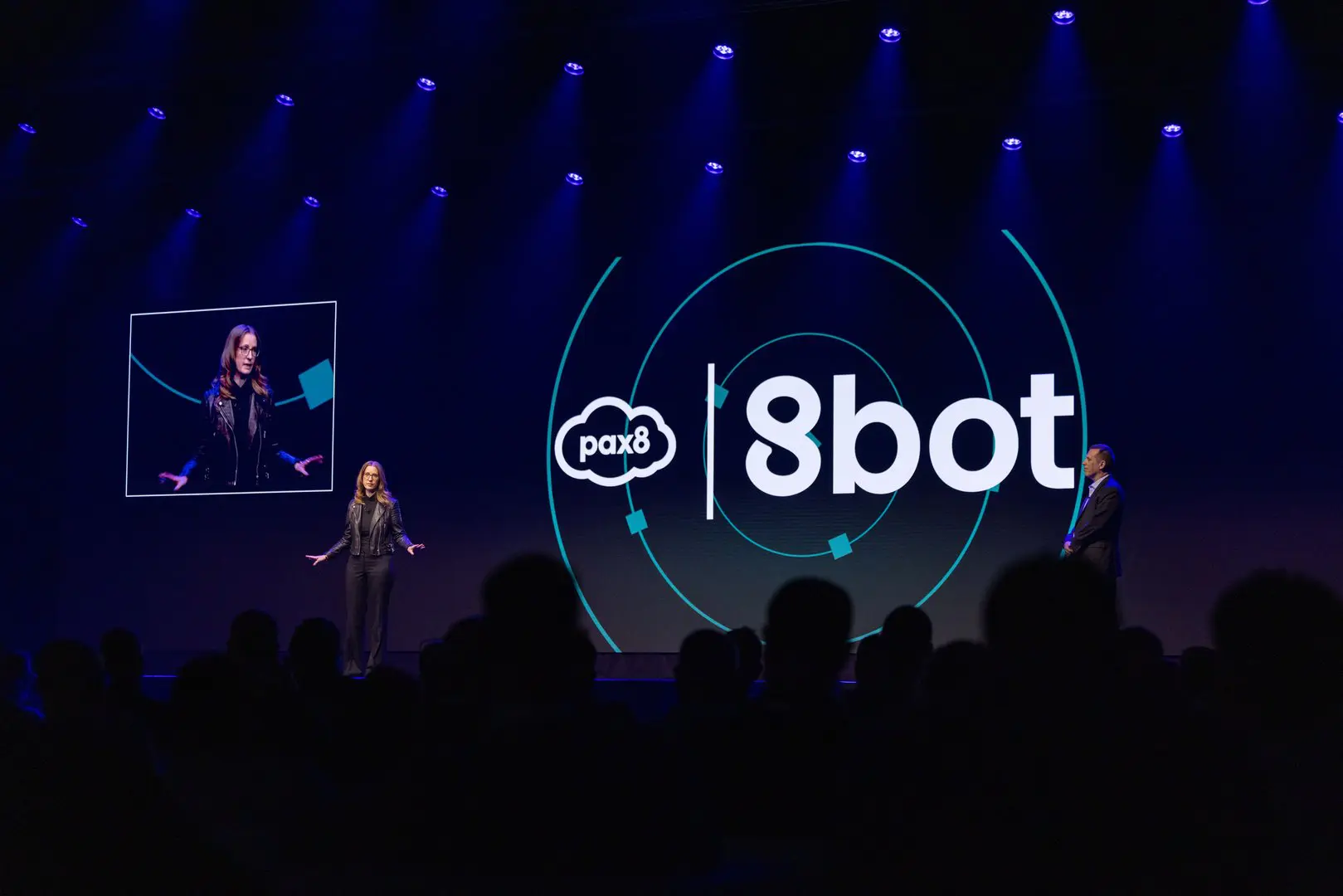
As an alternative, Chasin introduced 8bot in the same keynote, an AI colleague that the MSP rolls out for every employee of a customer. “Last year, we asked you to lead the AI transformation. Today, we are giving you a repeatable way to deliver it.” According to Pax8, deployment takes two minutes, and the MSP can offer 8bot under its own brand.
8bot connects to the employee’s email, calendar, Teams, and Slack. It keeps track of pending actions, writes first drafts of emails and quotes, flags what is at risk of being neglected, and filters what the employee needs to see that day. These are the four functions that SMBs in the Pulse survey most frequently chose for an always-on AI assistant. Shared bots for an entire team will follow later.
Libby McIlhany, Chief Product Officer at Pax8, demonstrated this on stage with Cortex IT, a fictional MSP with twelve employees and 80 customers. The MSP selects a customer, assigns 8bot to a user, and sends an invitation. “No IT project, no implementation cost,” McIlhany said. In 8os, the MSP can see per customer which AI agents are running, what they cost against the budget, and which customers have reached their ceiling.
8os runs underneath 8bot, the platform that Moon says also includes the Agent Gateway Pax8 introduced in June. In addition to 8bot, it manages other AI agents belonging to the customer. By default, 8bot runs primarily on Together AI models, supplemented by Amazon Bedrock. Automatic routing selects the appropriate model for each query. An MSP can also bring their own models and keys. On stage, Moon described 8os as the way to turn AI into “a service you can bill every time and at scale.”
This choice per task should also reduce costs. “It’s a very simple task, I might not need a frontier model for that,” says Groetelaars. “So I want to optimize those costs.”
Base plus ceiling
The cost of 8bot has not yet been finalized. Moon: “We believe a predictable price is important. There must be a fixed price for which you get a known amount of consumption. At the same time, you must be able to go above that, up to a ceiling.” Whether that will be per user or per consumption is still being considered by Pax8. 8os also works without 8bot, but 8bot only works with 8os. The testing phase will also determine whether 8bot will be charged separately.
If a customer reaches their ceiling in the middle of a task, 8bot pauses. “You don’t lose anything you’ve already done,” says Moon. The MSP receives a notification in advance when a customer is approaching their ceiling and can increase the budget.
According to the Pulse survey, 69 percent of SMBs would be more likely to expand AI if they could pay per result at a comparable cost. Moon cited that figure on stage as an opportunity for the MSP.
For many MSPs, Microsoft remains the foundation of their business. Nick Heddy, President and Chief Commerce Officer of Pax8, asked the audience who had already sold at least one Copilot license to a customer. “Selling a Copilot license and managing a staff of AI agents for your customers are two very different conversations.” Moon sees 8bot as a supplement to Copilot. “If a customer finds that Copilot works well, fine. Let’s make it part of the ecosystem.”
According to Groetelaars, the major AI providers are primarily chasing large enterprises. “There is no one serving the channel,” he says, in a way that allows an MSP to manage the agents of all its customers. Pax8 itself announced in June that it would sell Microsoft Agent 365 via its Agent Store starting in July, to manage AI agents across multiple customers.
From service desk to big four conversations
Groetelaars expects conversations with customers to change. A salesperson familiar with the ticketing system and the service desk must now talk about strategy, profitability, and cost control. “Those are big four conversations. We as a channel can have those now.” Moon says the same: a partner must increasingly understand the business their customer is in and how their processes run.
To initiate these conversations, Pax8 is deploying its own agent, the Transformation Discovery Assessment Agent. It surveys the customer’s employees about their processes and creates a roadmap with priorities. According to Groetelaars, this might reveal that a process simply needs to be automated without AI, or can be eliminated entirely. “AI doesn’t always have to be the solution.”
Groetelaars saw the transition from reseller to MSP up close. “That took some time. It meant that some people made it and some didn’t, and there was some consolidation. It’s quite possible that this will happen again.” Partners are now asking him: “Can I do this with my current people? Can I do this with my current company?”
The Dutch MSP Uniprofs opted for a separate business unit. Founder and owner Heine Stuivenberg decided after Beyond in Amsterdam in late 2025 to launch a new department for managed intelligence on January 1, 2026. An internal candidate has since been leading the regular MSP activities. Uniprofs built a chat agent that answers licensing questions, is working on a self-service portal for customers, and wants to automate invoice reconciliation.
Testing until the end of November
Partners at Beyond EMEA are getting early access to 8os and 8bot this week. Those who weren’t there can join a waiting list. Pax8 will admit new partners until Q4. According to Groetelaars, partners will test until the end of November and provide feedback via a button in the platform.
For general availability, which Pax8 plans for early 2027, it has not yet been determined what the MSP will charge its customer and what Pax8 itself will receive from that. Pax8 is still working out with its partners who owns the memory that 8bot builds up per customer. Pax8 intends to answer these questions using feedback from the testing round.