

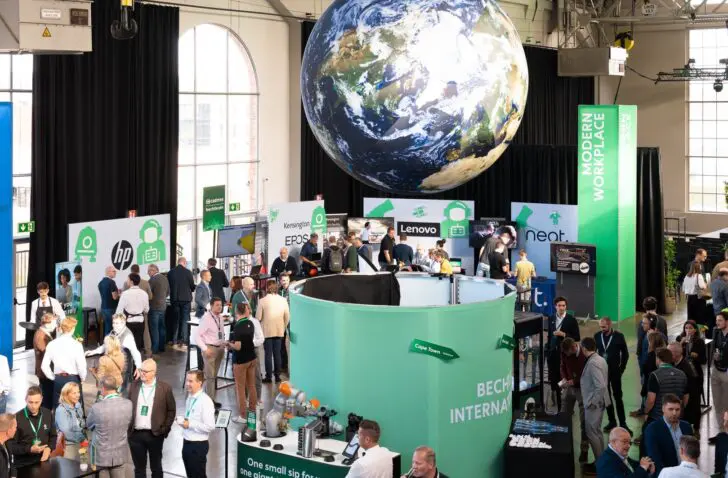
Jeroen Baert and Luka Kokot both cited the same figure at the Bechtle Summit: 95 percent of AI pilots stall at the demo stage. Closing speaker Kokot shows how the other five percent works, using AI agents at the service desk and elephants at the watering hole.
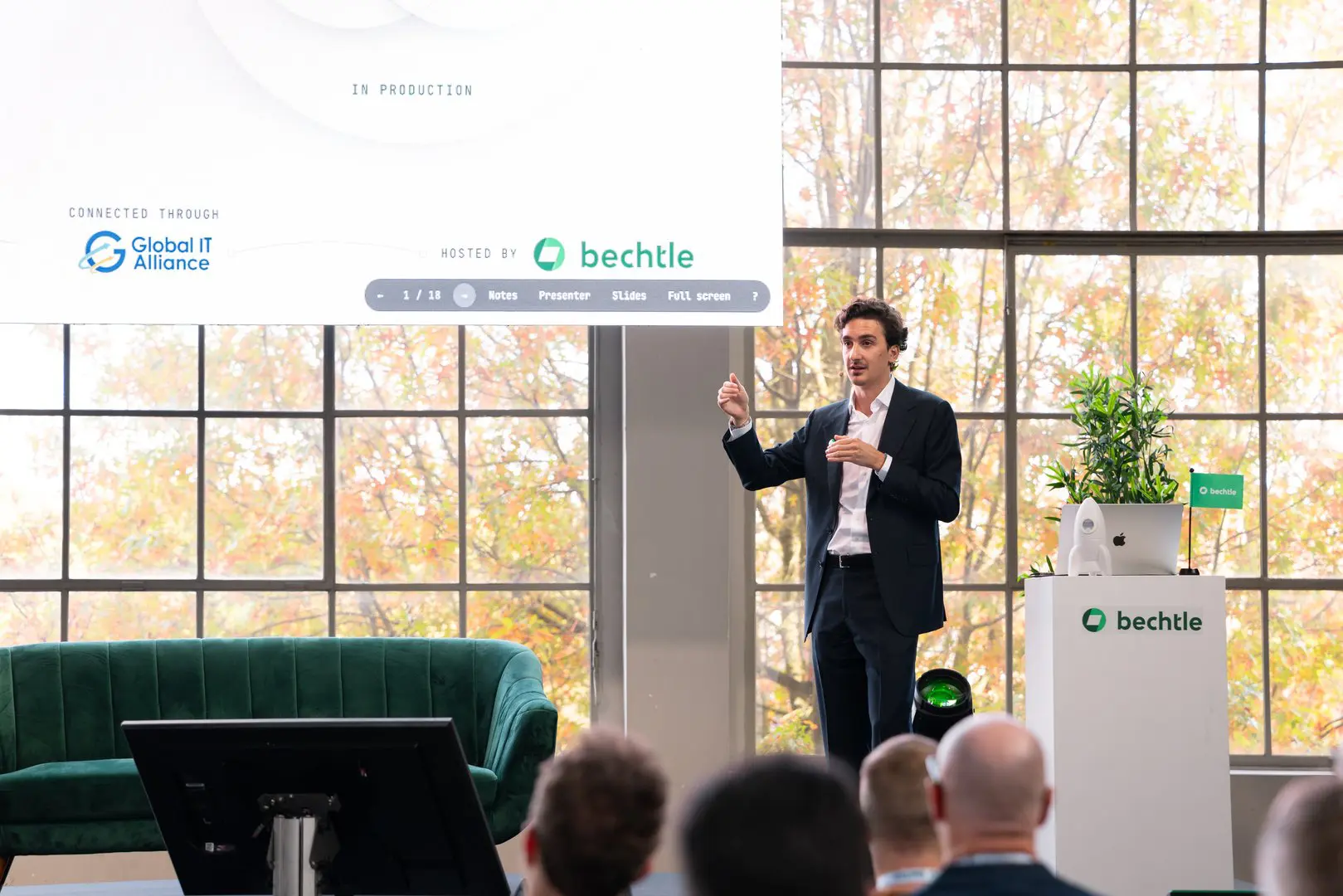
Luka Kokot hasn’t even shown his first slide before referring to the man who opened the day. “You have seen this statistic earlier today,” says the director of BroadVision Technologies on stage at the Bechtle Summit in Heusden-Zolder. The screen displays 95 percent—the share of organizations that attempt to roll out AI and never get past a demo. “Why that is the case is the reason we exist. And the gentleman from earlier, Jeroen, identified those reasons very well.”
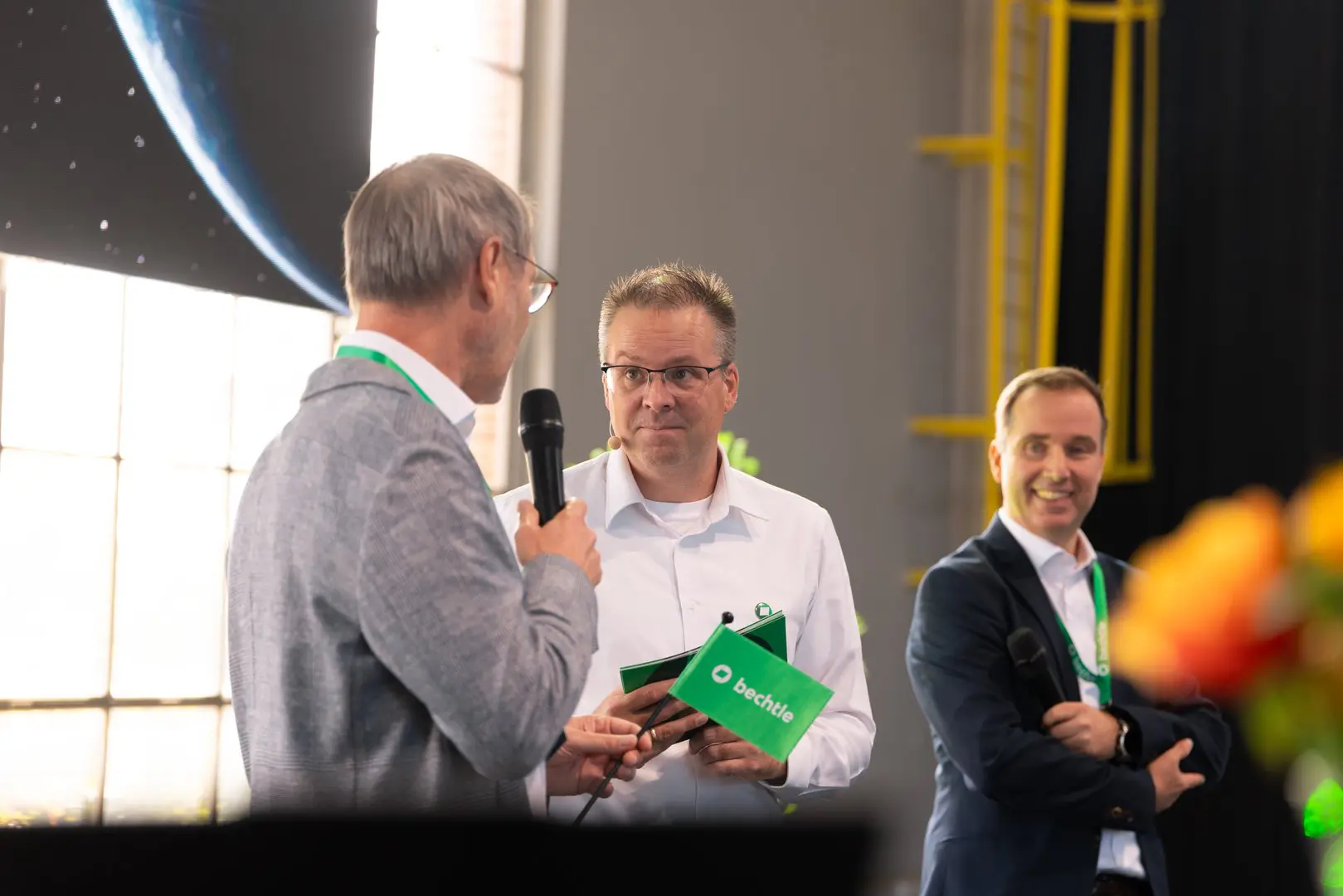
The day opened with a flag ceremony where Gozard Polak, thirteen years and one week at Bechtle, handed over the flag to Dimitri Buyse, who took over the leadership of Bechtle Belgium two weeks earlier. “Last year we landed on the moon; the next mission is to Mars,” says Polak. Buyse, who comes from 9altitudes, sticks to listening. “I am taking the time to listen and learn, to see what the ambitions and challenges are.” His first summit has 111 registered participants, mostly IT managers.
Longer emails with Copilot
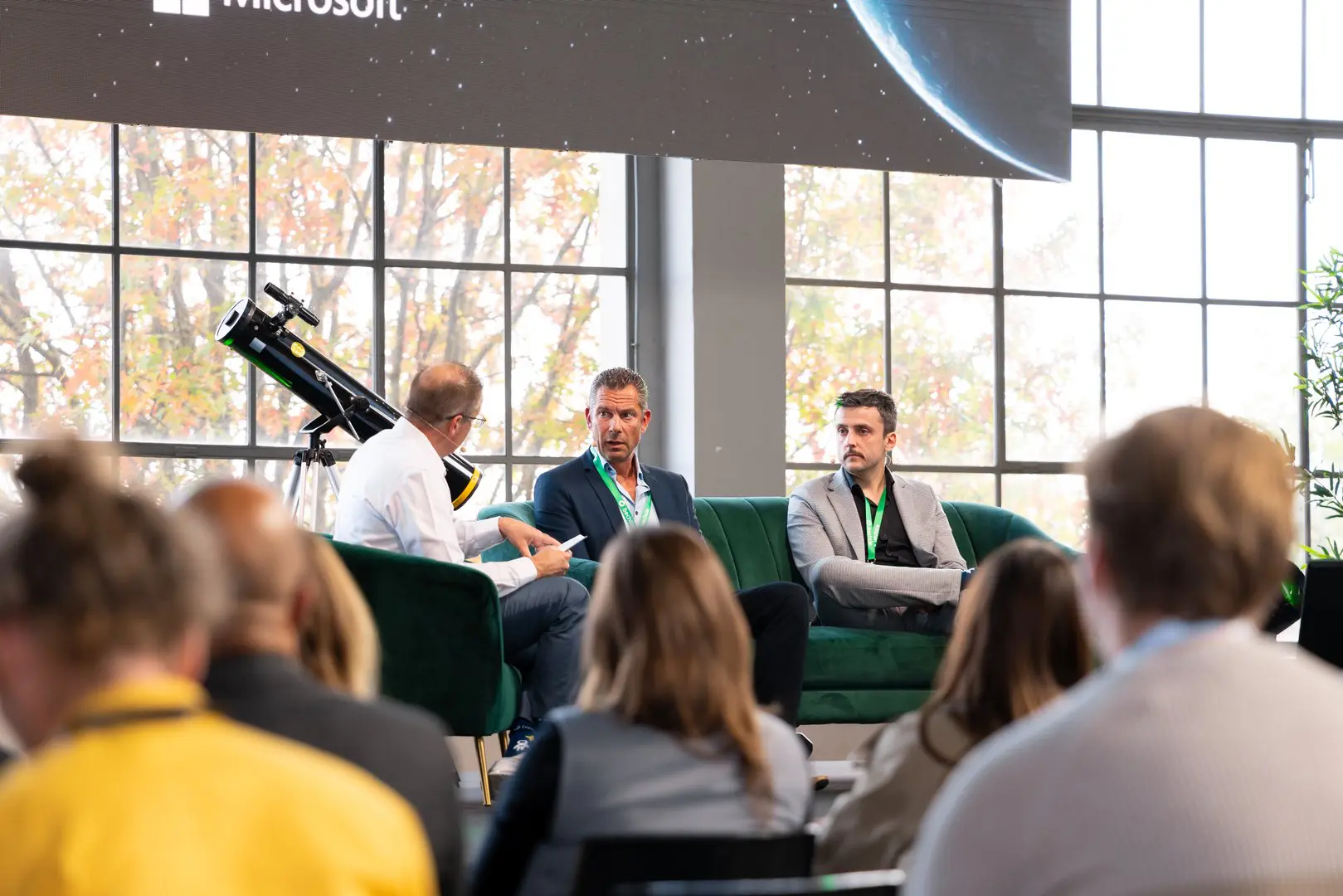
Jeroen Baert, an engineer known from the Nerdland podcast, is given an hour for his opening keynote and spends the first half-hour on the basics of neural networks, featuring his dog Poncho, who is mistaken for an air fryer by his own model. “You might be thinking: I’m in IT, I know all this already,” Baert says halfway through. Then comes his actual point. “The AI honeymoon phase is over. Many companies are discovering that a demo is cool, but a product you can rely on, with accountability and reliability, is something else entirely.”

At the companies he visits, Baert primarily sees Copilot licenses without measurable gains. He describes an employee who has Copilot expand four bullet points into a four-page email, and a colleague who has that same email summarized back into four points. “Are those the same four points? We can only hope. What companies are telling me is that their emails have become longer.”
His advice for the coming years consists of three points. Transparency regarding training data and where corporate data goes. Digital sovereignty, “because if a dictator forbids Microsoft or Google from providing services in Europe, every hospital shuts down.” And accountability. “If your AI system makes a mistake, where does that escalate? You need to have that scenario ready before you start.”
Monkey work at Radisson
Stefan Eeckhout has worked at Radisson Hotel Group for nearly 24 years and leads workplace services from Belgium for the group’s administrative offices, covering some 3,000 employees and 27,000 mailboxes from the Middle East to Asia. Radisson has more than 1,600 hotels in over 100 countries. “Ask ten IT professionals how to do something and you get ten answers,” he says. “The challenge is finding a standard, one way to move forward.”
That standard arrived under the pressure of COVID-19. “Suddenly we had to work from home, but we still had to onboard people, replace and support devices, without being able to enter the office,” says Eeckhout. At the same time, Radisson moved its servers to the cloud and wanted to eliminate the manual setup of PCs. According to him, the company sought a cloud-based way to manage devices and landed on Intune, which was already included in its Microsoft license.
Dennis Veestraeten, key account manager at Bechtle and a ten-year veteran, sent a consultant to Radisson for a day for what Bechtle calls a Modern Endpoint Assessment, followed by an environment audit and a report detailing the steps toward cloud-managed devices. As a major Microsoft partner, Bechtle was able to tap into Microsoft funding for this. “We provided many of those assessment and implementation services without Radisson having to pay for them,” says Veestraeten.
Veestraeten admits that at the start, he didn’t know the difference between AD-joined, hybrid-joined, and Entra ID-joined devices. Eeckhout thought it would be like a switch. “I thought: we turn it on and on Monday we work with it. That turned out differently. We have a complex environment with Active Directory, so we are moving first to hybrid and then to a full cloud solution, step by step. It’s not finished yet.”
Devices now go directly from the supplier to the employee, without a stop at the office. Asked about the biggest change in one sentence, Eeckhout replies: “Less complexity and less IT monkey work.”
Four reasons why a demo stalls
Kokot picks up on that a moment later. The South African electrical engineer lives in London and sits on the board of GITA, the Global IT Alliance of fourteen IT companies in which Bechtle plays a central role. BroadVision, his employer, is one of those members and established a branch for applied AI. “AI is my life,” he says. He doesn’t count rolling out Copilot as part of that. “You can do that whenever you want. I’m talking about real, usable intelligence about your organization.”
Kokot attributes the fact that 95 percent stay stuck in the demo phase to four causes. Demo environments are built without real links to the company’s systems. An agent that needs to perform a task requires permissions that no one has granted in advance. Every application on a language model must undergo a security review before it is allowed to touch anything. And someone must take ownership. “If that solution optimizes a process, we need to know who to hold accountable if things go wrong.”
He calls his answer a business operating system. All manual, repetitive processes are digitized and brought together in a single layer on top of existing systems. AI agents run on this layer to handle tasks, with a dashboard showing what each agent does and how accurate it is, measured against a human benchmark. On the right of his diagram are the people. “Who approves what happens? That’s them.” Kokot describes it as research and literature he brought together. It is also the product that BroadVision sells.
AI agents on probation
According to Kokot, you put an agent to work just like a new employee. “You give it a job title, you determine who it reports to, you give it the necessary access, a probationary period, and an evaluation moment,” he says. Before it can make any decisions, the agent must know the internal company data. According to Kokot, this can also be hosted locally for those who want to keep their data in-house.
As a first example, Kokot takes the service desk, where an employee reports that her password expired over the weekend. The agent reads the ticket, checks if the person exists, determines the severity, and performs the reset. “From the moment the ticket comes in until it is fully handled: 1.7 seconds.”
From the moment the ticket comes in until it is fully handled: 1.7 seconds.
Luka Kokot, Director at Applicat AI
When an example comes from the audience about Bobby, a dog that chewed through the network cable at the office, the agent turns it into a P3 ticket for the workplace team, citing the cause as “likely outside IT” and advising a new cable under a cable duct. A human still has to come and lay it.
The figures come from an organization of about 3,000 users where BroadVision rolled out triage and first-line agents. Kokot does not name the client. Out of 5,800 tickets, the agents handled about 2,000 entirely without human intervention, and 3,600 were immediately routed to the correct team. The time to categorize a ticket dropped from fourteen minutes to four seconds, the share of tickets routed correctly the first time rose from 72 to 92 percent, and engineering hours decreased from 520 to 60. He says nothing about the period over which this was measured.
Elephants at the watering hole
The second example was chosen by the Bechtle team, Kokot explains, who wanted something “uniquely African.” A hotel group with five properties in Zimbabwe, “not as prestigious as Radisson,” complained that too many man-hours were spent on work that doesn’t require man-hours. BroadVision consolidated data from the hotels’ separate PMS, POS, ERP, and CRM systems—mostly outdated on-premises systems—and built agents on top of them to track the group’s performance.
At a safari lodge, occupancy during the rainy season from January to April was significantly lower than in the dry season, when animals emerge from the brush. In the third year, the agents adjusted room rates in real-time based on the season. This resulted in six percent more overnight stays and four percent more room revenue for that single lodge.
Then the elephants. Kokot asks the audience who thinks heat determines Coca-Cola sales at the lodge, and many hands go up. For school holidays, there are fewer. For a four-legged animal, no one raises their hand. “The correlation with warm periods was 21 percent. With school holidays, there was none at all. The number of elephants at the watering hole in front of the lodge had an 89 percent correlation with the number of colas sold.”
Controlled for weather, in July and December, the connection held up. With the same amount of heat and fewer elephants, about eight fewer colas were sold. The lodge initially did nothing with this information, and while the herds grew in front of the terrace, cola sales stagnated.
If you connect your data and make it centrally visible, you find correlations you didn’t know existed.
Luka Kokot, Director at Applicat AI
Since then, a new rule applies to the guides. “If you see more than two elephants near the camp on the morning safari, radio the lodge to get extra cola ready.” Soft drink sales subsequently rose by seven percent. “There is an elephant in every company,” Kokot concludes. “If you connect your data and make it centrally visible, you find correlations you didn’t know existed.”
Asked about the most obvious application for any organization, Kokot points to the IT department itself. “Our own first-line support runs largely on agents. IT is in every organization, in every sector. Look there for what you can take away from your people.” For Bechtle Belgium, this aligns with what Veestraeten said earlier in the day about his first strategic meetings ten years ago, when the company was known as a box mover and had to transition toward services.
Buyse, two weeks into the job, is taking the flag with the Mars mission to customers and partners to hear what that destination should look like. Polak will remain until the end of this year to oversee the transition.