

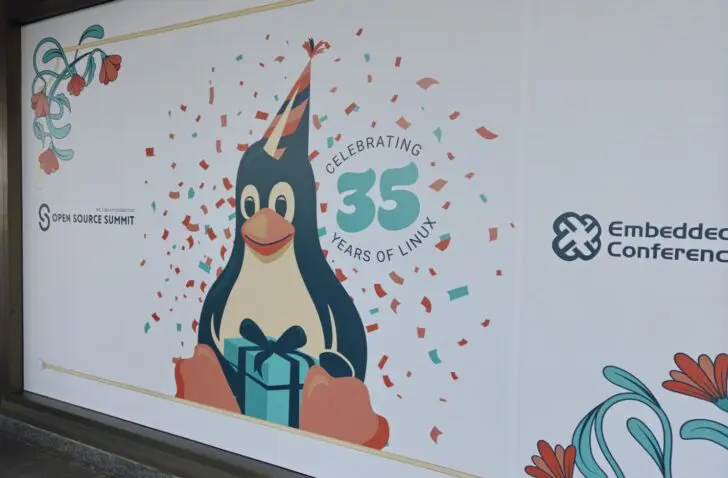
Linux celebrates its 35th anniversary in 2026. In that time, it has grown from a hobby project into the foundation of enterprise IT. Yet, its future is not yet guaranteed.
The Open Source Summit Europe, hosted in Prague this year, has something special to celebrate. It has been 35 years since Linux first saw the light of day. The friendly penguin mascot, Tux, is also celebrating his thirtieth birthday. Linux is a textbook example of how a hobby project can evolve into a critical component of enterprise software. To ensure the anniversary does not go unnoticed, the Linux Foundation has published a report looking back at 35 years of Linux.
August 25, 1991, is the exact birth date of Linux. A certain Linus Torvalds, then a student at the University of Helsinki, shared a free PC operating system on a developer forum. It was ‘just a hobby’ that would not become ‘big and professional,’ Torvalds wrote at the time. Thirty-five years later, Linux runs on approximately four billion Android devices, more than 200 million servers, all 500 of the world’s fastest supercomputers, and Apple’s 5G modems.
Towards a fixed release cycle
Until 2002, Linux operated without version control. Developers emailed their patches to Torvalds and checked the next release to see if their work had been included. The project then switched to BitKeeper, but lost its free license three years later. Torvalds then developed an alternative with an equally famous name in the open-source world: Git.
Git spread to other open-source projects and commercial software teams. With the hosting platforms and CI tools that emerged around it, working in small steps—with reviews and a visible history of every change—became the standard in open software development. For the first time, Linux established a fixed release cycle, without release plans or months of preparation. “Most people assumed that approach would fail,” writes Eric Hohndel, software lead at telecom giant Ericsson, in the report.
Today, a new kernel appears every eight to nine weeks, with nearly ten changes per hour. Version 7.2 saw a record 16,418 commits from 2,652 developers, not counting merges.
Banks were early adopters
In 1991, banks and stock exchanges ran on mainframes and proprietary Unix variants. By the late 1990s, according to the report, the financial sector became one of the first major business markets to deploy Linux for critical applications. The kernel had no per-system licensing costs, received patches quickly, and could be tuned for low latency.
Banks started with web servers, batch processing, and test environments, only later moving Linux to the core of their data centers. Eventually, stock exchanges in New York, Chicago, London, Frankfurt, and Shanghai also switched to Linux for their trading platforms.
As a primary supplier of mainframes, IBM had to follow its customers. From the late 1990s, it began publishing patches to run Linux on mainframes. Irving Wladawsky-Berger, who led the Linux initiative at IBM, says that IBM did not initially choose Linux “because we knew there was still a lot of work to be done. We looked at the community, were very pleased with what we saw, and that gave us the confidence that Linux would become much better over time.”
According to the report, more than ninety percent of the Fortune 500 today use solutions from Red Hat—under IBM’s wing since 2018—which marketed Linux from the start as a customizable alternative to Unix. That figure alone illustrates the massive impact Linux continues to have today.
From mainframes to cloud
Linux was not limited to on-premises systems; it also successfully made the leap to the public cloud. Additions such as namespaces, control groups, and OverlayFS in version 3.18 turned the Linux kernel into a fully-fledged container platform. Companies that previously wanted to run Docker had to patch their own kernels or use slow storage drivers.
Chris Aniszczyk, CTO of the Cloud Native Computing Foundation (CNCF), even calls Linux the building block of the cloud-native movement. “At 35, Linux remains the indispensable runtime for modern software workloads,” he says. According to the report, about ninety percent of public cloud infrastructure runs on Linux. In the same vein, it states that Linux powers 49.2 percent of global cloud workloads.
Real-time support
Linux also plays an undeniable role in factory and production environments. Real-time and long-term support were essential for this. Factory installations must last for decades, while a software version is often only maintained for a few years. Companies like Siemens and Toshiba therefore collaborate to support selected kernels for up to twenty years. According to the report, this work makes it easier to comply with ISE standards and European legislation such as the Cyber Resilience Act.
Real-time support only arrived in 2024, after Torvalds literally received this request printed on paper during a conference in Vienna. Version 6.12 became the first mainline kernel with built-in real-time support. According to the report, the biggest hurdle was funding. The Linux Foundation bundles the contributions of its members.
Red Hat, SUSE, and Canonical (Ubuntu) now offer real-time kernels for industrial robots, software-defined vehicles, 5G radio networks, and medical equipment. On the edge, according to the report, more than 75 percent of devices already run on Linux.
AI puts maintenance under pressure
The Linux community continues to grow rapidly. 2,362 developers worked on version 7.0, 489 of whom were first-timers. Version 7.1 saw 530 newcomers. That record didn’t last long, as release 7.2 already included patches from 613 new contributors. The report attributes this growth ‘most likely’ to the use of AI tools.
Since April 2026, AI in the kernel has officially been considered a tool. Its use must be mentioned in the patch, and a human must sign off on it. This stream of AI patches is increasing the pressure, according to the Linux Foundation.
“AI facilitates contribution, but it also causes an influx of poor contributions or contributions that we cannot process,” says Thierry Carrez, GM of Linux Foundation Europe, identifying the pain point during the conference. Linux is not the only one experiencing this problem; Google also shut down its bug bounty program because of it.
Nevertheless, the Linux founder remains a strong proponent of allowing AI into the kernel. “Linux is not one of those anti-AI projects. AI is a tool, just like other tools we use. And clearly a useful one,” says Torvalds himself.
Succession wanted
What does the future hold for Linux? More than eighty percent of all contributions to the kernel come from developers employed by companies. Between September 2025 and August 2026, there were 8,918 contributors and 981 active organizations. The hundred largest contributors handle half of the work. For the companies that pay for the bulk of kernel development, the next challenge will be the supply of such maintainers, especially as AI patches increase the review workload, the report states.
A quarter come from the US, with Germany and China in second and third place. The report names Ericsson, Igalia, and SUSE as European contributors. According to economic studies cited in the report, the GDP of an average country would be more than two percent lower in the long term if open-source software like Linux disappeared. During the Open Source Summit, the Linux Foundation called on European companies and policymakers to contribute more actively to open source.
Without open-source software like Linux, the GDP of an average country would be two percent lower.
In 35 years, Linux has grown from a hobby project into a critical building block of enterprise and industrial IT. The great constant in that evolution is the tireless dedication of its creator, Linus Torvalds. Although Torvalds shows no signs of stopping yet, the day will come when he must pass the torch. In early 2026, a plan was drawn up to ensure succession. Whether any progress has been made on that front, the report leaves unanswered.