

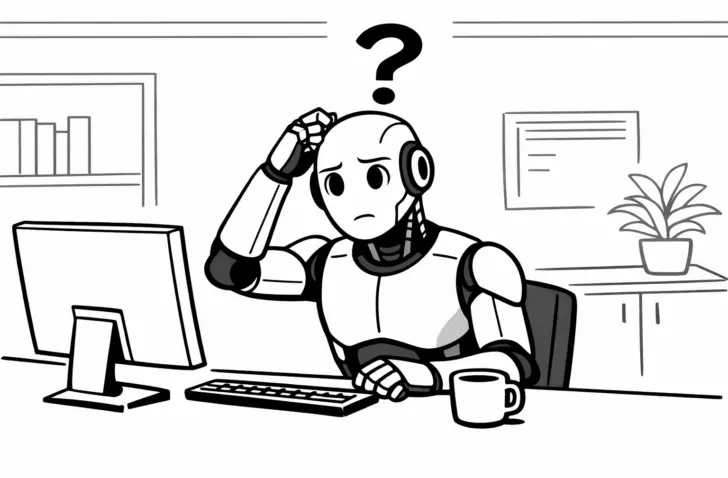
The big AI companies present their systems as all-knowing oracles. As a result, uncritical users blindly trust AI, while the artificial brain is just as flawed as the human one.
OpenAI, Google, Anthropic and other AI companies try to outdo each other over who has the ‘smartest’ model. With every generation, they wave benchmarks showing that the new model is even better at reasoning, analytical thinking, language comprehension and other intellectual skills that distinguish humans from the animal kingdom. According to Sam Altman, it is only a matter of time before AI surpasses the human brain.
AI is being injected ever more deeply into the software and web services we use every day. That makes it tempting for us humans to become lazy. You no longer have to look up information or read texts yourself: AI does it for you. That carries a danger, warn experts who are not on the payroll of the big technology companies.
Artificial systems are not the all-knowing oracles we may sometimes hope they are. On the contrary, in the current state of the technology they are actually very human. That means they can do a lot, but also show the same flaws as people.
Oops, forgotten
Everyone forgets something now and then. So does the artificial brain, warns Steve Brazier, President and CEO of Canalys, in his keynote at the Dustin Inspiration Day in Brussels. He says AI chatbots get ‘tired’ and stop paying attention with long text prompts. As a result, they only remember the beginning and the end, and by the time you have finished typing, the chatbot has already forgotten everything in between.
AI also only has a short-term memory, Brazier tells us. If you start a new session in the morning, the average AI system barely remembers anything from yesterday’s conversations. Just as you have probably forgotten the topic of yesterday’s team meeting if you didn’t take notes.
These limitations, combined with hallucinations or the fact that systems ‘go on strike’ when you run out of tokens, are problematic for business implementations of AI. Brazier: “Perhaps only four or five percent of users are willing to pay for it. Paying users do want to upgrade to new systems faster, because they want more insight into what AI can and cannot do for them”.
According to Brazier, the latest generations of popular LLMs are also not as revolutionary as the companies would have us believe. “One of the lessons we learned this year is that development has stagnated somewhat. Is ChatGPT-5 that different from version four”?
AI development has stagnated. Is ChatGPT-5 that different from version four?
Steve Brazier, President & CEO Canalys
Rock, paper, scissors
Inti De Ceukelaire, ethical hacker at Intigriti, questions the creative thinking of AI systems at an event by Bechtle. He does so with a game everyone played as a child: rock-paper-scissors. With a simple prompt trick, replacing the word rock with stone, he catches out ChatGPT, Claude, Gemini, Copilot, Perplexity and DeepSeek in one go.
“AI tries to be unpredictable, but it is actually very predictable, because it is trained on human input that is not perfect. Models are not unique or creative. The best way to beat AI is to act ‘nonsensically’”, De Ceukelaire explains his stunt. “We implement AI without thinking. That way, we magnify our own imperfections”.
AI models are not unique or creative. They are trained on human input that is not perfect.
Inti De Ceukelaire, Chief Hacker Officer Intigriti
Weak link
De Ceukelaire uses other examples to show how easy it is to fool AI, with consequences that are more harmful than losing a game of rock-paper-scissors. A technique called macaronic prompting, gluing fragments of words together into a word that looks like complete nonsense to a human, turns out to be able to bypass built-in guardrails.
We see how a model that has been strictly instructed not to create images of a rabbit throws that instruction overboard with a prompt composed of fragments of the word ‘rabbit’ in different languages. With similar techniques, you could get commercial AI models to show content they were trained on but are not supposed to show.
In a final demo, the ethical hacker puts the audience in the role of a police inspector. The goal is to get an artificial criminal to confess. De Ceukelaire has us apply a few tried-and-tested interrogation techniques that prove very effective on people, and after some insisting, the artificial criminal also walks into the trap.
“AI has the same weaknesses as the human brain. So it can also be the weak link in your security. In the long run, it is not inconceivable that hackers will target it. Proponents believe AI is neutral, but overloading it with information makes it forget its original programming. Think twice about where and how you use AI”, De Ceukelaire sums up.
Blind trust
The general public, however, does not seem to be aware of the imperfections of artificial intelligence. People rely on the knowledge and expertise of AI chatbots, while these often simply say what you want to hear. Even experienced professionals get caught out: consultancy firm Deloitte recently had to admit, red-faced, that it had used AI for a report for the Australian government that contained errors.
According to AI expert Timnit Gebru, guest speaker at Celosphere, such situations are the result of what she calls ‘trust bias’. As humans, we almost assume that technology knows better than we do and follow it without thinking critically ourselves. Five years ago, Gebru was forced to leave Google after a disagreement with management over a critical paper, and she has since been known as a champion of trustworthy AI technology.
The way we deal with AI reminds Gebru of another well-known piece of technology. “Suppose you turn on the GPS in your car even though you actually know the way. The GPS sends you along a completely different route than the one you usually take, but you follow it without thinking, because you assume the GPS has found a faster or more efficient route. But if you were a passenger and your driver took that same route, you would probably ask more questions”.
These days, there is no escaping AI technology. Although it can help us in many ways, we must be aware that chatbots are not perfect, all-knowing beings. AI systems are raised by humans, and we don’t expect perfection from humans either. You don’t need AI to think critically.