

The Wi-Fi Alliance has simplified the naming of different types of Wi-Fi, but that hasn’t immediately made things clearer. From now on, you’d better know what Wi-Fi 6 means and how it differs from Wi-Fi 6E. And how important is Wi-Fi 7, while Wi-Fi 8 equipment is already being developed? We’ve broken it all down for you.
In 1997, the Institute of Electrical and Electronics Engineers (IEEE) established the first standard for wireless internet communication. The 802.11 protocol was born. 802.11 was the precursor to the first truly commercially embraced Wi-Fi standard: 802.11b. Since its introduction in 1999, about a dozen new protocol standards have emerged, all with 802.11 in the name followed by one or two letters. Every standard brought improvements and remains backward compatible with its predecessors to this day.
The Wi-Fi Alliance, which today has authority over Wi-Fi standards, decided in 2019 that the complex-looking naming convention was confusing. That is why the Alliance introduced an alternative intended to be more accessible to consumers. The result is that those who are somewhat familiar with the wireless world suddenly find themselves lost among the new marketing terms. From now on, there are six (or seven) standards: Wi-Fi 1 through Wi-Fi 8. Wi-Fi 6 received a variant in early 2020: Wi-Fi 6E. These standards cover some, but not all, existing Wi-Fi protocols. For the sake of completeness, the Wi-Fi Alliance went back to 1999 with the rebranding. We’ve broken it all down.
Wi-Fi 1
Wi-Fi 1 is the new name for 802.11b from 1999. This standard works exclusively on the 2.4 GHz frequency and has a maximum theoretical throughput speed of up to 11 megabits per second. As mentioned, it is not the very first Wi-Fi standard, but it was the first successfully commercialized protocol.
Wi-Fi 2
Also in 1999, 802.11a saw the light of day. That standard is now called Wi-Fi 2. 802.11a was the first to operate on the 5 GHz frequency, with throughput speeds up to 54 Mbit per second. Wi-Fi 1 and Wi-Fi 2 coexist. The 5 GHz band gives 802.11a the advantage in terms of speed, while the lower frequency of 802.11b provides better range.
Wi-Fi 3
802.11g was launched in 2003. For many people, this standard was their first experience with wireless internet at home. The protocol lives on under the name Wi-Fi 3. Wi-Fi 3 relies again on the 2.4 GHz band, with a maximum throughput speed of 54 Mbit per second.
Wi-Fi 4
In 2009, 802.11n appeared on the scene. You will undoubtedly still find such routers in many places. Today, however, you can call it Wi-Fi 4. 802.11n can exist on both 2.4 GHz and 5 GHz, and has a maximum throughput speed of 600 Mbit per second. Wi-Fi 4 is the first standard to support MIMO (multiple-in-multiple-out), addressing the ever-growing number of devices wanting to connect wirelessly to a router.
Wi-Fi 5
Wi-Fi 5 was introduced in late 2013. 802.11ac officially works only on the 5 GHz band and is combined in routers with the 802.11n protocol on the 2.4 GHz band. Routers compatible with this latest standard will henceforth be on the shelves with the Wi-Fi 5 label. Wi-Fi 5 is characterized by more advanced MIMO capabilities and other useful technologies such as beamforming. Devices connected via the ac protocol can enjoy a maximum throughput speed of up to 3.5 Gbit per second.
Wi-Fi 6
The first Wi-Fi 6 router was launched in late 2018, but the standard was only officially finalized in September 2020. Compatible routers are becoming increasingly numerous, and modern endpoints are also supporting the standard more and more. Think of laptops with the latest generation Intel chips or flagship phones. Behind the marketing term lies the 802.11ax protocol. This focuses on the 2.4 GHz and 5 GHz frequencies. The maximum throughput speed is 10 Gbit/s, and MIMO capabilities have increased once again.
Wi-Fi 6E
In early 2020, the Wi-Fi Alliance decided to complicate the reasonably simple naming convention with the introduction of Wi-Fi 6E. Wi-Fi 6E is essentially just Wi-Fi 6 and therefore 802.11ax. The ‘E’ implies that a device with the label can handle Wi-Fi 6 over the 6 GHz frequency. This extra frequency comes on top of 2.4 GHz and 5 GHz, bringing additional channels with it.
The advantage of the extra frequency band is that it is sparsely populated, has little interference, and the throughput capacity is high. The disadvantage is that technologies like beamforming are needed to counter the higher absorption of the high frequency. Europe has since released 500 MHz of spectrum around the 6 GHz band that routers can use. Belgium and the Netherlands have since followed the European guidelines, so that compatible devices are also appearing on our shelves.
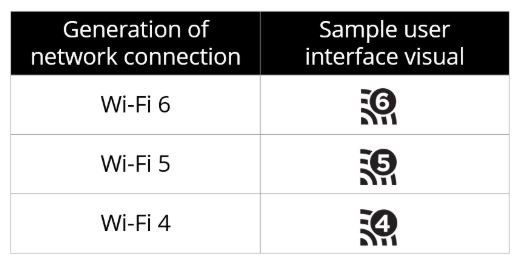
The Wi-Fi Alliance wants to give the standards their own logo and have that logo appear in the interface of your smartphone or PC. This way, you can see at a glance, via a small number, what kind of network you are connected to. Whether Wi-Fi 6E will get its own logo remains unclear.
Wi-Fi 7
To maintain consistency in naming, it has been given the simple name Wi-Fi 7 (or IEEE 802.11be). The Wi-Fi Alliance first mentioned the upcoming standard in 2020.
The keyword describing Wi-Fi 7 is speed: the latest standard promises data transfer speeds up to 46 Gbps. That is more than four times higher than the peak speed of Wi-Fi 6 and Wi-Fi 6E, which is capped at 9.6 Gbps. Important to keep in mind: this refers to theoretical speeds that only apply under optimal conditions. The standard uses the same frequency bands as its predecessors: 2.4 GHz, 5 GHz, and 6 GHz. The latter band especially plays an important role because there is more available bandwidth and therefore less interference between devices.
The biggest innovation in Wi-Fi 7 lies in speed and efficiency, with a maximum throughput speed of approximately 47 Gbps in theory. This is made possible by various technological improvements. Among other things, the channel width is increased to 320 MHz, allowing more data to be sent simultaneously. Additionally, Wi-Fi 7 uses Multi-Link Operation (MLO). This allows a device to connect via multiple frequency bands or channels at the same time. Instead of using just one band, data can be sent simultaneously via, for example, the 5 GHz and 6 GHz bands. This increases not only the speed but also the stability of the connection.
Wi-Fi 7 is primarily intended to connect many devices simultaneously that need to process large amounts of data. Think of smart homes, offices with various devices, high-resolution videos, and XR applications. The first Wi-Fi 7 routers, chips, and other compatible devices are already on the market, although it will take a few more years before the technology is fully established everywhere.
Wi-Fi 8 in the starting blocks
So Wi-Fi 7 is not yet widely established, but companies and chip manufacturers are already talking about the next big step in wireless networks. The new standard, officially 802.11bn, succeeds Wi-Fi 7 (802.11be) and is primarily intended to provide more stable connections and lower latency, rather than just higher peak speeds. According to the schedule, the standard should be approved starting in September 2028, but companies like Qualcomm are already working on chips with support for Wi-Fi 8.
With Wi-Fi 8, the Wi-Fi Alliance is aiming for a theoretical maximum throughput speed of about 46 Gbps. That is the same as with Wi-Fi 7. Just like recent generations, Wi-Fi 8 operates on the 2.4 GHz, 5 GHz, and 6 GHz bands. In Europe, the 6 GHz band is not fully permitted. Europe has not yet decided whether it is the Wi-Fi providers or the mobile providers who can claim the band.
Techniques such as MIMO also ensure higher speeds with this standard, and reliability improves when many devices are on the same network. Manufacturers are placing more and more emphasis on places like homes, offices, and factories with dozens or hundreds of identical connections. Beamforming also plays a role here. This involves a router directing the radio signal toward a device instead of broadcasting it in all directions. This increases signal stability and can improve speed.
The standard is being designed with a focus on the stability required for XR applications, industrial automation, and real-time collaboration. Instead of just increasing the maximum speed, Wi-Fi 8 must ensure that connections remain more stable under heavy network loads.
The first commercial equipment is not expected until the end of this decade.
Take note
With the new naming, the Wi-Fi Alliance does not cover all standards by any means. Only the widely available commercial protocols are being addressed. For example, there is no mention of intermediate standards such as 802.11ad. These are not intended for office or home coverage, but as a standard for wireless docking stations, for example. Because such devices are technically not routers, they remain separate from the Wi-Fi 1 to 6 naming conventions.
The new names also remain silent on other technical details, such as band steering, dual or quad-band, or other technical tricks where throughput speeds exceed the officially established theoretical maxima of the protocol. It is therefore a good idea not to discard your knowledge of the protocols. Anyone who truly wants to make an informed choice needs more than just the Wi-Fi Alliance’s marketing terms.
This piece is part of our ‘IT Explained’ series, in which we explain important concepts and technologies behind today’s products and innovations in an understandable way. We periodically keep this piece up to date with the latest developments. Last update: April 14, 2025, by Joachim Cruysberghs.