

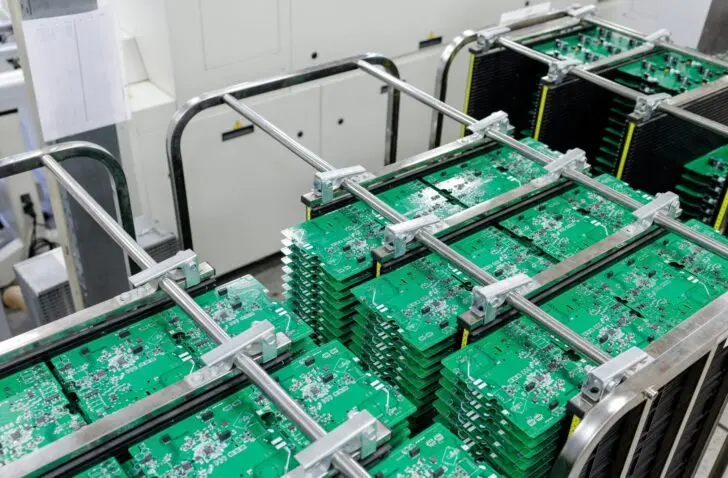
The Global Electronics Association is warning of a worldwide shortage of printed circuit boards because of demand for AI servers. The trade body does not expect real relief until after mid-2028.
The Global Electronics Association, which represents the entire electronics manufacturing chain, published a global warning about the supply of printed circuit boards. According to the association, demand for printed circuit boards (PCBs) is outpacing supply at every link in the chain, from glass fabric and resin to finished boards. It expects standard materials to remain scarce until at least the first half of 2027 and says the consequences could match those of the 2021 chip shortage.
A printed circuit board for a desktop PC has about twelve layers. For AI servers, manufacturers go from 20 to 40 layers or more, and every extra layer requires more glass, resin, copper foil and laminate. According to the association, the pressure comes from the volume in which hyperscalers are ordering those boards all at once.
Orders outpace deliveries
In North America, orders for printed circuit boards were 56.1 percent higher through September than a year earlier, according to figures from the association. Deliveries rose by 13.3 percent over the same period. For boards with many layers, the lead time runs to sixteen to twenty weeks or more. Prepreg, the resin-impregnated glass fabric that bonds the layers together, became roughly 180 percent more expensive year on year through August.
Suppliers of glass fabric and laminate are directing their scarce output to the more expensive materials for AI, the association says. Manufacturers of cars, industrial equipment, medical devices and defence systems thus end up at the back of the queue.
“The build-out of AI data centres is shifting capacity to boards with many layers. That lengthens lead times and leaves less room on the production lines for more traditional boards,” says Cori Masters, analyst at Gartner, to The Register.
Europe vulnerable to printed circuit board shortage
According to the association, Europe’s share of global printed circuit board production fell from 13.8 percent in 2000 to 2.2 percent in 2023. In 2025, barely 0.1 percent of all server boards came from the EU. In a survey in August, 35 percent of European respondents cited laminate and resin as a major source of disruption, compared with sixteen percent worldwide.
Recent European investments went mainly to acquisitions and upgrades of existing plants, such as more than 30 million euros from AT&S in its plant in Fehring, Austria. In Southeast Asia, roughly 10 billion dollars went into new plants over the past three years, and in China almost as much, according to research firm N.T. Information.
The memory shortage is making PCs more expensive. According to the association, production capacity left unused as a result cannot simply be shifted to servers, defence or medical applications, because a twelve-layer PC board and a 40- to 50-layer server board require different materials, machines and production steps.
Call to buyers and governments
The association asks buyers to share realistic forecasts and not to place duplicate orders, and asks printed circuit board makers to qualify a second supplier of laminate, prepreg and copper foil now. From governments, it expects, among other things, a system that tracks lead times, support for printed circuit boards like that given to chip factories, faster permits and priority for defence, aviation, medical applications and critical infrastructure.
Because buyers are now ordering ahead, the association expects a correction in 2027. It does not expect real relief from the shortage before mid-2028.