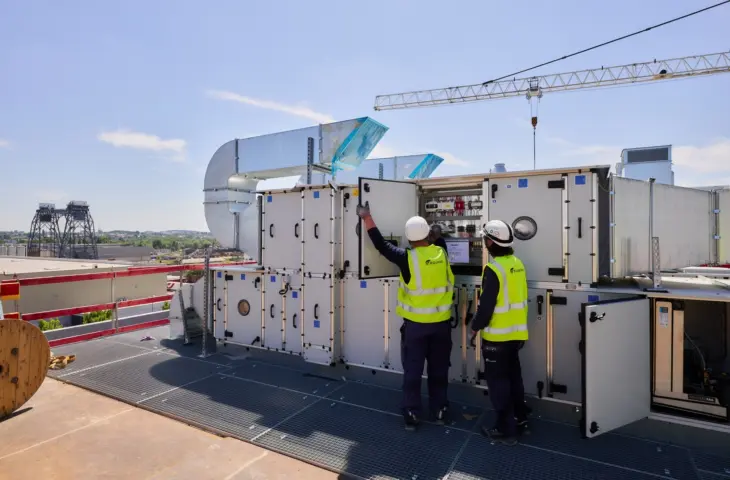
Most newer data centers in Belgium are originally designed for conventional enterprise workloads, typically supporting industry standards; rack densities between 6 and 12 kW. While this was sufficient for traditional IT environments, it no longer meets the demands of emerging AI platforms. Systems like NVIDIA’s DGX H200 and especially the latest B200 series have changed the equation. Depending on configuration, these systems can require between 40 and 58 kW per rack, far beyond what most existing facilities can accommodate.
Next gen digital campus
That is exactly why Kevlinx is building a new AI-ready campus of more than 32 MW in Brussels. Strategically located close to Europe’s political heart, the site has been designed from the ground up to deliver the kind of high-density, future-proof capacity that traditional facilities cannot offer. The first phase of the campus will open in December 2025, featuring a 17.5 MW shell with 4 MW fully fitted and ready for use, a critical starting point for Belgium’s transition to truly AI-capable digital infrastructure. The second phase will add another 14.5 MW shell and fit-out capacity, bringing the total campus capacity to over 32 MW. And the design does not stop there, the campus masterplan allows for further growth beyond 32 MW, ensuring Belgium can keep scaling to meet tomorrow’s AI and high-performance demands.
read also
Powering Belgium’s AI Ambitions: High Density Infrastructure That’s Ready When It Matters Most
“Belgium rightfully wants to position itself as a serious player in the European AI landscape, we need local infrastructure that can support the next generation of compute,” says Carole Santens, Managing Director at the Belgium Digital Infrastructure Association (BDIA). “Having a site that’s prepared to deliver up to 150 kW per rack is not just a technical step, it’s a strategic enabler for innovation, sovereignty, and Belgium’s ambition to lead.”
The infrastructure gap is no longer just a technical constraint, it’s a strategic barrier. If Belgium is to realize its ambitions to become a European leader in AI, including hosting one of the EU’s AI Factories under the InvestAI programme, it must ensure that high-density, high-performance digital infrastructure is available locally. This is not only about compute capacity, but also about digital sovereignty, security, and economic competitiveness.
The availability of 4 MW capacity in two data halls, capable of supporting densities up to 60 kW per rack in December 2025 is no coincidence. It marks a strategically timed response to rising market demand. This capability allows public and private organizations alike to deploy advanced AI systems locally, without offshoring workloads or facing long procurement lead times for customized infrastructure builds.
Big leap forward
“We’ve built this platform with Belgium’s future in mind,” says Eric Boonstra, CEO of Kevlinx. “With up to 60 kW per rack available by December, we’re taking a big leap forward in making Belgium truly AI-ready. But that’s just the beginning. This 4 MW is part of a larger 17.5 MW deployment, with the remaining 13.5 MW already in development to support liquid-cooled environments at over 150 kW per rack. It’s how we make sure Belgium stays relevant for the most advanced technologies and innovations in the world.
The datacenter campus is fully modular, designed to grow alongside customer demand. While the initial 4 MW enables immediate deployment of high-density AI workloads, the full 17.5 MW build-out is already underway. As part of that roadmap, 13.5 MW is being developed specifically for liquid-cooled environments, supporting densities beyond 150 kW per rack. This future-ready design is critical for organizations focused on AI model training, multi-node GPU clusters, and edge-intensive computing, ensuring Belgium has the infrastructure to lead in next-generation innovation.
This is a contributed article written by Linne Voets, Strategic Marketing Manager at Kevlinx. Click here for more information about the company.