
When thinking about AI, IBM might not be the first name that comes to mind. Yet AI is deeply rooted in IBM’s architecture and is now more accessible and simpler than ever.
Many may not know this, but IBM was one of the pioneers of AI. However, IBM still carries the stigma of being little more than a specialized provider of expensive and complex architectures and mainframes. With the new Power11 server, IBM aims to shed this label.
“The Power platform is the evolution of what IBM has always done well. The focus is on resilience and trust, both open and hybrid,” begins Gregory Verlinden, Vice President of Data and AI at Cegeka. Together with Gaetan Willems, Vice President of Cloud and Digital Platforms at Cegeka, he explains as a loyal IBM partner how the company is playing the AI card again with Power11.
This new generation of Power servers is designed to build on what was already solid, while making room for modernization and new technologies like AI. The Power11 server puts IBM back on the AI map and offers opportunities for companies wanting to deploy AI in a targeted, simple, and secure way.
IBM and AI
Today, when people mention AI, they might not immediately think of IBM. Yet IBM was among the pioneers of artificial intelligence even before the AI hype began. With Deep Blue, IBM surpassed human intelligence in chess as early as 1996, and in 2011, the company proved how powerful more general AI could be with its supercomputer Watson. During a TV game show, Watson demonstrated that AI could not only understand questions but also formulate confident answers, all in less than three seconds.
This breakthrough laid the foundation for practical business applications, from financial analysis to customer service, and led to IBM’s AI platform: watsonx.
Foundation
IBM is primarily known for both mainframes (zSeries) and midrange systems like AS/400. Just as AI is developed to process data safely, quickly, and without errors, the same was true for mainframes and midrange systems. They form the basis of many critical IT systems, the backbone on which large organizations’ core processes run.
IBM mainframes and Power systems still form the backbone of banks and governments today, simply because they don’t fail.
Gregory Verlinden, Vice President Data and AI at Cegeka
Applications on such systems were written in old programming languages like COBOL, which few people still master. Companies therefore rarely venture into tinkering projects within a mainframe.
However, these systems are often a key element for digitalization. “With Power11, IBM focuses on modernizing and expanding into contemporary technologies,” says Verlinden. “The Power11 systems make it easy to extract information from mainframes or midrange systems,” adds Willems.
Technologies are now prominently linked to open source, such as Red Hat OpenShift, allowing companies to connect their existing systems with new applications or AI models.
AI Accelerator
The Power11 servers are supported in AI power by IBM’s Spyre card. Spyre is an AI accelerator designed for Power11 servers. This card performs AI inference tasks directly on the system, without requiring separate GPUs or cloud infrastructure. This allows companies to run AI models locally and securely, close to their data, with lower latency and energy consumption.
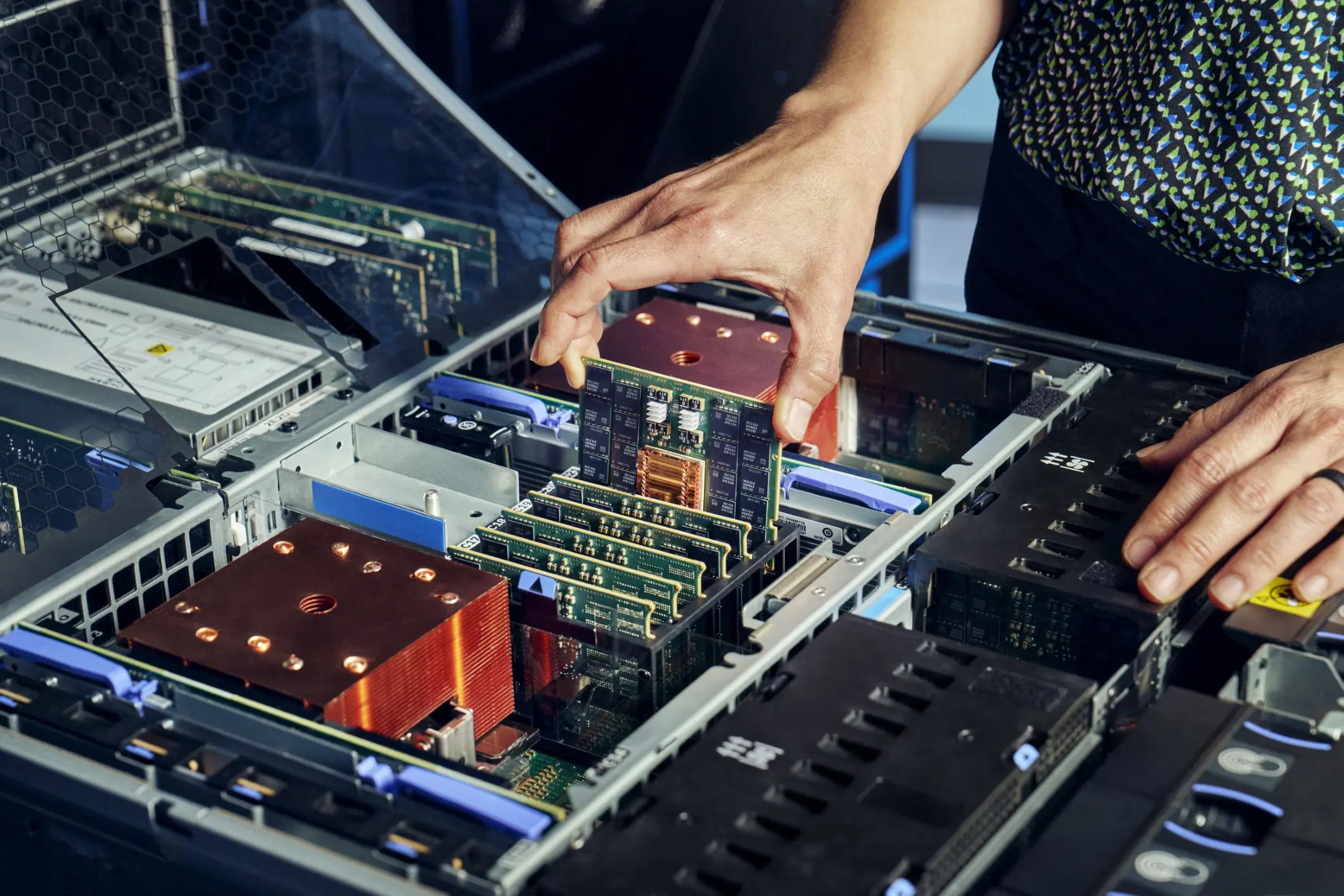
“With the Spyre accelerator, IBM brings a kind of low-code/no-code perspective to Power servers. With simple coding, you can quickly add an AI layer above your ERP system, service desk, or supply chain planning,” says Verlinden. “You don’t need to be an AI expert for this.”
Willems emphasizes that IBM is not competing with, for example, Nvidia’s large GPU offering. “We deliver specific AI use cases for customers in terms of SLMs rather than LLMs. We’re not building an AI platform but rather use-case-based tools for customers from different segments,” he continues.
AI Closer to Data
One of the biggest concerns about AI relates to data security. Who has access to my data and where does AI run? “Often there’s a lack of trust in AI because data is sent to the public cloud,” says Willems. With Power11 systems, this is no longer necessary.
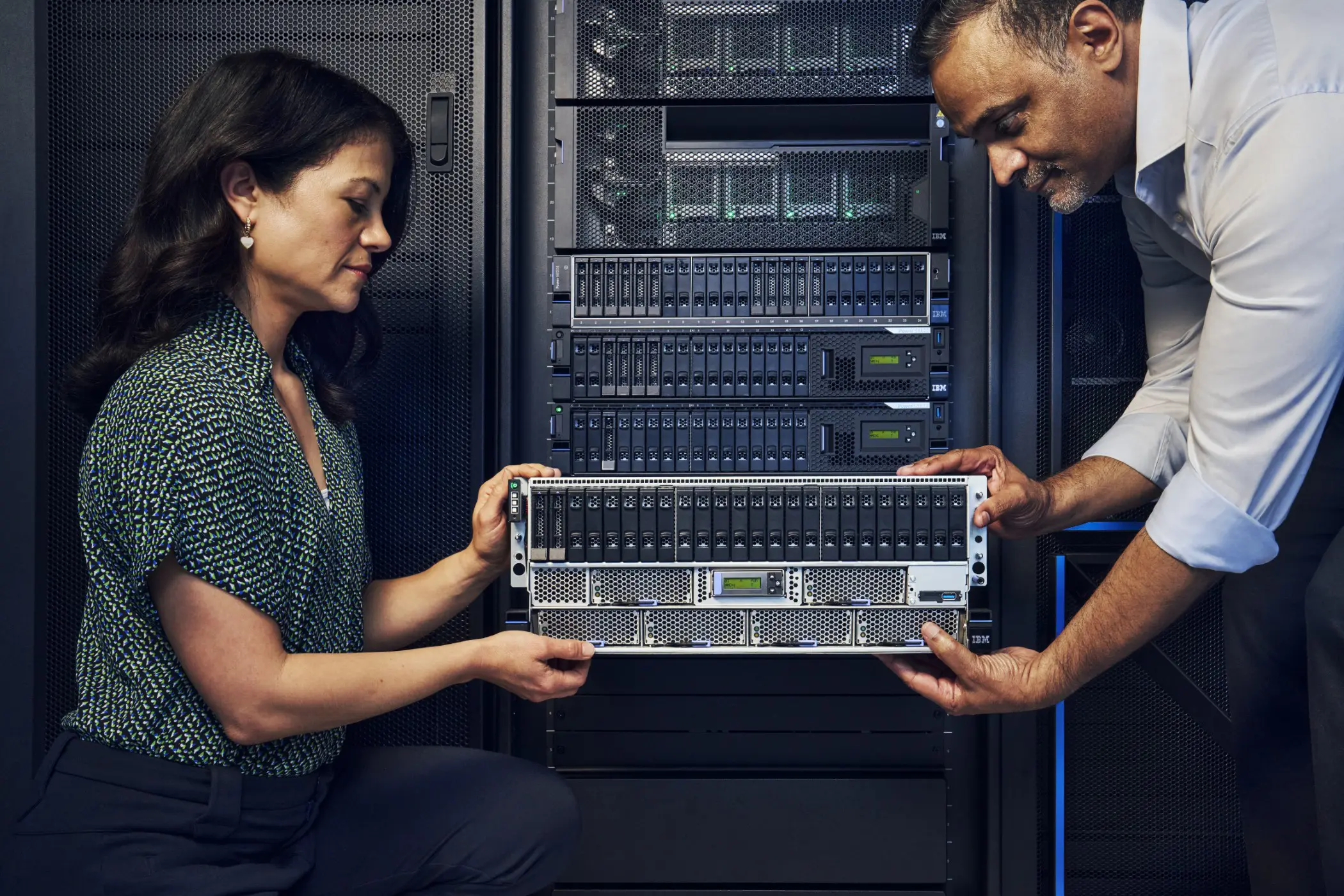
The AI runs locally in the same protected environment as the rest of your critical systems. The Power11 systems essentially bring AI to your data rather than the other way around. This creates more trust, control, and efficiency. With this, IBM has a trump card in the sovereign debate around AI in the private cloud.
Solid Foundation for AI
Although IBM uses a very different architecture than traditional players, this shouldn’t discourage you. IBM encompasses more AI than we think and goes beyond traditional mainframes.
Don’t hesitate to look beyond the classics like Intel or Nvidia, IBM and Cegeka encourage. Especially when your company needs specific AI use cases without having to build a large AI model. In this context, IBM provides a solid foundation with room for movement within your own secure environment.