
At first glance, the Oppo Find X9 Pro is an evolution of its predecessor, not a revolution. However, with prolonged use, it becomes clear that Oppo has innovated very thoughtfully on the points where the impact is greatest, effectively ushering in a new era.
Thanks to the immense battery and the spectacular cameras, the Oppo Find X9 Pro is an excellent choice for those looking for a premium device that can last five years or longer.
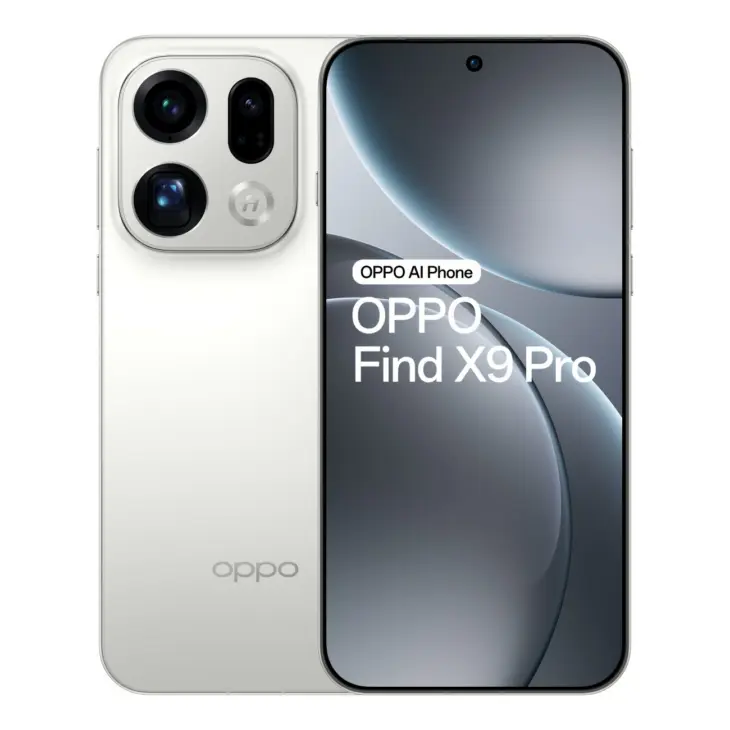
“Are you walking around with an iPhone now?” We received this surprised question more than once during the test period of the Oppo Find X9 Pro (1,299 including VAT) and we understand why. For its latest Find, Oppo has said goodbye to its own design with a large camera circle and has clearly taken inspiration from the apple farmer on the other side of the ocean.
Waterproof and drop-resistant
Not that we care much: every smartphone today is primarily a large screen, with a back that you will put a case over. More important is the build quality, and the Oppo Find X9 Pro is a solid smartphone. Oppo specifies an IP68 and IP69 rating, which guarantees high-quality dust protection, as well as extensive waterproofing. The phone can survive underwater for a long time and can even withstand pressurized water jets.
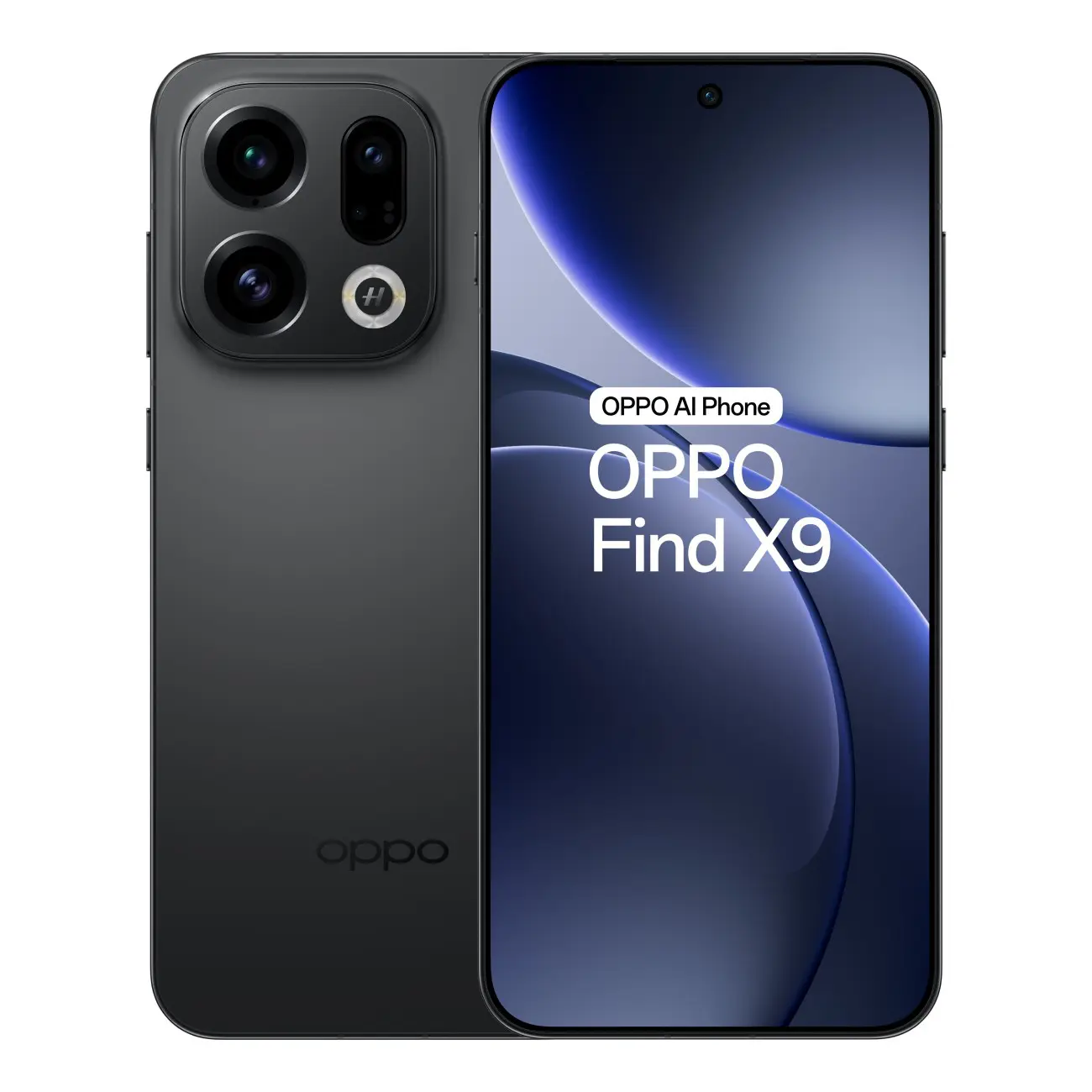
Furthermore, the Oppo Find X9 Pro is drop-resistant. We know this because the matte glass on the back of the device is particularly smooth. We dropped it hard onto parquet and stone from a modest height several times, but we couldn’t discover a scratch. The included screen protector did crack dramatically on the first small drop, so we had to remove it immediately.
We also note that Oppo does away with rounded screen edges and opts for an aluminum border. That border returns around the particularly sturdy camera island. The fact that the aluminum frame around the phone itself is matte, but has a glossy finish around the island, bothers us a little more than we want to admit on our white test model.
Specifications
The Oppo Find X9 Pro feels large and sturdy, but to our surprise, weighs only ten grams more than its predecessor (225 g vs. 216 g). That is striking, given the specifications and specifically the immense battery. Let’s dive straight into the components. Our test model of the Oppo Find X9 Pro is equipped with:
- 6.78 inch AMOLED screen (120 Hz)
- 1,272 x 2,772 pixels (19.5:9)
- MediaTek Dimensity 9500 (8-core CPU, G1 Ultra GPU)
- 512 GB UFS 4.1 storage
- 16 GB RAM
- Wi-Fi 7
- 7,500 mAh battery
- 50 MP main camera
- 200 MP zoom camera (periscope)
- 50 MP wide-angle camera
- 50 MP selfie camera
Three things catch the attentive reader’s eye: the use of a MediaTek Dimensity 9500 is a flagship, above a chip from Qualcomm, the immense 7,500 mAh battery, and the 200 MP sensor behind the zoom camera. It is these choices that make the Oppo Find X9 Pro an exceptional phone.
Immense Battery
The 7,500 mAh battery is one of the two greatest assets of the Oppo Find X9 Pro. The capacity is immense and you notice that. On ordinary days we can regularly skip a charge. Getting two days on one charge, without having to resort to battery saving mode at the end, is achievable.
During more intensive use, it becomes tighter. On a busy day with a lot of phone use, it is possible to use almost half of the battery capacity. In theory, a second day is also achievable, but in such situations we felt more secure with an extra charge.
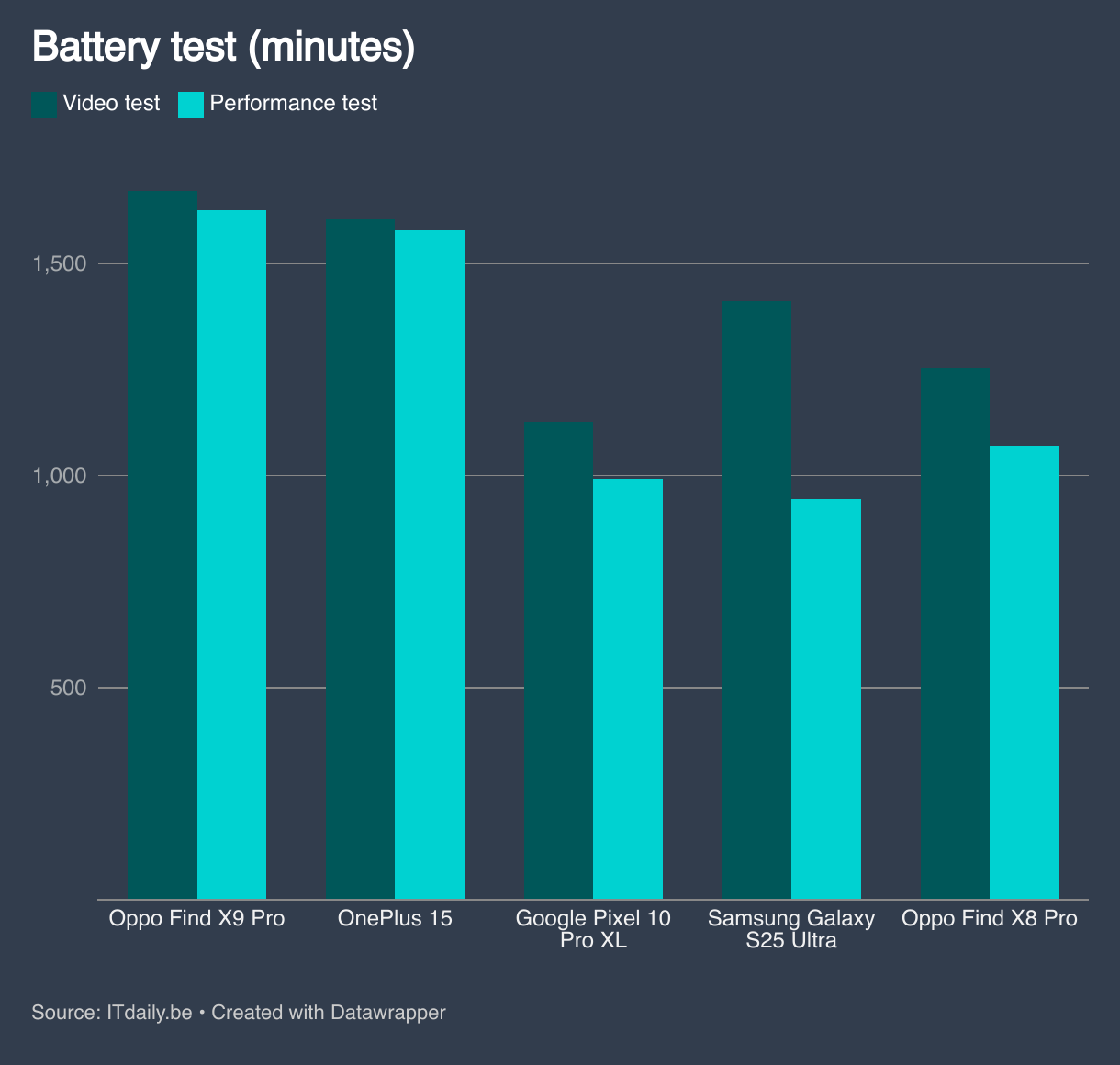
The benchmark test confirms our experience. Only the OnePlus 15 comes close. That is no coincidence. OnePlus is a subsidiary of Oppo and the OnePlus 15 has several similarities with the Oppo Find X9 pro, including an equally large battery of 7,300 mAh.
For the Long Term
More important than the fact that you can survive two days on one charge is the implication for long-term use. Oppo will provide six years of updates. The battery is so large that it is very realistic to expect that a full day on one charge will still be achievable in year six. Oppo itself states that the battery should still have at least 80 percent of its capacity after five years.
You can also contribute to the lifespan of the battery by setting the device to never fully charge. You can reduce the maximum charging capacity to 80 percent. Lithium-ion batteries wear out the most in the top and bottom 20 percent of their capacity. Just like with cars or laptops, it is therefore a good idea to only charge to the maximum when it is really necessary. During our tests, 80 percent was still enough charge to get through one day with plenty of margin.
(Reasonably) fast charging
Unfortunately, Oppo sticks to its own SuperVooC standard for charging, but does not include a compatible charger in the box with the Oppo Find X9 Pro. The fastest charging is possible with such a separately purchased charger, at 80 watts. The UFSC standard developed from China is also supported at that wattage, but the more ubiquitous USB-C Power Delivery is not. Power Delivery is what you get when you buy a more universally compatible charger, and the charging speed is limited to 55 watts there.
According to Oppo anyway. We measure a maximum of 43 watts via Power Delivery and, moreover, that power drops quickly. The OnePlus Find X8 Pro was in the same boat. In combination with the huge battery, this means that the phone does not get fully charged very quickly.
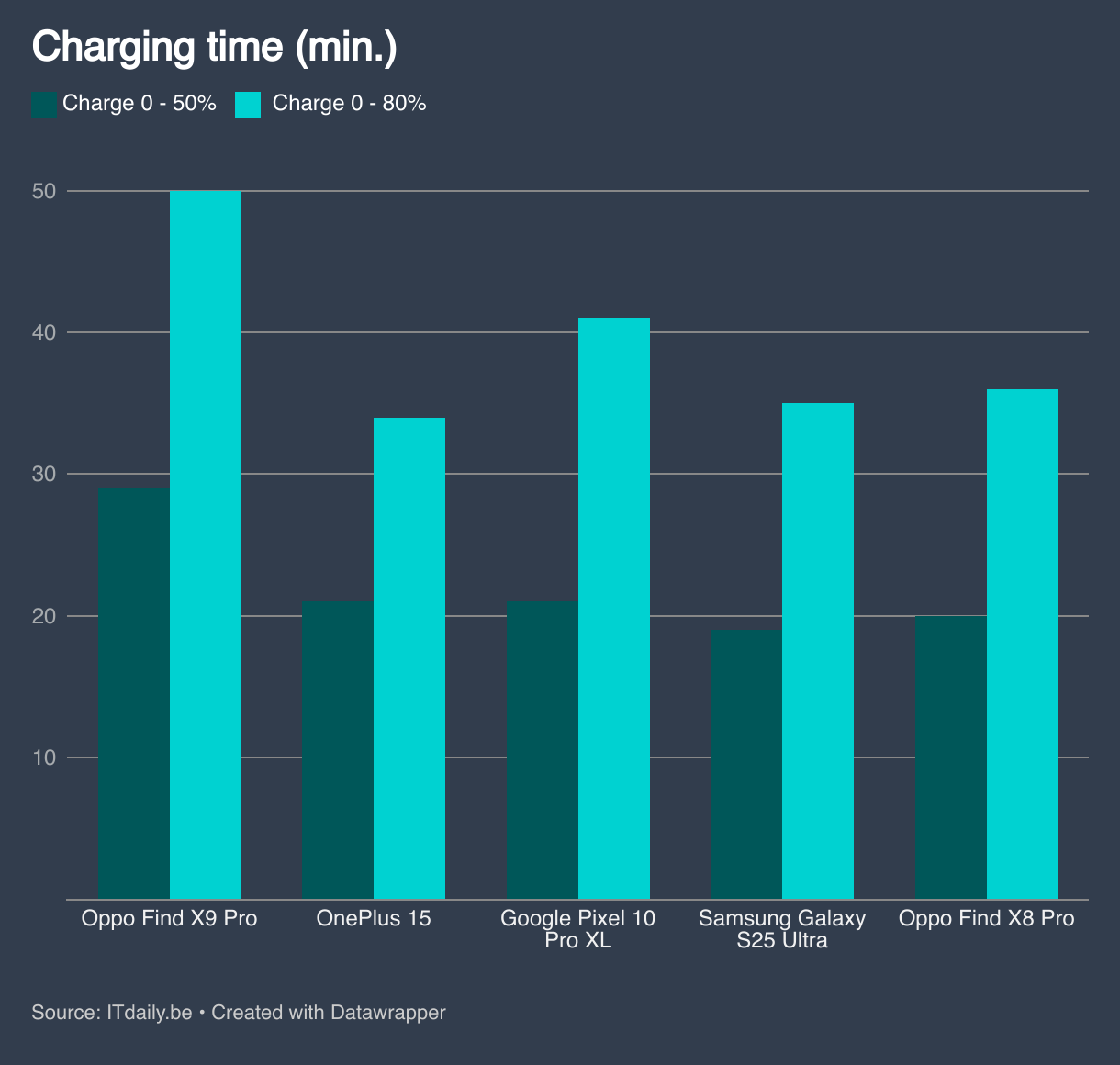
It is striking that the OnePlus 15 can refuel much faster. Since both phones come from the same stable, Oppo is missing a trick here.
Some nuance is in order: it is not fair to say that the Oppo Find X9 Pro charges slower than other devices, since the battery capacity is so much larger. For a fairer comparison, we have compared the average charging speed to the battery capacity. Below you can see how many minutes of use you get per minute at the socket.
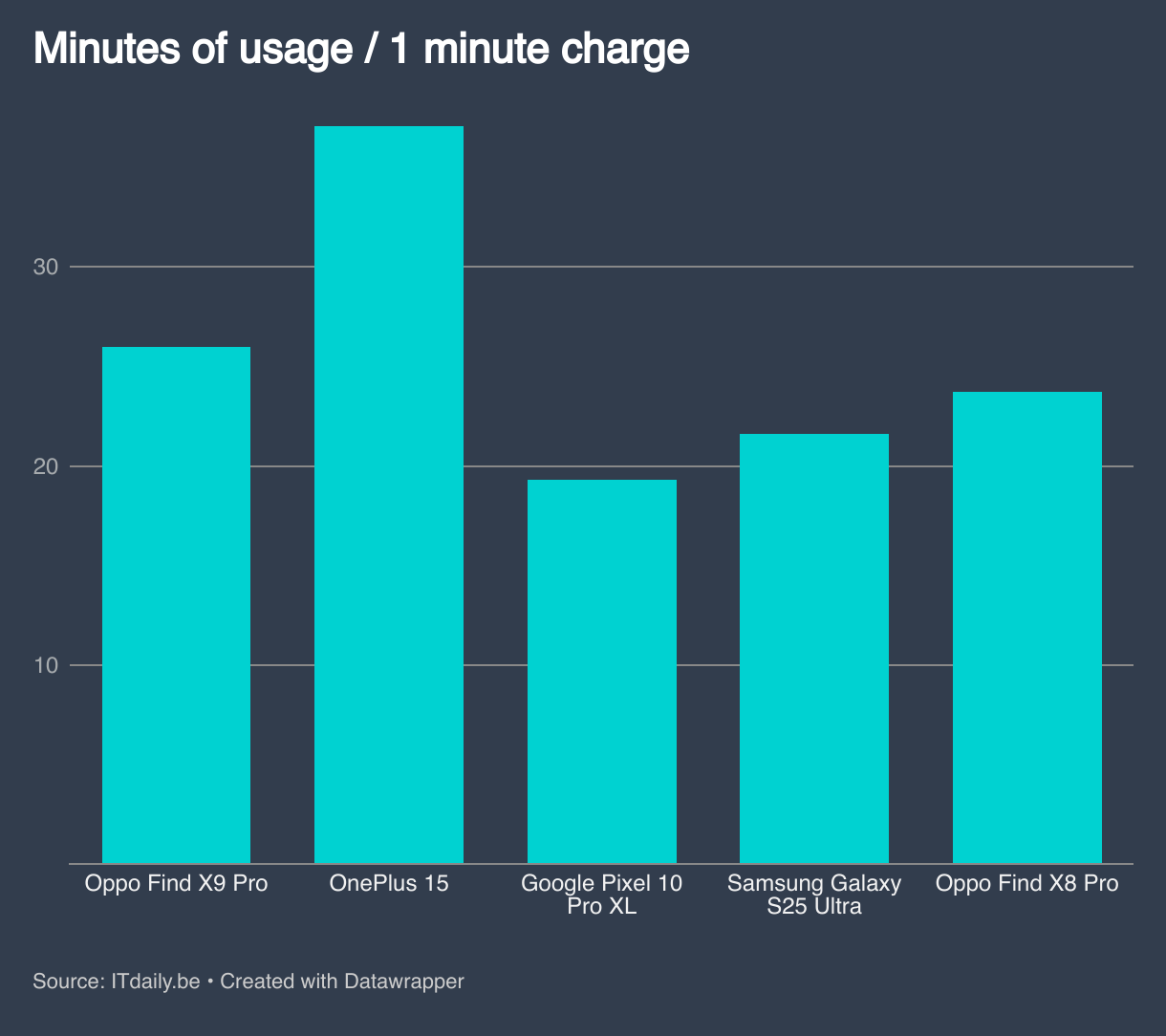
This shows that the Oppo Find X9 Pro, even with the curtailed Power Delivery standard, gets more minutes of use per minute of charging than all other high-end phones on the market except for the OnePlus 15.
As far as battery and charging are concerned, Oppo (together with OnePlus) is promoting to a new class. Manufacturers such as Google and Samsung have no answer to the stamina of the Oppo Find X9 Pro in the current device generation.
Solid muscle
The stamina is related to the consumption of the MediaTek Dimensity 9500. That chip turns out to be very efficient. The chip has a selection of eight cores on board (1×4.21 GHz C1-Ultra & 3×3.5 GHz C1-Premium & 4×2.7 GHz C1-Pro). These deliver great performance. The Snapdragon Elite Gen 5 in the OnePlus 15 is slightly faster when all computing cores work together, but the Dimensity chip has the strongest single core performance.
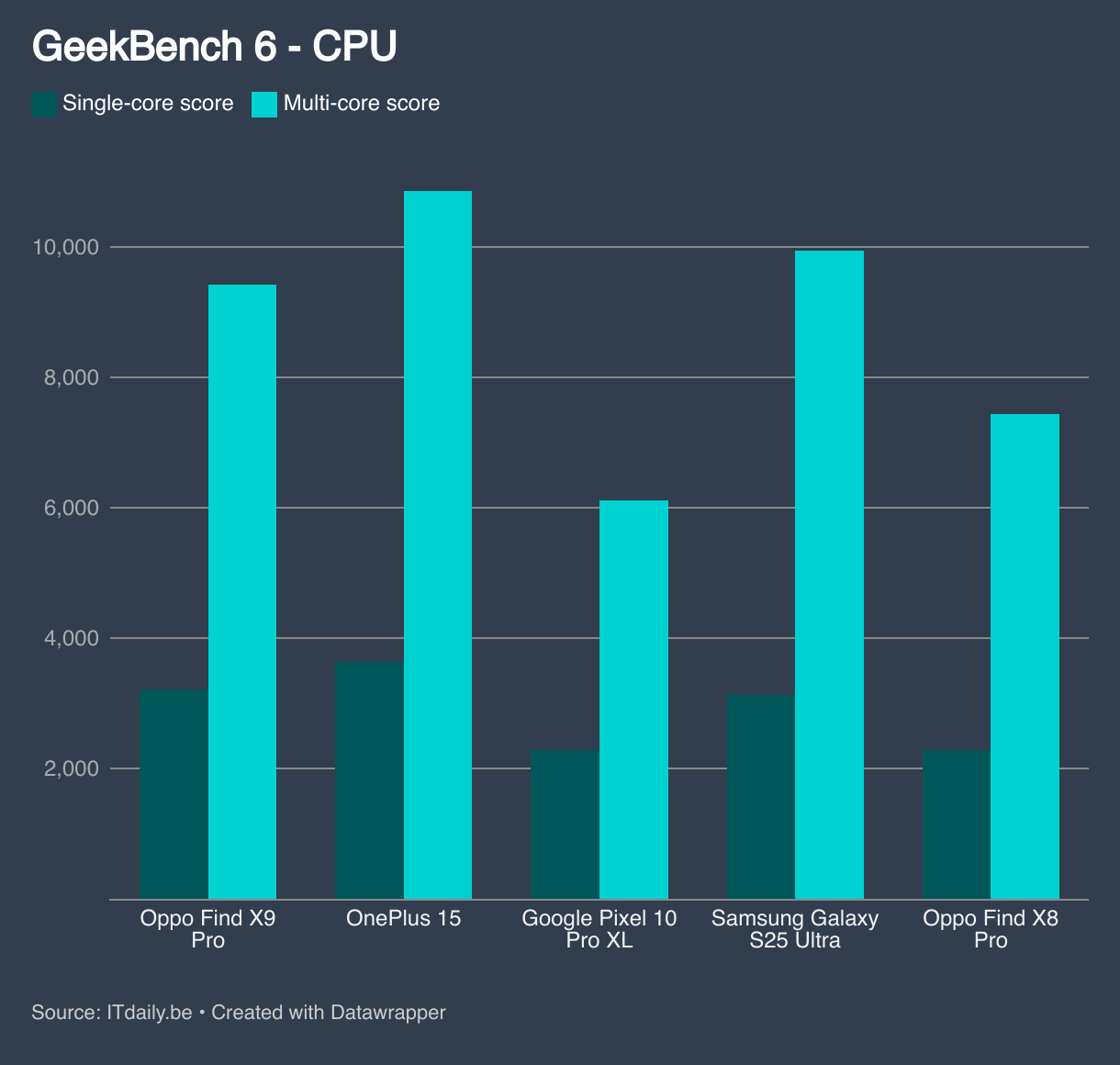
There is no doubt that the Oppo Find X9 Pro is a lot faster than its predecessor. The Google Pixel 10 Pro XL has the same recommended retail price (1,299 euros) and performs much worse. Samsung can also just outperform the Dimensity chip with a previous version of the Snapdragon Elite in the Galaxy S25 Ultra.
read also
Samsung Galaxy S25 Ultra review: more AI, more ultra?
In daily life you are not going to run benchmarks but just use the device. The difference in speed is then not noticeable: the Oppo Find X8 Pro is a speed demon with which you can multitask without delay.
Graphics quality
The phone also does reasonably well graphically. The G1 Ultra-GPU (former Mali) is fast enough to drive 3D applications. The Adreno-GPU from Qualcomm is traditionally more powerful.

Again, fast enough is fast enough. Only those looking for a phone for gaming should worry about the difference between different devices. The Google Pixel 10 Pro XL is again the exception with severely substandard performance in this price range.
Pleasure in use
In daily use, it is striking how fast the phone is. The 120 Hz screen contributes to the smooth experience, supported by the solid hardware. ColorOS 16 (built on Android 16) is a good, clear and stable operating system.
The screen has a particularly high maximum brightness and is also very easy to read in direct sunlight. Conversely, you can also dim the display a lot: a pleasure for those who reach for their smartphone in the winter mornings when the alarm goes off.
You will also not be blinded by the fingerprint sensor. Oppo chooses an ultrasonic sensor for the Find X9 Pro, so that no bright light shines under your thumb when unlocking. For us, the sensor is consistently fast and responsive.
AI memory space
Oppo finds it necessary to build in some AI capabilities. There is the AI Mind Space or the Memory Space. There you can save memories using screenshots or recorded audio. You can also bundle the memories into collections, which are smartly supplemented.
For example, if you are going on a business trip to Porto, you can look up information about the city in anticipation and view websites with sights. With a press of the specially provided button at the top left of the device, the AI Mind Space scans your screen and adds memories. If you created a ‘Porto’ collection, the scanned information will end up there. Then you can ask questions in natural language in the AI Mind Space to plan your trip, based on the added memories.
Oppo relies on Google Gemini for the functionality and the system works quite well. Gemini understands Dutch, but sometimes prefers to answer in English. All in all, this AI functionality is fun, although we wonder to what extent it is the task of manufacturers to impose AI everywhere.
AI writer
We ask ourselves that question all the more with the ‘AI writer’. That tool is less successful than the Memory Space. A prompt to open the AI writer appears on your screen at every turn. The function is intended to invent captions for photos on social media, but also interferes in WhatsApp, for example.

The AI writer can then invent a caption in different styles based on the photo. In the best case, the result is generic AI text, in the worst case the text is irrelevant or laughable. You can see an example in the photo of the cat.
No interest in AI? You can ignore or disable the functions. For example, it is easy to give the button for the Memory Space a different function. Then you can, for example, switch Do Not Disturb on or off with the press of a button.
Bloatware
Unfortunately, we notice that Oppo has not learned from its mistakes with the Find X8 Pro. Again, there is more bloatware on the device than can be justified with a smartphone of 1,299 euros. Chinese junk including Temu and TikTok are rammed down your throat and the completely crazy Autodoc app also makes a reappearance. That is good news for those looking for a playful way to buy a carburetor for their car, but otherwise shows little class.



Moreover, Oppo plays a bit dirty during the installation procedure. You can uncheck Oppo-specific applications such as the ‘Internet’ app or the ‘App Gallery’, but at the end of the ride your preferences are ignored and the unwanted applications are simply on your device.
The ‘Lock Screen Magazine’ is also intrusive. You end up there if you accidentally don’t keep your finger still enough and swipe on the lock screen. Oppo may be a little more restrained with unsolicited software: the manufacturer is disfiguring an otherwise phenomenal smartphone here.
Camera wonder
We have kept the best of this review until last: the camera. That is the second unsurpassed trump card of the Oppo Find X9 Pro, in addition to the battery. Oppo builds on the already spectacular camera module of the Find X8 Pro and adds visible improvements.
50 MP and LUMO
In the bulky, Apple-inspired camera island on the back we find three cameras. Both the main camera and the wide-angle camera are equipped with a 50 MP sensor. That is in line with the specifications of the previous Find.
Yet the results are better, thanks to the software. Oppo introduces the LUMO Image Engine. Underneath lives a collection of smart photo algorithms that simultaneously distribute workloads across CPU, GPU and NPU. The result of this are photos that no longer need pixel binning in normal lighting conditions.
Oppo, but also other manufacturers, traditionally rely on pixel binning, where two or four pixels on a sensor work together to create one pixel in the final photo. With a 50 MP sensor you get 12 MP photos of high quality. With LUMO, Oppo delivers photos of equally high quality but with the full 50 MP under decent lighting conditions.


The photos look good, with beautiful pronounced colors, even in challenging lighting conditions (such as above with backlight from the autumn sun). However, the display remains realistic, without excessive saturation.




If the lighting conditions become worse, the phone still dynamically combines two or four pixels into photos of 25 MP or 12 MP, so that the overall quality and exposure are maintained.
‘Zoom and enhance’
The advantage of this is especially visible in photos taken in good lighting conditions. Then you can zoom in a lot more to crop a photo as desired. The selfie camera is of the same quality.
For the zoom camera with periscope lens, Oppo goes one step further. Behind the lens, which offers three times optical magnification, Oppo puts a 200 MP sensor. In 3X magnification with adequate lighting you also get 200 MP photos. You can zoom in spectacularly on that.


Important detail: photos with such a high resolution do take up some space. Count on about 20 MB for a photo taken with the 3X zoom camera at full resolution. Click on the images in the galleries below to open them in full resolution.









The difference with the Oppo Find X8 Pro with the same lens but a 50 MP sensor is large. When you zoom in on the photos, you see significantly more detail. Even without zooming in on the end result, it is striking how sharp the photos are. Click on each image and zoom in on the tower to clearly see the difference in details.


Like other manufacturers, Oppo embraces AI to make very far zooming possible. Thanks to the high resolution of the sensor, that AI zoom only kicks in later and photos look realistic for longer.








Beautiful portraits
The zoom camera also serves as a portrait camera. After all, the lens’s optical 3X magnification ensures very portrait-friendly proportions. Once again, the high-quality lens, the LUMO algorithms, and the sensor work together to capture spectacular images.
The realism of the depth of field is particularly striking. The Oppo Find X9 Pro almost perfectly distinguishes between hairs in the foreground and the background, which needs to be partially artificially blurred. Details in faces, eyes, clothing, etc., are also perfectly preserved. Portrait photos with the Oppo Find X9 Pro are of a higher quality than what an amateur would achieve with a much more expensive camera system.



The zoom camera of the Find X8 Pro already blew us away, both for zoomed-in photos and for portrait photos. With the Find X9 Pro, Oppo visibly improves upon an already phenomenal result.
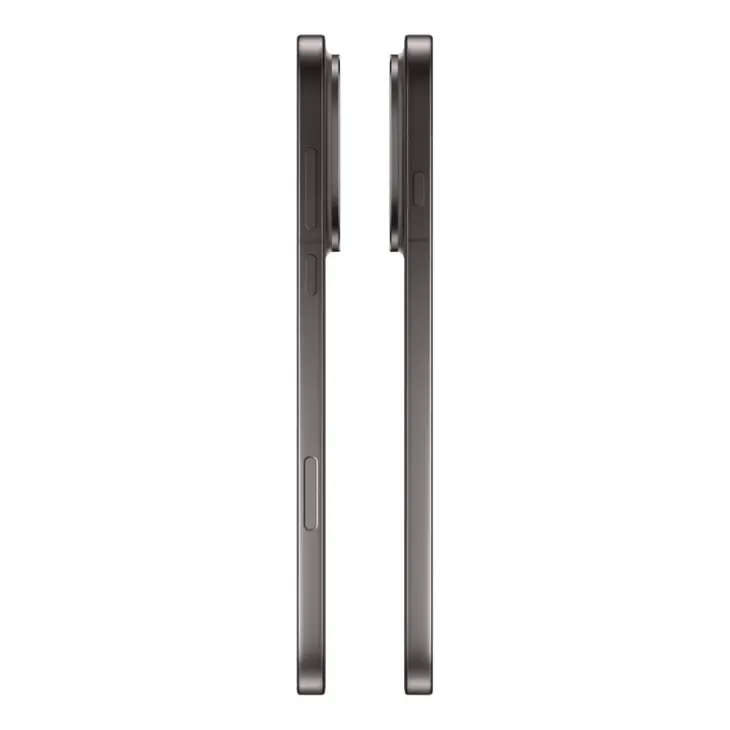
Oppo provides some additional AI functions for the photos, although not all of them are local. For example, you can brighten faces in an underexposed photo (via cloud AI), and that works quite well. We notice one less positive detail: on the side of the Oppo Find X9 Pro, at the bottom right, there is a touch-sensitive slider that allows you to start the camera and zoom. It works well in itself, but it is easy to accidentally touch the button when, for example, taking a selfie.
We usually hold our breath when a manufacturer starts touting megapixels: more MP usually means worse photos, because a sensor with a high resolution in the specifications has to mask the low quality of the other components. Nothing could be further from the truth in this case: Oppo chooses the 200 MP sensor behind the zoom lens for a reason and delivers photos of an almost unprecedented level.
Moving image
The video qualities of the Oppo Find X9 Pro are also excellent, and that through all lenses. All cameras can record 4K video at 60 fps. The main and telephoto cameras can even handle 120 fps. Those who want to use it (semi-)professionally can make LOG recordings for color correction afterwards.
Oppo also adds live photos with a 4K resolution with the Find X9 Pro. These moving photos become a lot more interesting, even in more challenging lighting conditions. In low light, we do notice that the live photo recordings sometimes flicker a bit.
A class above
On paper, the Oppo Find X9 Pro looks like an evolution of the Find X8 Pro. The DNA remains the same: a MediaTek Dimensity processor, three high-quality cameras on the back, one of which with a periscope zoom, focus on the battery… The specifications do increase, but our first impression was more one of evolution than revolution.
read also
Oppo Find X8 Pro review: Hubble telescope in your pocket
After an extensive test period, we have to adjust that initial opinion. What we estimated as gradual improvements turns out to be a big leap. Oppo improves where it matters. The battery is not just bigger, but finally big enough to really take charging out of the daily routine. The sensor behind the zoom lens doesn’t just have more pixels, but delivers a resolution that is high enough for (literally) razor-sharp portrait photos and fine details at a great distance.
Long-term investment
1,299 euros is and remains a lot of money for a smartphone, but Oppo, like no other manufacturer, makes the argument that this investment can be worthwhile. Six years of updates alone does not guarantee that a device will be usable for six years. The battery is the biggest pain point in that case: nobody is happy with a device that doesn’t last the day on a single charge.
With the immense 7,500 mAh battery, that concern disappears. We dare to assume that it will still perform at a level comparable to a brand new Pixel 10 Pro XL today, even within 6 years. The cameras, in turn, are of such a high level that you will still be very satisfied with the photos you take with this device in a few years. In other words: for the first time, we really believe that you can use this device with pleasure for six years.
In that context, we forgive Oppo the blemishes, which are mainly related to bloatware and a messy charging standard. These are worth mentioning in the review, but no longer important once you have properly started using the device.
The fantastic cameras – and especially the zoom camera – combined with the enormous battery make this smartphone deserve the label Editor’s Choice: anyone who wants to purchase a phone in this price range and also has the long term in mind is making a well-considered choice here.
Thanks to the immense battery and the spectacular cameras, the Oppo Find X9 Pro is an excellent choice for those looking for a premium device that can last five years or longer.
Tested: Oppo Find X9 Pro, 16 GB RAM, 512 GB storage, Energy label A – 1,299 euros incl. VAT.
.pro’s
- Enormous battery
- High photo quality in high resolution in all cameras
- 200 MP camera for zoom/portrait
- Robust (IP68/69)
- High performance
- Flexible extra button
- Beautiful screen with high dynamic range
.contra’s
- Bloatware
- Installs what you don’t want during setup
- Only 80-watt charging with its own charger
- No 55 watt with PD as advertised