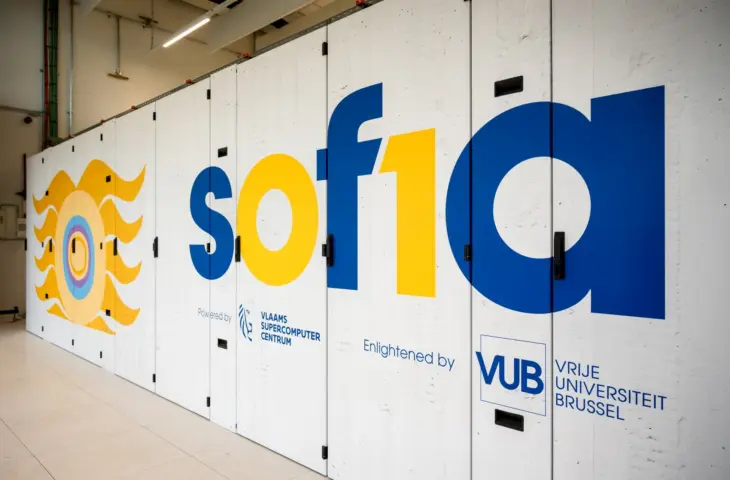
VUB’s new Tier 1 supercomputer has been inaugurated. The system is named Sofia.
Flanders’ newest Tier supercomputer has been officially inaugurated. The system, which is managed by the Free University of Brussels, is named Sofia. The name is a reference to the Greek Sophia, meaning wisdom. Sofia is currently Flanders’ most powerful supercomputer and has a price tag of 8.6 million euros.
To house Sofia, VUB entered into a partnership with Penta Infra. This data center specialist operates the brand-new Br01 data center in the Research Park in Zellik. This newly built modern site has a special room built to Sofia’s specifications. The system is located on the ground floor behind glass, making it easy to view.
read also
Supercomputer in the Showcase: Visiting Penta Infra’s First Belgian Data Center
Sofia was developed by NEC and excels in energy efficiency. This is partly due to the use of liquid cooling. The previous Tier-1 system was already partially water-cooled, and for Sofia, NEC, VUB and Penta Infra built further on that knowledge. Sofia contains a combination of CPUs and GPUs and can thus accelerate workloads, but also process traditional HPC workloads.
Flemish ambition
“With an investment of 8.6 million euros, we underscore our ambition to have Flanders pioneer in innovation and sustainable high-tech development,” says Flemish Minister-President Matthias Diependaele. “By making strategic choices and investing in the ‘engine room of the future,’ we create the right conditions for Flemish researchers to excel. This is how we work today on solutions for tomorrow’s challenges. Flanders has everything it takes to be among the world’s top in research and innovation.”
Karin Voets, CIO of VUB: “The supercomputer will serve to develop models that can lead to interesting innovations. This can range from simulations of waterways and weather models to predict when another cloudburst might occur, to creating AI models to predict defects in steel cables in time. We have already seen examples of companies that can execute their simulations up to ten times faster this way.”