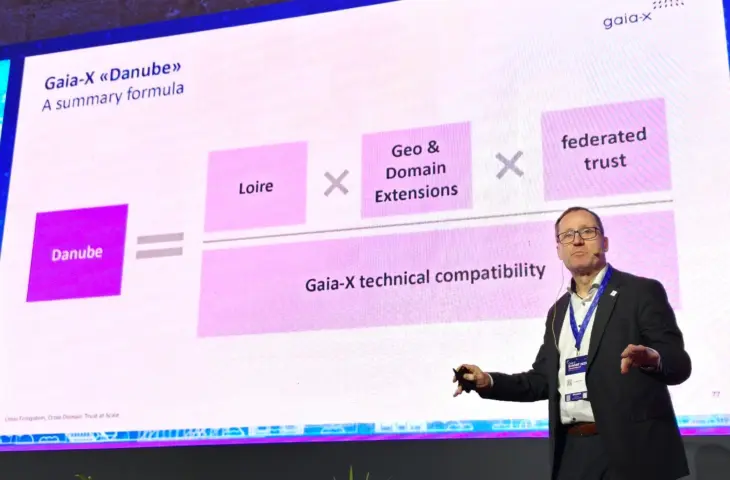
Gaia-X gets a new level of secure interoperability between sectors and regions with Trust Framework 3.0 – better known as Danube.
At the Gaia-X conference in Porto, Portugal, Christoph Strnadl, CTO of Gaia-X, and COO Roland Fadrany launch the Danube release of the Trust Framework project. Trust Framework 3.0 brings secure interoperability, including between sectors and regions.
The goal of Gaia-X and the new framework is to provide organizations with an architecture to share data in a secure, sovereign and decentralized way, with automatically built-in control over both the identity of participants and the rules regarding the data itself.
Extensions
This happens in practice in a so-called data space. Danube extends the capabilities of that data space both at the level of rules and regarding control over the participants themselves.
Danube automates compliance with regulations across borders. This is a crucial step in developing a federated digital ecosystem that remains workable and scalable.
The framework contains an extension mechanism that includes automation for arbitrary rules from different ecosystems, in a way that remains technically compatible.
Trust as an extention
In the previous release of the framework – Loire – the compliance system was baked into the core of Gaia-X. With Danube, that core works with extensions. The Loire compliance system itself becomes such an extension, but rules and compliance or identity mechanisms from other sectors or areas can also serve as extensions.
“With this release, building trust – within and, more importantly, between different ecosystems – is no longer a manual process,” says Strnadl. “With Danube, we can automate governance rules and compliance frameworks in an extensible way, enabling data spaces tailored to specific sectors and regions, while maintaining full interoperability.”
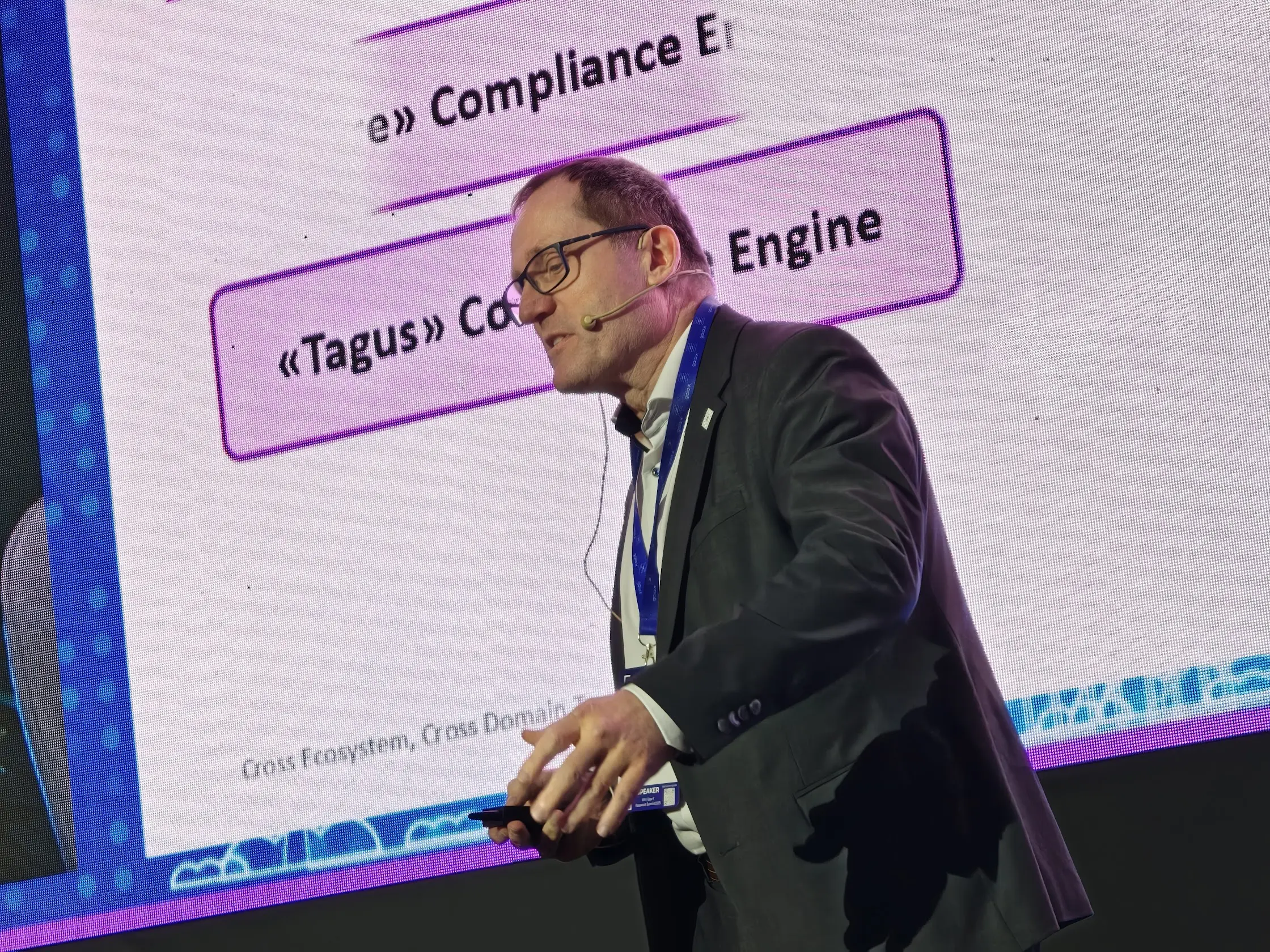
Organizations active within their own ecosystems and geographical regions can now embrace the Gaia-X Trust Framework without compromising interoperability.
Cross-border trust
Specifically, Danube enables different parties from different regions or sectors to participate in their own data space where they will share data. This data exchange is guided by the Trust Framework, which can both verify the identity of participants and take regulations into account.
With Loire, that framework was focused on collaborations within the EU and within sectors. Gaia-X provided identity control and compliance with EU rules in the database.
With Danube, Gaia-X now also offers a technical framework to verify compliance with industry-specific rules, as well as verify identities outside the EU. Think of a data space for companies from the aviation sector, with very specific rules, collaborating in a logistics chain that also involves Japanese companies.
BYOR
“With Danube, the Gaia-X framework is compatible with rules and criteria that almost no one knows and no one has heard of,” says Strnadl enthusiastically. He even gives the capability its own acronym: BYOR, short for Bring Your Own Rules.
With Danube, the Gaia-X framework is compatible with rules and criteria that almost no one knows and no one has heard of.
Christoph Strnadl, CTO Gaia-X
At the conference, Strnadl shows how Danube goes even one step further. Data exchange between data spaces from completely different ecosystems is even possible, although this does require participants to place trust in controlling identities from the other ecosystem.
The flexibility should help Gaia-X grow from a purely European initiative to a global architecture for organizations seeking digital collaboration across national and sector boundaries. This is an important theme at the conference. Gaia-X CEO Ulrich Ahle, for example, repeatedly emphasizes the interest from Japan, South Korea and Canada, among others, all of which have sent delegates.