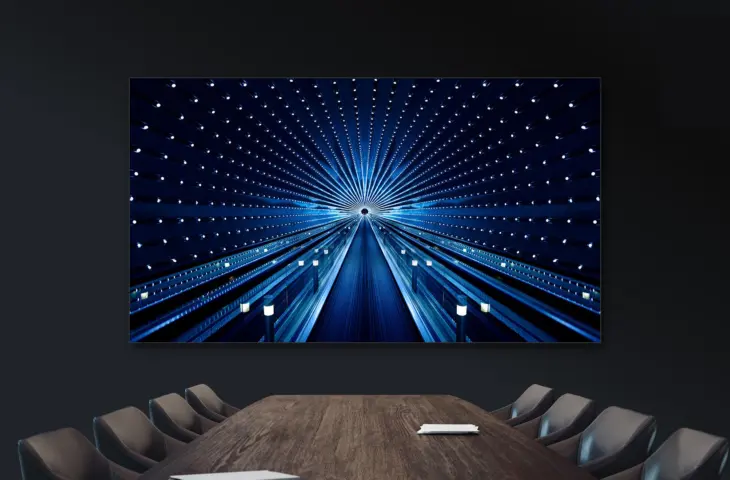
ISE may be a European trade show, but an American-style supersize trend is prominently present. Bigger, sharper, more pixels, and more robust are key words when it comes to meeting rooms.
In the conference meeting rooms of tomorrow, everything must be bigger. “We really see supersizing as a trend,” says Evert Van Camp, Head of Display Division at Samsung Benelux, during a conversation at Integrated Systems Europe (ISE) in Barcelona. “That has everything to do with people’s expectations.”
Expectations from the living room
As is often the case, the home situation of employees influences the requirements in the workplace. No one is satisfied with an unwieldy 2.5 kg work laptop these days, thanks to the slim and attractive consumer PCs that employees have become accustomed to at home. These same employees then sit behind their TV in the evening, where their expectations about screens are formed.
We used to think a 40-inch TV was big, but now people have a 65-inch TV screen at home.
Evert Van Camp, Head of Display Division, Samsung Benelux
Van Camp: “We used to think a 40-inch TV was big, but now people have a 65-inch TV screen at home, which they sometimes watch from their couch barely a meter away. Big is the norm for displays.” The meeting room has to keep up: anyone who watches their favorite show at home and sees all of the pores of the main character in detail is understandably dissatisfied when the other party in an important video meeting is barely visible on a screen that is too small on the other side of the meeting room.
More relevant since COVID
“In addition, meeting rooms have become more important in the office,” Van Camp outlines. “That is of course related to COVID. The office has evolved from a collection of individual workplaces with perhaps a single meeting room, to a collection of meeting rooms with a flexible workplace here and there.”
“Large screens are necessary to collaborate in hybrid meetings, and most meetings are hybrid today. Moreover, we use the screens to collaborate and present.”
More than a laptop screen
The shift to large and larger is taking place at all levels, starting with the small huddle rooms. “Initially, those rooms, suitable for a couple of people, didn’t even have an extra screen,” Van Camp recalls. “The laptop screen was sufficient. That is changing: now such small meeting rooms are equipped with a separate screen. Of course, that shouldn’t be too big, because you’re sitting close to it.”
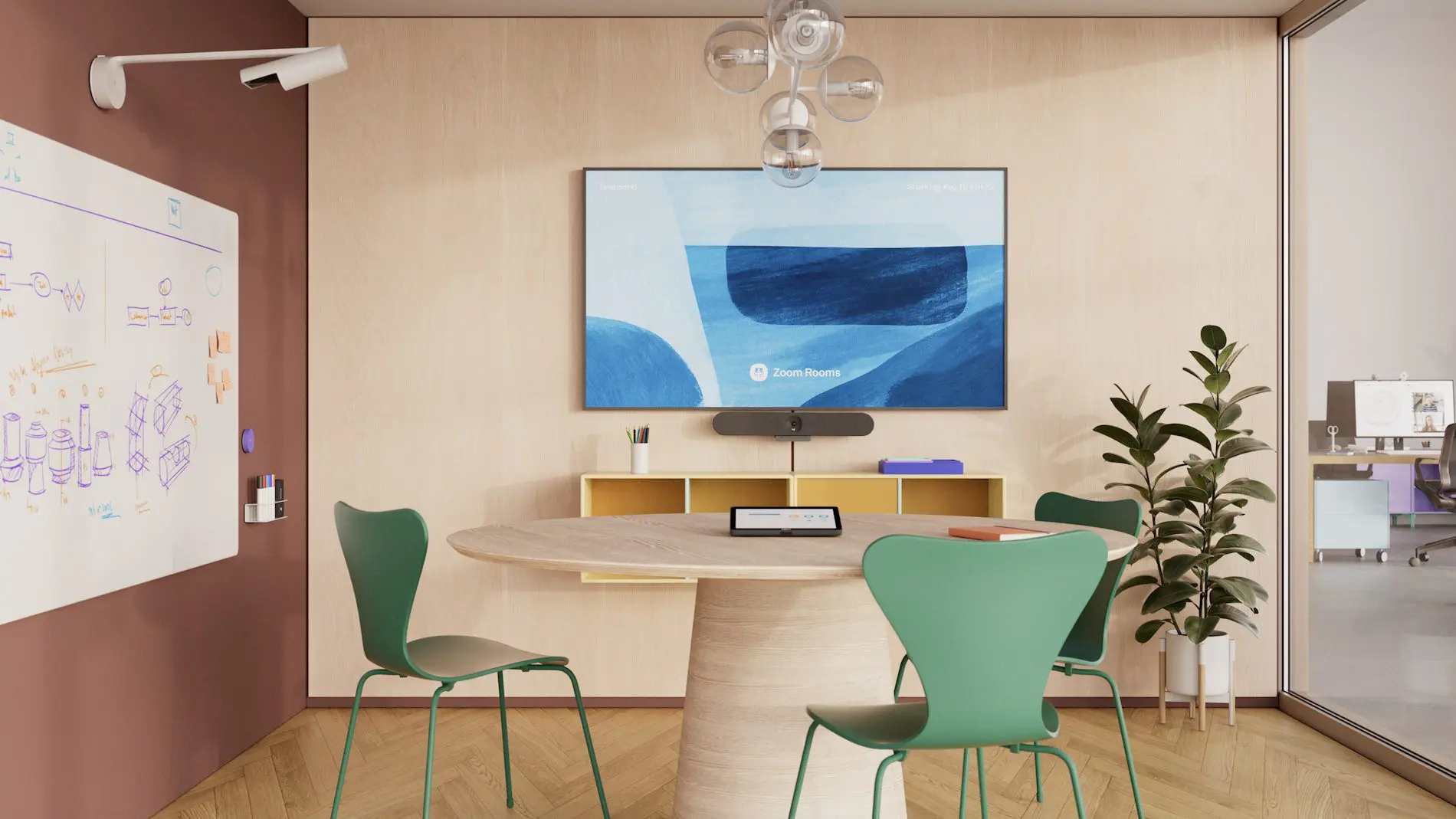
In larger meeting rooms, suitable for, for example, six to eight people, larger screens are present. They are often similar in size to TVs that people have at home, although these are professional displays. These are not only sturdier, but can be managed by IT teams and contain build in security.
Security
In the case of Samsung, that security comes from mature Knox Security platform, which also protects your Galaxy smartphone. Knox has been around since 2013 and includes various security components. Think of FIPS 140-3 and ISO 27001 and 27701 certificates, but also support for post-quantum cryptography.
“In the context of banks, government institutions and defense, that security is very important,” says Van Camp. “The story around Knox really resonates. After all, a financial institution wants to be very sure that data appearing on the screen is not simply reproduced somewhere else.”
read also
Cryptography in (Post-)Quantum Times: Fast Cheetah or Slow Sloth?
Big and bigger
In larger meeting rooms, setups with two screens are common. For the largest and especially the most premium meeting rooms, such as boardrooms, even that is not enough. There, organizations are increasingly looking for displays of 115 inches, 130 inches or even more.
At ISE, one solution stands out: Samsung’s 130-inch micro-RGB screen. That screen uses RGB LED technology, where the light behind the colored pixels can not only be switched on and off per small zone for deep blacks, but can also change color. If a lot of green is visible, the pixels are illuminated by green LEDs. The result is a contrast and saturation that stands out in a huge trade show with countless screens. Samsung is showing the first commercial model of this screen at ISE 2026.
The elevator is the limit
However, there are practical objections for those who want to put something like this in their most beautiful meeting room. Van Camp: “From 98 inches upward, you have to start checking whether the screen fits in the elevator. For 130 inches that is no longer an option at all, so you have to think carefully about how you will get such a display into the room.”
“And yes,” he laughs. “It has certainly happened that it only became clear on the spot that a partner would not be able to fit a large screen inside a customer’s premises. In that case, we will of course look for a solution together and, if necessary, take the display back.”
Biggest
Anyone who wants to equip a boardroom with a truly immense screen is still dependent on a modular LED system. LED is traditionally somewhat fragile, but Samsung provides a solution tailored to meeting rooms with a special coating over it. This makes the black values deeper and ensures that you can bump into the LED screen while presenting.
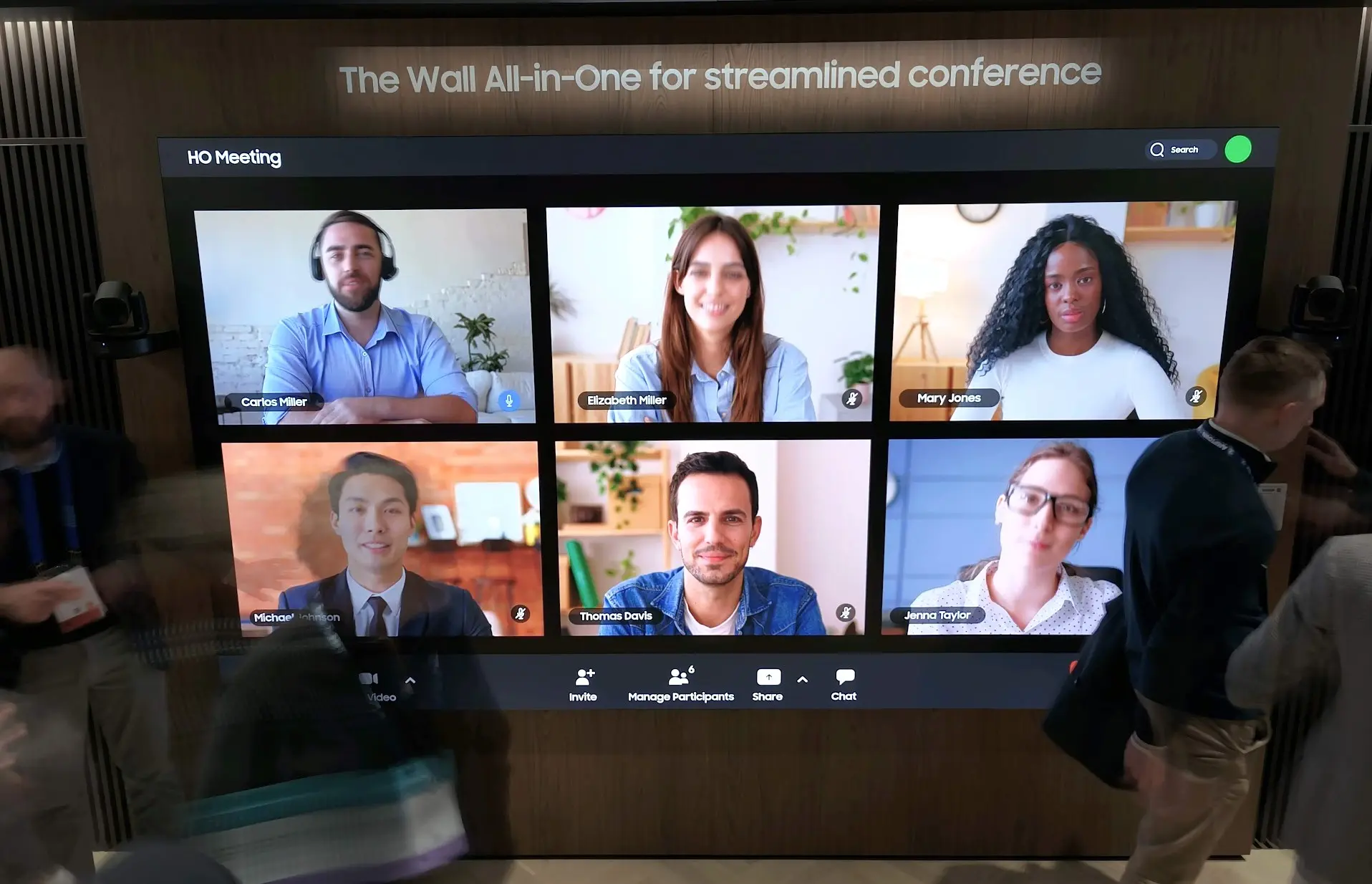
At ISE 2026, Samsung announced that its own Wall All-in-One, or Wall-in-One if you wish, is certified by Cisco. Samsung thus offers a total solution with an LED wall and Cisco equipment tailored to video meetings, which can be built in a few hours.
read also
Samsung’s large LED wall receives Cisco certification for boardrooms
Something that size obviously comes with a cost. For a truly high-end solution, with the best and finest LED diodes, you can think of pricing in the order of 100,000 euros. More common variants, which are also sufficient, quickly become cheaper with prices of 40,000 euros or 25,000 euros.
The standard in new construction
The price is a factor, but doesn’t really scare people off. “We sell dozens of LED walls for meeting rooms per year,” Van Camp knows. “In the past, a projector was used in such rooms, but you have to darken the room for that. When such offices are renovated, LED is often considered.”
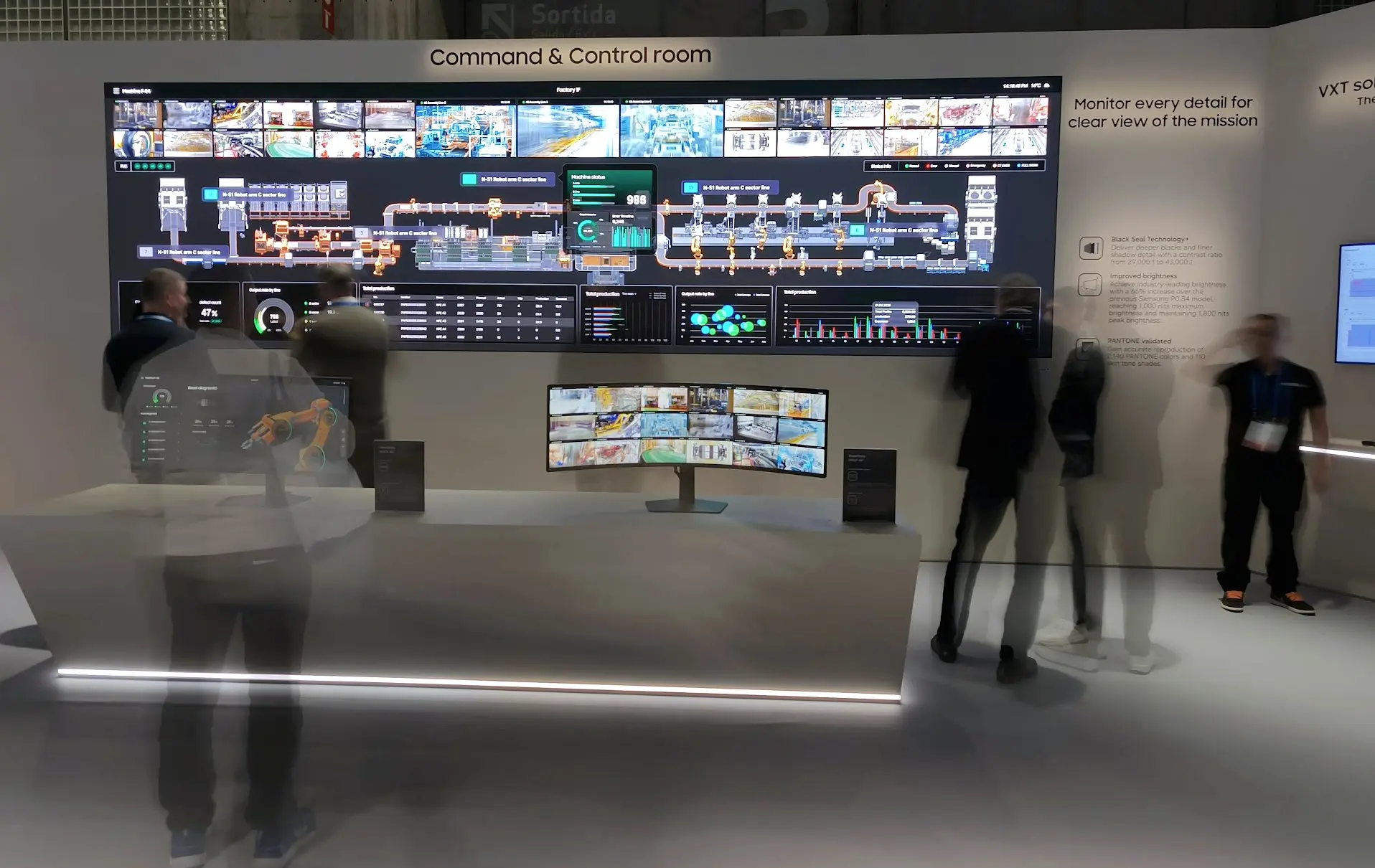
Van Camp sees solutions such as the Wall-in-One working well in new construction. “In such a case, an LED wall is usually considered for the most beautiful room. The cost of this is then included in the construction budget.”
More than IT
That illustrates that meeting infrastructure is more than just the perview of the IT departement. Meeting rooms with screens, cameras and microphones must be worked out and installed perfectly. “IT doesn’t always have the knowledge for that,” Van Camp knows. “AV people specialize in this.”
That realization also prevails in the market. It is for good reason that Benelux IT specialist Econocom has taken over multimedia integrator BIS. Setting up meeting rooms is a profession in itself, with not only an IT component but also a large AV component.
Furniture included
The role of a partner should not be underestimated, according to Van Camp. They can help assess what fits best in a room and provide not only the equipment. The right furniture is also provided by the partners.
On the manufacturer’s side, collaborations are also essential. Samsung is the market leader in screens worldwide and in the Benelux, but you can’t hold a hybrid meeting with just an LED wall.
Collaboration
“We are collaborating with all major Unified Communications parties,” says Van Camp. “We work together with Poly, Jabra and Barco, among others. Our collaborations with Cisco, Microsoft, Google and Logitech are the most in-depth though.”
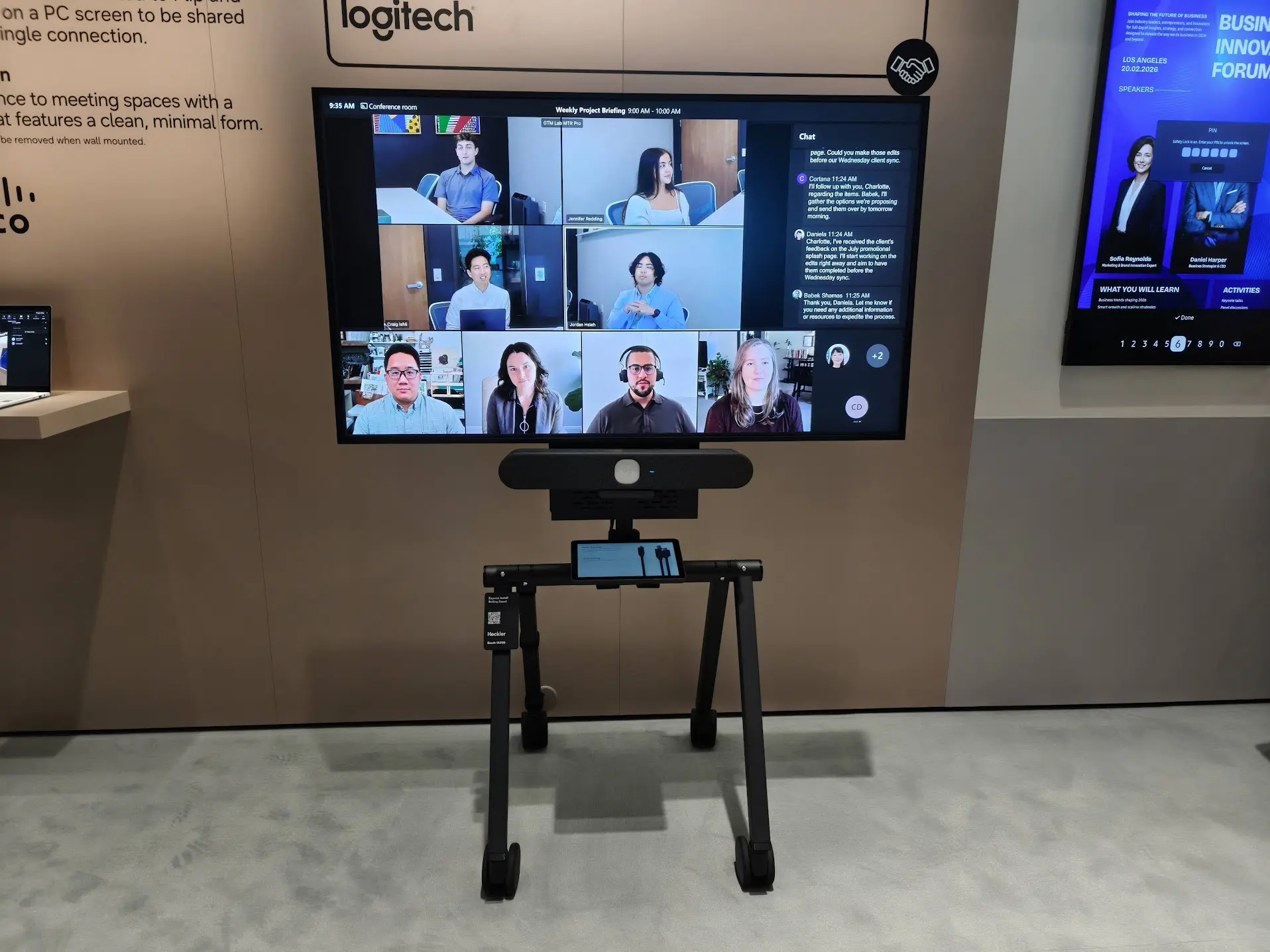
For example, Cisco also uses Samsung screens in its own solutions, which demonstrates the interaction between the two parties. In the US, you can then buy a total solution directly from Microsoft, which you can roll into an office with a Samsung screen, Logitech video bar and Microsoft Teams as a software solution, if it fits in there at least.
In any case, the role of a screen continues to grow, and more literally than ever. LED walls are evolving from exception to norm in large boardrooms, and smaller meeting rooms are also being equipped with increasingly larger screens. As long as all parties involved know the dimensions of the elevator in the office building well, there are few limits.