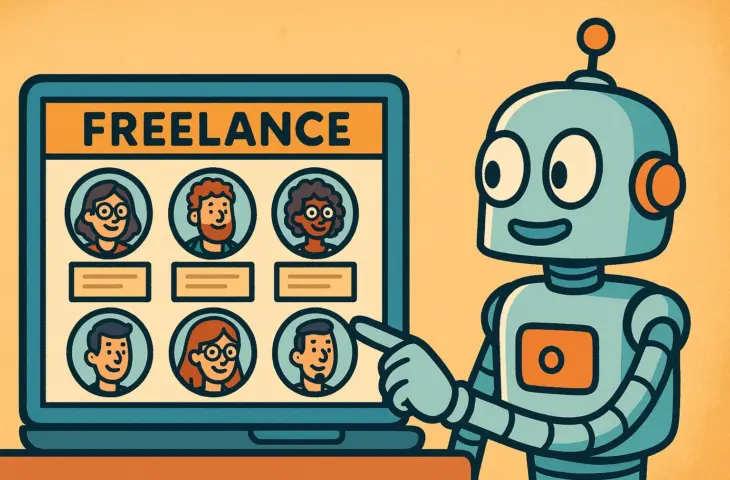
Specialized freelancers are an increasingly popular choice for companies looking for specific experts. An AI-based matchmaker can simplify that search.
For both freelancers and companies, finding the right match is anything but obvious today: the freelance pool is full of diverse profiles, but it is precisely this abundance that often makes the choice difficult.
Malt wants to simplify that search by using AI as a smart matchmaker. Companies can describe their needs in plain language, after which Malt’s AI-powered matching immediately puts forward the most relevant profiles and at the same time helps manage all practical matters related to the collaboration.
“Today we have 90,000 clients who are looking for independent talent via Malt, on the other hand, some 900,000 freelancers in Europe are active on the platform,” begins Claire Lebarz, Chief Technology Officer at Malt. The company also established a presence in Belgium four years ago. “Currently, there are 27,000 freelancers active in Belgium,” adds Gaelle Houyoux, Communications & Community Manager at Malt.
War on (IT) talent
The battle for IT talent is raging and many companies are looking for employees with the right knowledge and experience. Because permanent employees are not always easy to find, companies are setting their sights on freelancers. They can use their expertise to help companies with (temporary) assignments.
Approximately a quarter of all freelancers on the Malt platform are tech and data experts.
Claire Lebarz, Chief Technology Officer at Malt
“Approximately a quarter of all profiles on the Malt platform are tech and data experts. This category continues to grow, especially since Covid,” says Lebarz. In addition, she notes a subtle increase within the categories of finance, product development and marketing. “Management profiles in particular are experiencing growth of more than 40 percent in a year,” she knows.
“The landscape is very dynamic,” she adds. Moreover, freelancers shift between categories as their skills evolve, such as developers who are now reorienting themselves to become AI developers.
Belgian maturity
It is no coincidence that Malt joined the Belgian market four years ago. According to Lebarz, our country is much further ahead in the field of freelancers than France. “Belgian companies have evolved further in working with independent professionals and are much more open to this model, while in France that adoption is slower,” Lebarz notes.
Belgian companies are more open to the freelance model compared to France.
Claire Lebarz, Chief Technology Officer at Malt
Yet there are also similarities to be noted. “The type of profile of freelancers is very similar in both countries. The tech sector was the first to embrace the freelance model, but disciplines such as communication, marketing, finance, or legal quickly followed,” says Lebarz. Moreover, the rates are also largely at the same level.
Administrative Relief
Freelancers specialize in a particular field and help companies with temporary assignments. The last thing they want to deal with is administrative tasks or sending payment reminders. To ensure that they can focus on their expertise, Malt takes care of the administrative hassle.
“‘The contract remains between the freelancer and the end client, but via the Malt platform we guarantee payment and advance the amount, so that freelancers are paid faster and more reliably, even if the client only pays after 60 or 90 days,” Lebarz knows. Furthermore, they take over the entire section of invoicing and payment follow-up, so that freelancers do not have to pursue late payments themselves.
In addition, freelancers can have their own clients invoiced via Malt for a low commission, in exchange for pre-financing and administrative relief. Malt emphasizes that no subscription is required for freelancers and companies. “We only take a percentage once a project has been successfully completed,” says Lebarz.
AI understands what you are looking for
Malt’s platform is more than a marketplace for freelancers. “We are strongly committed to using AI to find the right match between freelancers and companies,” says Lebarz.
Instead of just entering keywords, a customer can describe the entire project in plain language or upload a document. AI converts that free text into a set of competencies, seniority levels, context and technical requirements. Based on this, a relevant shortlist of freelancers is made instead of a rough keyword search.
On top of that, the shortlist is enriched with a second algorithmic layer. “Based on historical data, the model searches for freelancers with relevant experience and a proven match with similar assignments,” says Lebarz. In addition to skills, factors such as the type of company, project goal or desired working method are also taken into account.
With AI Search, Malt aims to support the freelance market by finding the perfect match between companies and freelancers. “Based on AI, we first try to understand what the customer is really looking for, in order to then link the best possible profiles to it,” concludes Lebarz.