

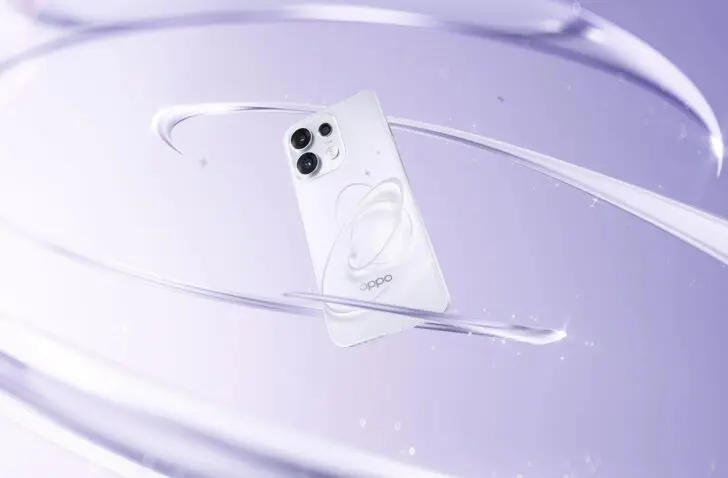
Oppo seems to be positioning the Reno series as the successor to the departed OnePlus. In terms of cameras, the Reno 16 Pro fully delivers, but less so in terms of performance.
Oppo is wasting no time with its Reno series. Eighteen months ago we reviewed the Reno 13, and we have already reached the Reno 16. There were only a few months between the launches of the Reno 14, 15 and 16 series. Why is Oppo in such a hurry? We don’t have to look far for the explanation.
OnePlus is departing
The Reno 16 Pro launched just as OnePlus closed the doors on the European market, and that is likely no coincidence. Just as striking as the timing is the pricing: at 1,099 euros incl. VAT, the Reno 16 Pro costs no less than 300 euros more. This is a significant increase that cannot be attributed solely to more expensive RAM. It is also probably not a coincidence that this is exactly the same price as the OnePlus 15 at its launch.
This strongly suggests that Oppo is pushing its Reno series forward to fill the void left by OnePlus. As a result, the Reno 16 Pro must play in a different league and compete with premium phones. Does it succeed? Is the Oppo Reno 16 Pro the OnePlus 16 that we will no longer see in Europe?
3D design
The Reno series does not shy away from outward show. Oppo often dares to experiment with design. The black model sent to our editorial office is quite conservative, but there is also a white version featuring a 3D figure integrated into the back. With a screen size of 6.3 inches, it is a ‘smaller’ smartphone that feels light and comfortable in the hand.
The screen is of more than decent quality. 1,216 x 2,640 pixels ensure a sharp image, although Google packs slightly more pixels into the same area in the Pixel 11 Pro (1,280 x 2,856). The Oppo Reno 16 Pro compensates for this with a higher refresh rate of up to 144 Hz, ensuring smooth visuals when playing video or games. The maximum brightness is rather modest at 772 nits.
Cameras steal the show
The cameras have been the flagship feature of the Reno series for years. Oppo targets content creators rather than business professionals. Over the years, it has introduced creative camera functions such as taking photos underwater. Video is not left behind, with support for 4K video (60 fps), optical image stabilization, slow-motion, and time-lapse videos, naturally supplemented by necessary and unnecessary AI functionality.
In terms of camera specifications, the Reno 16 Pro receives no noteworthy upgrades. The 200 MP main camera is again flanked by a 50 MP wide-angle camera and a telephoto camera. The front also features a 50 MP wide-angle camera that allows for self-portraits at different focal lengths.
Oppo chooses to keep what is good, and the cameras are simply good. The main camera captures a lot of detail, and images are rendered with correct and realistic colors. The wide-angle camera effortlessly maintains that sense of sharpness and color right to the edges of the frame. Whatever you try to photograph and however you do it, these cameras will very likely succeed.












Zooming like a Pro
With the Find X9 Ultra, Oppo may have put the best zoom camera ever into a smartphone. You shouldn’t expect the Reno 16 Pro to reach the same level, but the zoom camera in this device also performs at a high level. The 50 MP camera supports 3x optical zoom but can go surprisingly far with digital zoom before you start to see the first ‘grain’.
If you reach beyond 60x digital zoom, the AI takes over. The AI zoom will replicate details in the photo as accurately as possible: the hands on a clock will show you the correct time, even if you couldn’t read them with the naked eye. However, the further you zoom in, the more your photos start to look like a watercolor painting, so do not expect to be able to zoom in indefinitely without loss of quality.











Processor & performance: not so Super
The high level of the cameras does not extend to the internal hardware of the device. The Reno 16 Pro is equipped with a MediaTek Dimensity 8550 Super. That last word does not hide the fact that this is not the fastest racehorse from the MediaTek stable, and it certainly cannot compete with Qualcomm’s Snapdragon Elite chips.
Benchmarks show that the Reno 16 Pro does not perform at a flagship level. The difference with the Samsung Galaxy S26, which is a hundred euros cheaper, is visible. The scores even fall below the Pixel phones, for which we have been saying for years that the Tensor chips are on the ‘slow’ side in this segment. The biggest underperformer in this chart is the Samsung Flip 8: foldables still sometimes come with concessions.
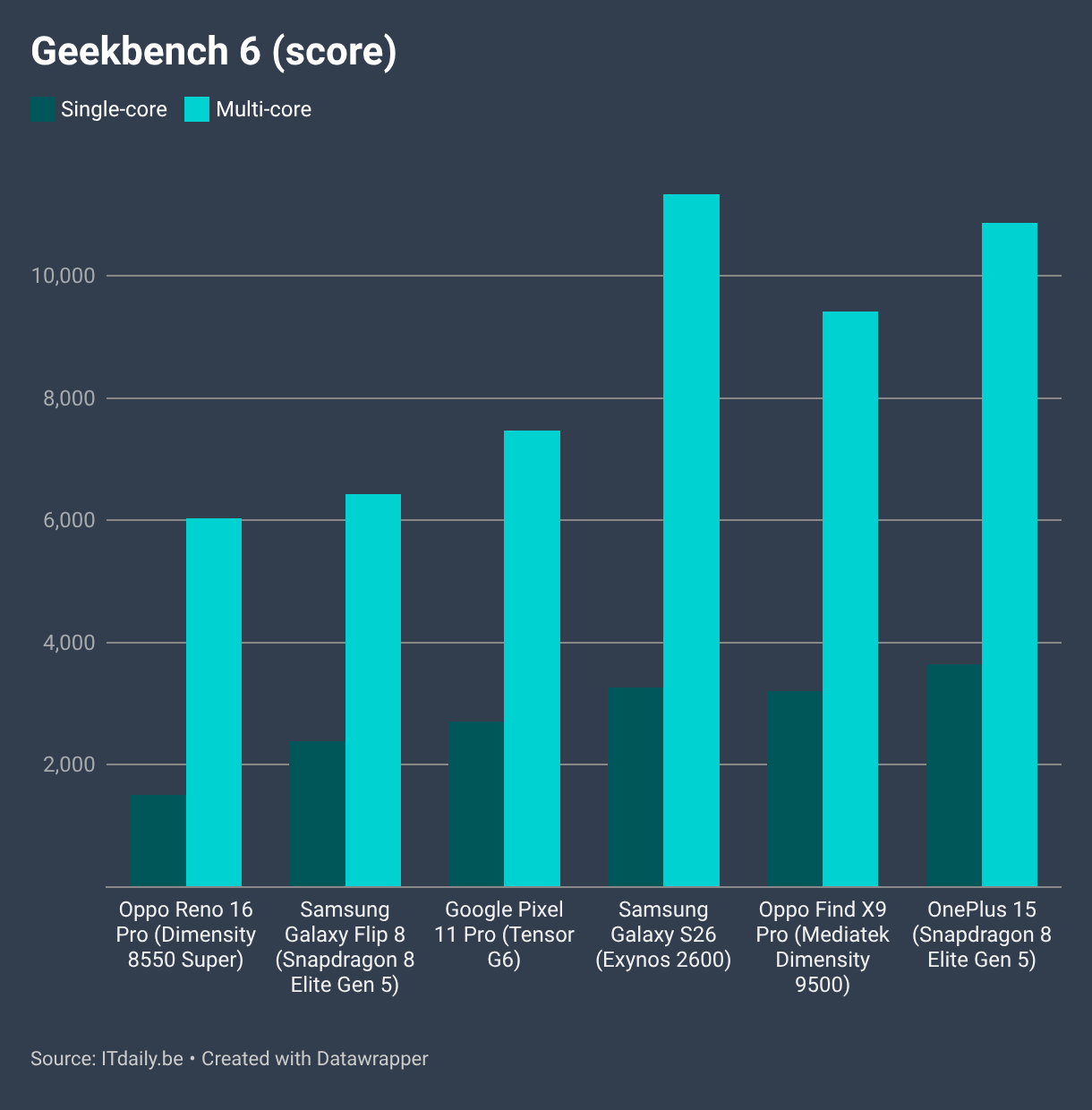
Looking beyond the numbers, we cannot say that the Reno 16 Pro doesn't do its job. During our testing period, we did not notice any stutters or visibly slow performance. With 12 GB of RAM and 256 GB of storage, you won't lack for anything in terms of memory.
GPU: consistency over power
We don't expect a graphic miracle chip. In terms of GPU performance, the OnePlus 15 remains the undisputed champion, although the S26 also has a lot of graphic power. The Reno 16 Pro's scores are low in comparison, but the device is strong enough to handle 3D games.

What does work in favor of the Reno 16 Pro is that the GPU performs consistently. It is not unusual for heavier GPUs to peak high but then drop back significantly. We see this with the Oppo Find X9 Pro and the Samsung Flip 8. The Reno 16 Pro may have a modest peak, but it continues to run at 82 percent of that peak.
Battery
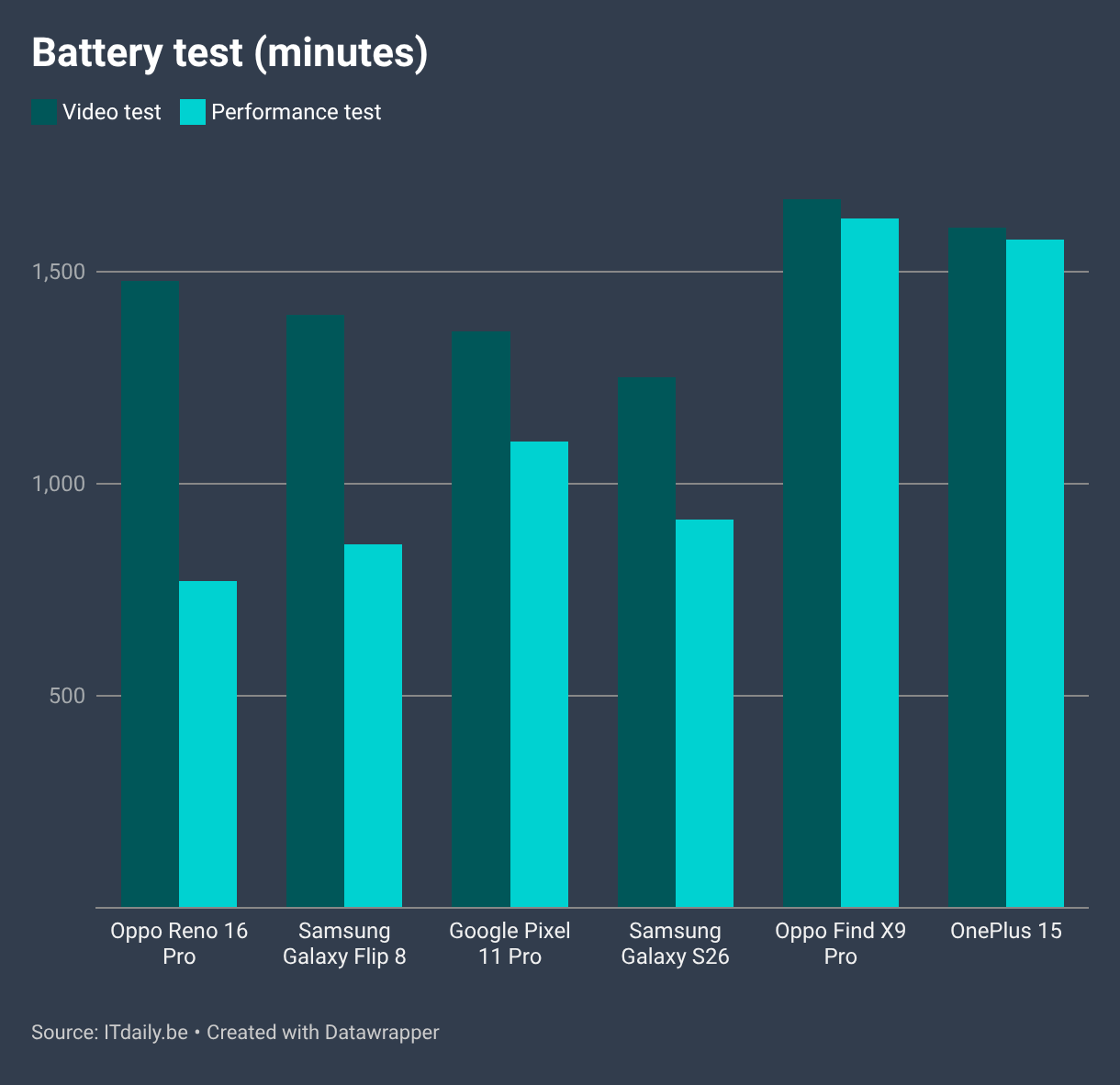
Smartphones have large batteries in 2026. The Reno 16 Pro joins the trend with 6,700 mAh. You can expect a good score on battery tests, and for video, that is certainly the case. Even at maximum screen specifications, we were able to stretch the battery to just under 24 hours. Knowing that these are not 'normal' usage patterns, you can be sure that in daily use you will also get 24 hours on a single charge.
Intensive use leaves its mark on the battery more quickly. In the performance test, it was over after thirteen hours. This is likely due to the processor being less able to handle continuous load. All other devices with 'heavier' internals perform better in this test, even if the battery is smaller.
Fast charger (wired)
The official specification list mentions a charging capacity of up to 80 W for the Reno 16 Pro. What we have repeatedly observed in tests of Oppo devices is that this promised charging speed is only achieved with a SuperVooc charger. If you don't have one, you're stuck with 55 W using a 'standard' Power Delivery cable.
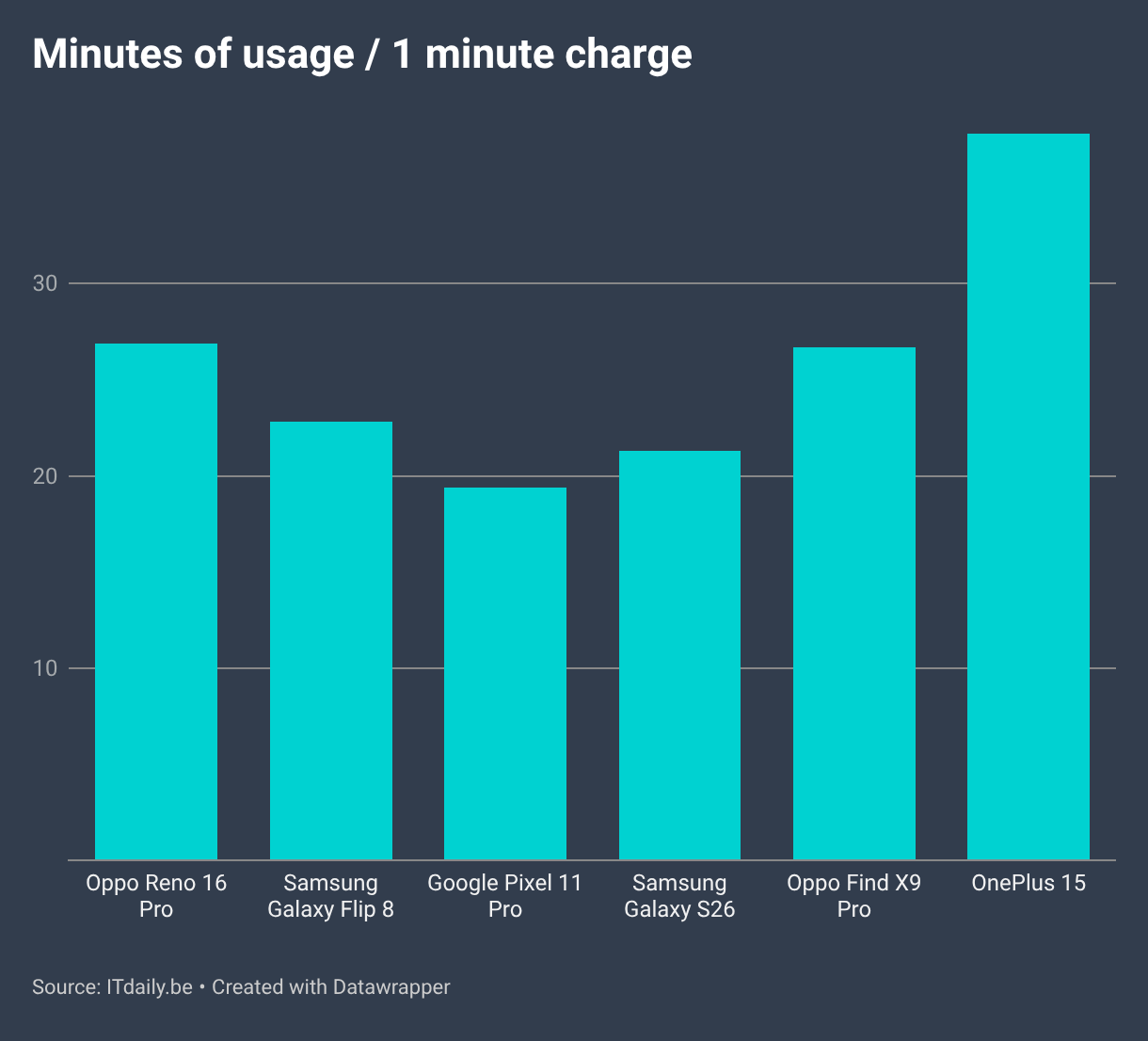
Even with that 'curtailed' charging capacity, the Reno 16 Pro achieves fast charging times. To reduce the factor of battery size as much as possible, we look at how many minutes of use you get per minute of charging. For the Reno 16 Pro, that is about 27 minutes, the same as the Find X9 Pro. Only the OnePlus 15 performs better.
The Reno 16 Pro does not support wireless charging. This is actually standard nowadays for phones costing a thousand euros or more. It shows that the Reno 16 Pro is not yet a full-fledged flagship.
Unprofessional software
Unfortunately, Oppo is once again guilty of recurring sins in terms of software. The ColorOS operating system is tainted with bloatware. When you first start this device, you might think you've received a second-hand phone because almost an entire home screen page is filled with pre-installed apps.
We are willing to overlook the folder of Oppo apps, but Chinese apps like TikTok, Temu, and Alibaba do not belong on your phone. The app that crosses all boundaries of decency is not of Chinese origin: with AutoDoc, you can order car parts. To do so, however, you must allow all kinds of trackers to be installed on your device. No thank you.
Once you get past the initial shock and the big cleanup is over, ColorOS is actually a perfectly fine Android skin. Oppo promises up to six years of software updates, in line with European regulations. Most competitors in this price range now offer seven. Here too, Oppo could have shown it was serious about the Reno 16 Pro, but it missed the opportunity.
Conclusion: big shoes to fill
With the Reno 16 Pro, Oppo's mid-range series takes its first cautious steps into the premium segment. In terms of design, battery, and certainly cameras, the device has earned its place there, but in terms of performance, the device is still punching above its weight. The question is whether the Reno series needs to make that step.
In this review, we have repeatedly compared it to OnePlus. It is not in the highest price segment that the departure of OnePlus will be missed, as Oppo already has the Find X series. For the (higher) mid-range segment, the Reno 16 Pro has all the ingredients to be a standout. This device can fill the shoes of OnePlus, if Oppo gives it the right shoe size.
Tested: Oppo Reno 16 Pro CPH2863 – MediaTek Dimensity 8550 Super, 12 GB RAM, 256 GB storage, 6,700 mAh battery, Android 17, 6 years of updates – 1,099 euros incl. VAT.
Pros
- Flagship-worthy cameras
- 144 Hz display
- Good battery life
- Fast charging (wired)
Cons
- Distracting bloatware
- Wireless charging not supported
- No premium processor
- Significant price increase