


Open Secure AI Alliance launches SAFE guidelines and expands with Mistral, Amazon, and Visa for better AI agent security.
At the Black Hat conference in Las Vegas, the Open Secure AI Alliance (OSAA) is demonstrating its serious ambition to bring collaboration and openness to AI, in a quest for a framework for secure artificial intelligence. To this end, the Linux Foundation is publishing a Request for Comments for a new concept: the Shared AI Findings Exchange (SAFE).
SAFE includes new guidelines designed to turn cybersecurity incidents involving AI agents into shared protection for the entire sector.
Confidential sharing
SAFE will confidentially collect data on incidents and near-misses involving AI agents and provide analysis. The goal is to inform involved parties, identify recurring vulnerabilities, and publish recommendations that reduce systemic risk. In doing so, OSAA members explicitly want to move away from the culture of secrecy that is the norm in cyber incidents today, which prevents the entire sector from growing together.
Nvidia, Cisco, CrowdStrike, Hugging Face, and Red Hat, among others, worked on the initial proposals. According to the alliance, rapid collaboration is necessary because every technological shift creates new attack surfaces, and defenders must be able to react as quickly as the agents they protect.
Contributions throughout the full AI security stack
In addition to SAFE, members of the alliance are also providing other concrete tools. Nvidia is contributing the NOOA research environment, the OpenShell runtime, and various open models such as Nemotron and Cosmos, supplemented by security tools like Garak and NeMo Guardrails.
In the area of identity and access, Okta, Palo Alto Networks, and Red Hat are contributing projects that determine who or what can interact with an agent. Amazon, joining the alliance today, is bringing in its Strands Agents toolkit and the Cedar authorization system. Capital One, Cloudflare, Microsoft, and Wiz are also providing tools to test and monitor agent behavior.
At the model level, Cisco, CrowdStrike, and Mistral are working on specialized security models, while Akamai, Perplexity, and Uber are focusing on the detection and analysis of agent activity. Visa is also joining the alliance with its own tool for vulnerability research. Finally, LangChain and Veeam are focusing on resilience, so that agents can safely resume after a failure without data loss.
With SAFE and the additional tools, the Open Secure AI Alliance aims to make security around AI agents less dependent on individual companies. By sharing incidents and solutions, organizations should be able to learn from each other’s experiences more quickly.
Momentum
The momentum seems enormous. After all, the Open Secure AI Alliance was only launched last week. In just one week, the number of members has exploded, and the alliance is trying to demonstrate its relevance with concrete plans.
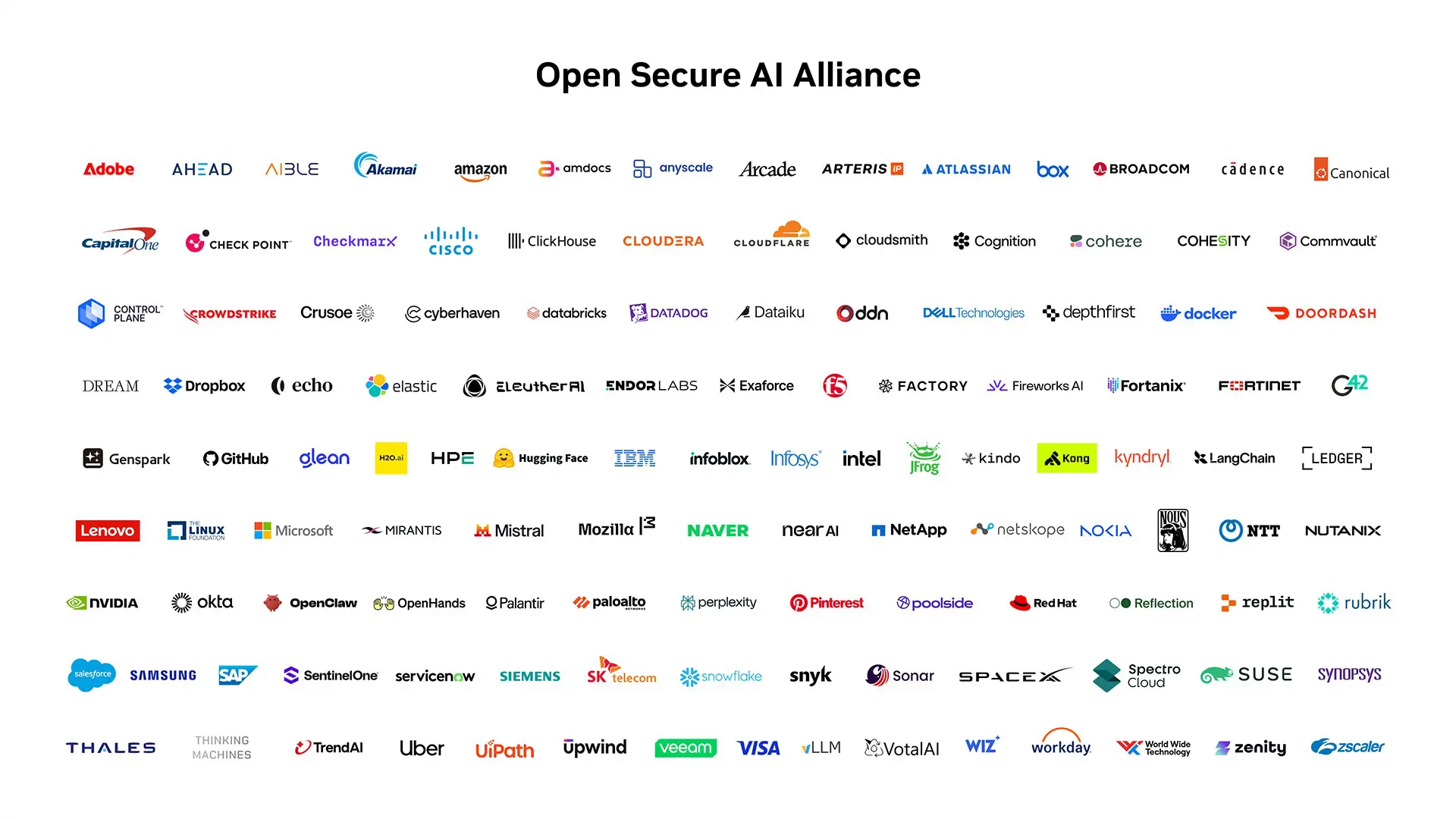
The organization now has more than 120 members. Mistral’s name was not yet on the roster at the alliance’s launch, and major security names including Fortinet and Check Point are also new, as are Amazon and Visa. Notable absentees remain OpenAI, Anthropic, and Google. Google is the only one of the three hyperscalers that builds its own frontier AI models and the only one that has not yet backed the open approach.