


If you’re expecting innovation in every possible area, Google’s Pixel 10a isn’t for you. The smartphone shows hardly any improvement over the Pixel 9a.
For years, Google has been trying to follow a clear formula with the Pixel series: strong cameras, a pure Android experience, and smart AI features for a relatively competitive price. The Google Pixel 10a (549 euros incl. VAT) continues that tradition. The device is Google’s latest mid-range model, aimed at users who want a premium smartphone experience without paying a flagship price. With a Tensor chip, an excellent camera, and long-term software support, the Pixel 10a looks like an attractive choice once again.
Yet, this model is also a rather meager update. Much of the hardware is similar to the previous generation, meaning the real improvements are mainly in software and minor details. So the question is: is the Pixel 10a still one of the best choices right now, or would you be just as well off buying a Pixel 9a?
Minimalist and flat
In terms of design, Google stays true to the minimalist Pixel style. The Pixel 10a has a fairly sleek and simple design with rounded corners and a matte finish. The device measures approximately 153.9 × 73 × 9 mm and weighs around 183 grams, making it comfortable to hold and not too heavy.
The back is made of plastic, while the frame is aluminum. This means the device doesn’t feel as premium as glass smartphones, but it does make the Pixel 10a robust, earning it an A rating for drop resistance. Furthermore, the phone features IP68 water and dust resistance, which is rare in this price range.

Notably, the back is completely flat. The device doesn’t wobble on a table due to the lack of a protruding camera island. This issue is easily solved with a case, but for those who prefer to take risks and use their smartphone unprotected, it’s undoubtedly a welcome update. On the front is Gorilla Glass 7i, which should be more resistant to scratches and cracks than previous generations. The smartphone is available in several colors, including black, white, purple, and red. With this, Google offers slightly more variety than with earlier models.
The design isn’t revolutionary, then, but it is solid and practical. For a mid-range phone, the Pixel 10a feels sturdy and well-finished.
Clear content consumption
The Pixel 10a features a 6.3-inch OLED screen with a resolution of 2424 × 1080 pixels. The screen supports a 120 Hz refresh rate, making scrolling and animations feel very smooth. Brightness can reach a peak of about 3,000 nits, ensuring the screen remains legible even in bright sunlight. The colors are typical for OLED: deep blacks, vivid tones, and high contrast. This makes the screen ideal for videos, social media, and games.
Google uses Actua display technology for the screen, which is intended to improve color reproduction and energy efficiency. In practice, the screen feels very sharp and responsive. While some competitors offer even higher resolutions, Full HD+ is more than sufficient for a device of this size. The combination of OLED and 120Hz primarily ensures a very pleasant daily user experience.
Performance and hardware
Under the hood, the Pixel 10a runs on the Google Tensor G4 chip, the same processor used in some previous Pixel models. The chip is primarily optimized for AI tasks and image processing. The processor is paired with 8 GB of RAM and 128 or 256 GB of storage. For daily use such as multitasking, social media, and photography, this is more than enough. Apps launch quickly and everything feels smooth.
Performance here is more than decent for most users. With this chip, Google focuses primarily on AI functionality such as voice recognition, photo processing, and smart assistant features. Additionally, the Pixel 10a features the Titan M2 security chip, which provides extra protection for data and biometric information.
Software and AI features
The Pixel 10a runs on Android 16 and will receive seven years of Android updates, Pixel Drops, and security patches. We were pleased to see that there is no bloatware in the app list. Competitors like OnePlus and Motorola could learn a thing or two from that. Under the hood is the Google Tensor chip, combined with 8 GB of RAM. That processor isn’t necessarily designed to break records, but rather to ensure AI functions and image processing work well.
Our benchmarks confirm this. The Pixel 10a scores well on everyday tasks such as browsing and emailing, and it clearly outperforms the Nothing Phone 4a and the Motorola Moto G86. In the premium segment, the Tensor chip punches above its weight class, but for a mid-range device like the Pixel 10a, it’s the right choice.
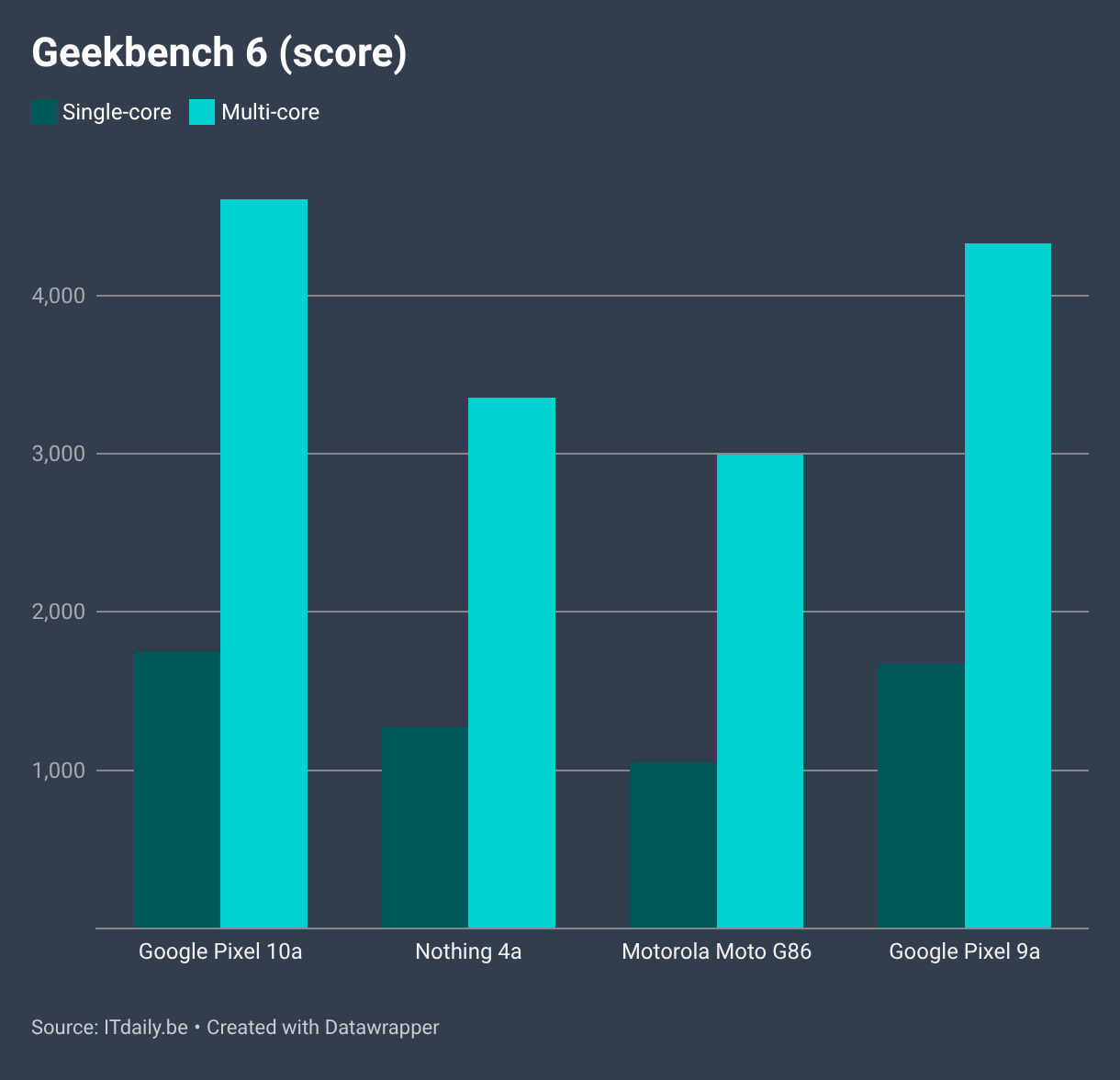
However, the Pixel 9a remains slightly faster during heavier tasks such as photo editing. This difference is minimal in daily use, but it also shows that the Pixel 10a doesn't reach new heights and adds nothing in terms of hardware compared to the previous model—on the contrary.
Camera
The camera has been a strength of Pixel smartphones for years, at least if you don't zoom in often, and that also applies to the Pixel 10a. The device features a 48 MP main camera and a 13 MP ultra-wide-angle lens. A telephoto lens is missing, leaving you with only disappointing digital zoom.
The photos below clearly show why Pixel cameras are so well-loved. Landscape photos along the canal show beautiful detail: the sky remains clear while the shadows still contain detail. Colors are also rendered very naturally. In photos of trees, water, and buildings, tones remain realistic without excessive saturation. This ensures that images look less artificial than on some other smartphones.




In evening photos, such as the one of the illuminated statues and the tree in the dark, it's striking how well the night mode works. The camera manages to retain a surprising amount of detail while noise remains limited.


The ultra-wide-angle camera is slightly less sharp than the main camera, but still very usable for landscapes and architecture. Pixel software plays a major role here by automatically optimizing contrast and color.
Battery life
The Pixel 10a features a battery of approximately 5,100 mAh, which translates into excellent battery performance. During the video test, the Pixel 10a lasts about 1,260 minutes. That's over twenty hours of continuous video playback, clearly outperforming the Nothing Phone 4a and the Moto G86. When the processor is under heavier load, the device remains active for about 1,020 minutes. The Pixel 9a performs slightly better here, but the difference remains limited.
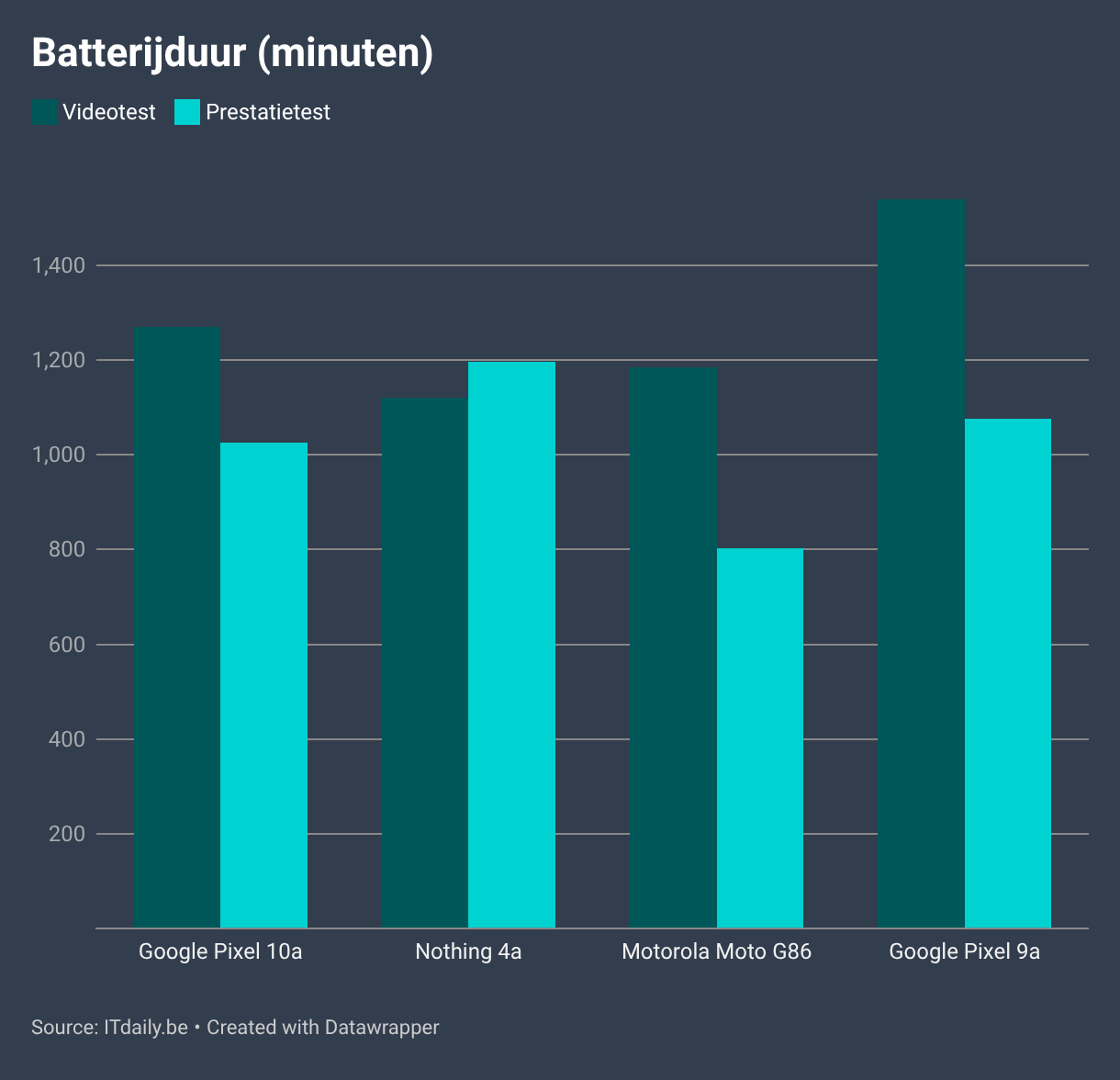
This means the Pixel 10a can easily handle a full day of intensive use. With average use, it can even push toward a day and a half of battery life.
Charging
Pixel phones have never been known for their fast charging times, and it's no different here. Charging from 0 to 50 percent takes about 26 minutes, while 0 to 80 percent takes about 49 minutes. That's not the fastest charging speed on the market, but it is reasonable for a device in this price range. Some competitors charge faster, but Google clearly prioritizes battery health and efficiency.
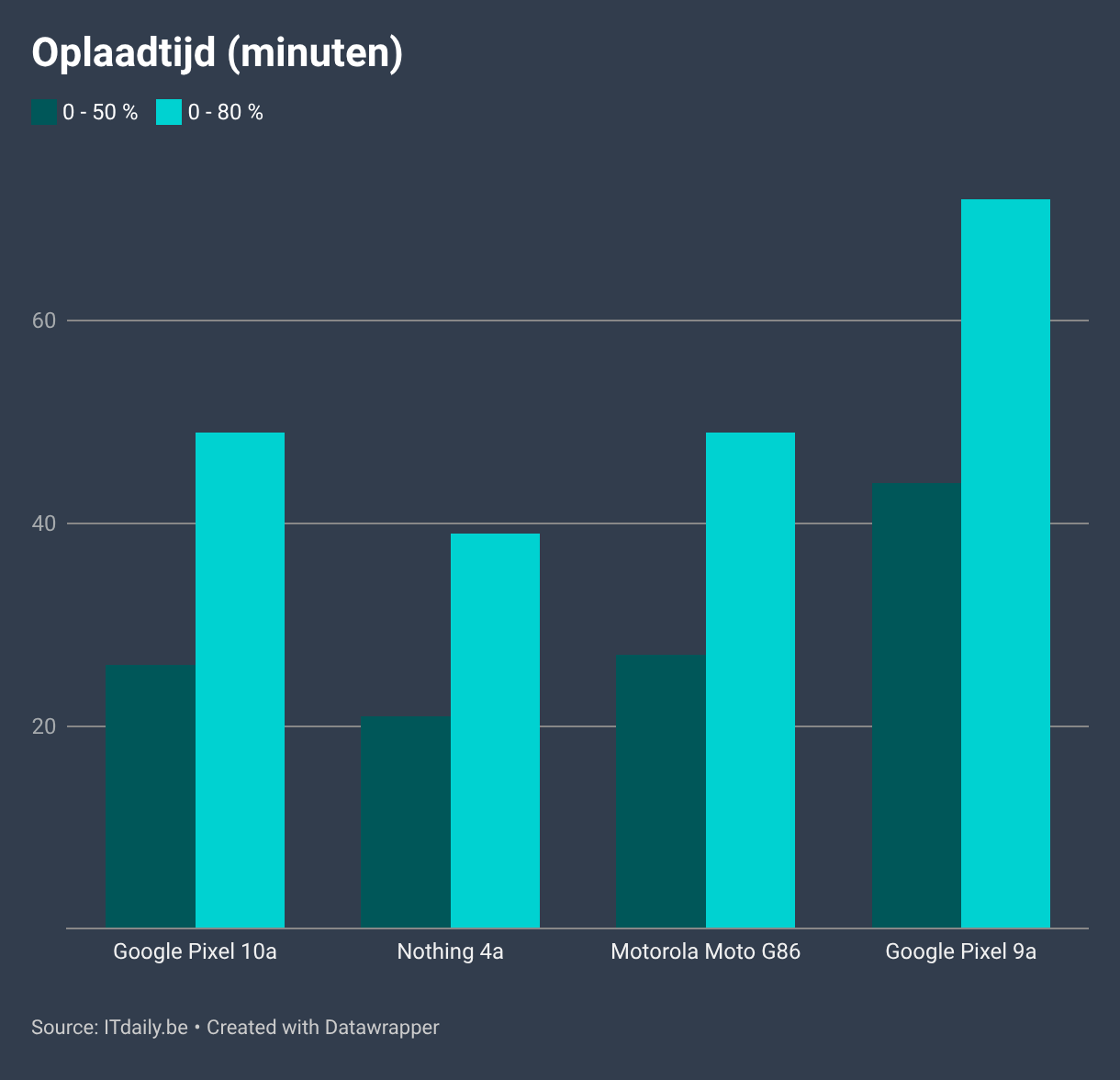
For daily use, this means a short charge is often enough to keep you going for hours.
Conclusion
The Google Pixel 10a is once again a strong mid-range contender that excels primarily in software, camera, and user experience. The device offers a bright OLED screen, a reliable battery, an excellent camera, and one of the best update promises in the smartphone world.
For users with an older smartphone, the Pixel 10a remains a very attractive choice. The combination of a good price, long software support, and solid cameras makes the device one of the better smartphones in its price range. The main drawback is that the hardware hardly differs from the previous generation. Those who already have a Pixel 9a will likely see little reason to upgrade.
Tested: Pixel 10a, 549 euros incl. VAT, 7 years of Android and security updates, eco-label A
Pros
- Flat design
- Bright OLED screen
- Solid cameras (except for the zoom)
- Good battery
Cons
- Little difference compared to the Pixel 9a
- No digital zoom