

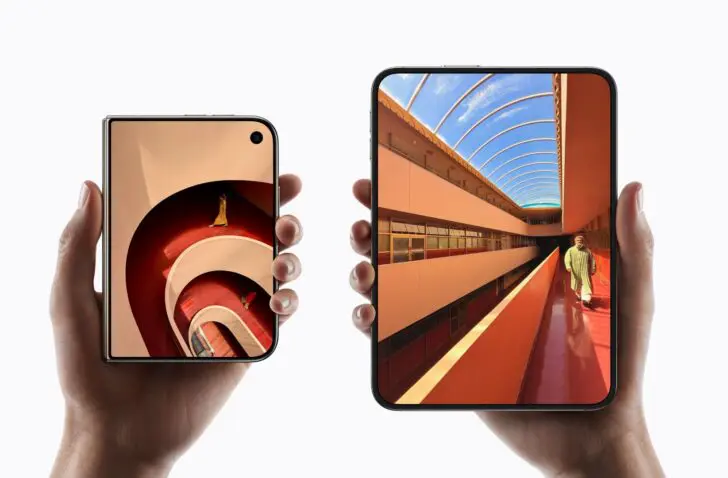
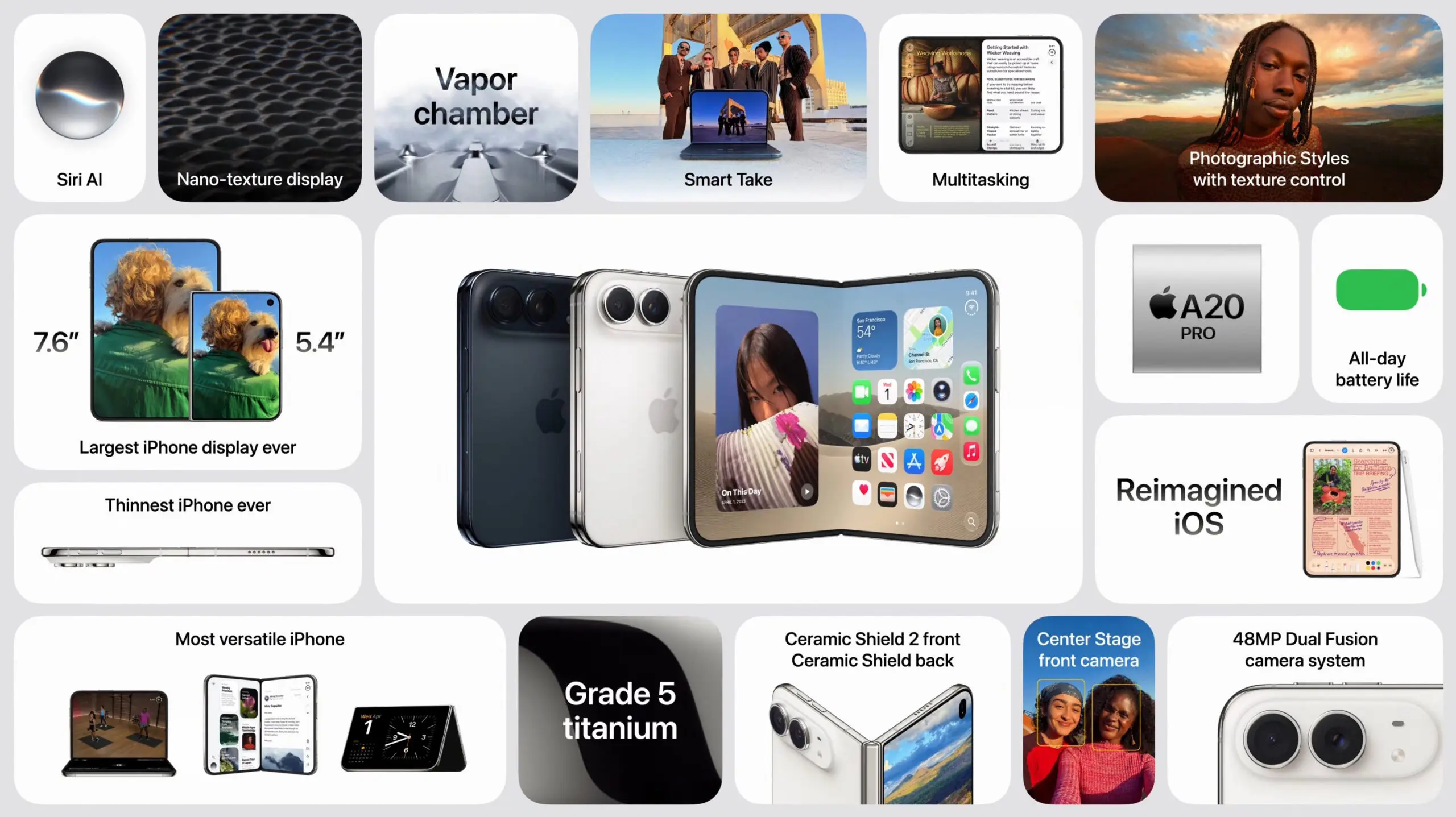
After seven years, Apple is entering the foldable market with the iPhone Duo: a titanium device in passport format with a 7.6-inch inner screen, a 5.4-inch outer screen, the A20 Pro, and Touch ID instead of Face ID. The Duo starts at 2,339 euros, will be available from October 23, and works exclusively with eSIM.
The iPhone Duo is the centerpiece of the first keynote under John Ternus, and the new CEO doesn’t hold back on the superlatives: “the most transformational change to iPhone since the original.” It is the first iPhone with two screens and the first Apple device with a flexible display. When unfolded, Apple claims it is the thinnest iPhone ever.
The fact that Apple is recycling that name from Microsoft’s ill-fated 2020 Surface Duo will likely be greeted with a wry smile in Redmond.
The Duo immediately fills a gap in the lineup: the standard iPhone 18 will not be released this fall. Apple said nothing about it during the keynote. It is possible that the scarcity of memory and chips plays a role and that Apple is consciously choosing the more expensive models, iPhone 18 Pro and 18 Pro Max, which were introduced earlier in the evening.
Two screens, one chip
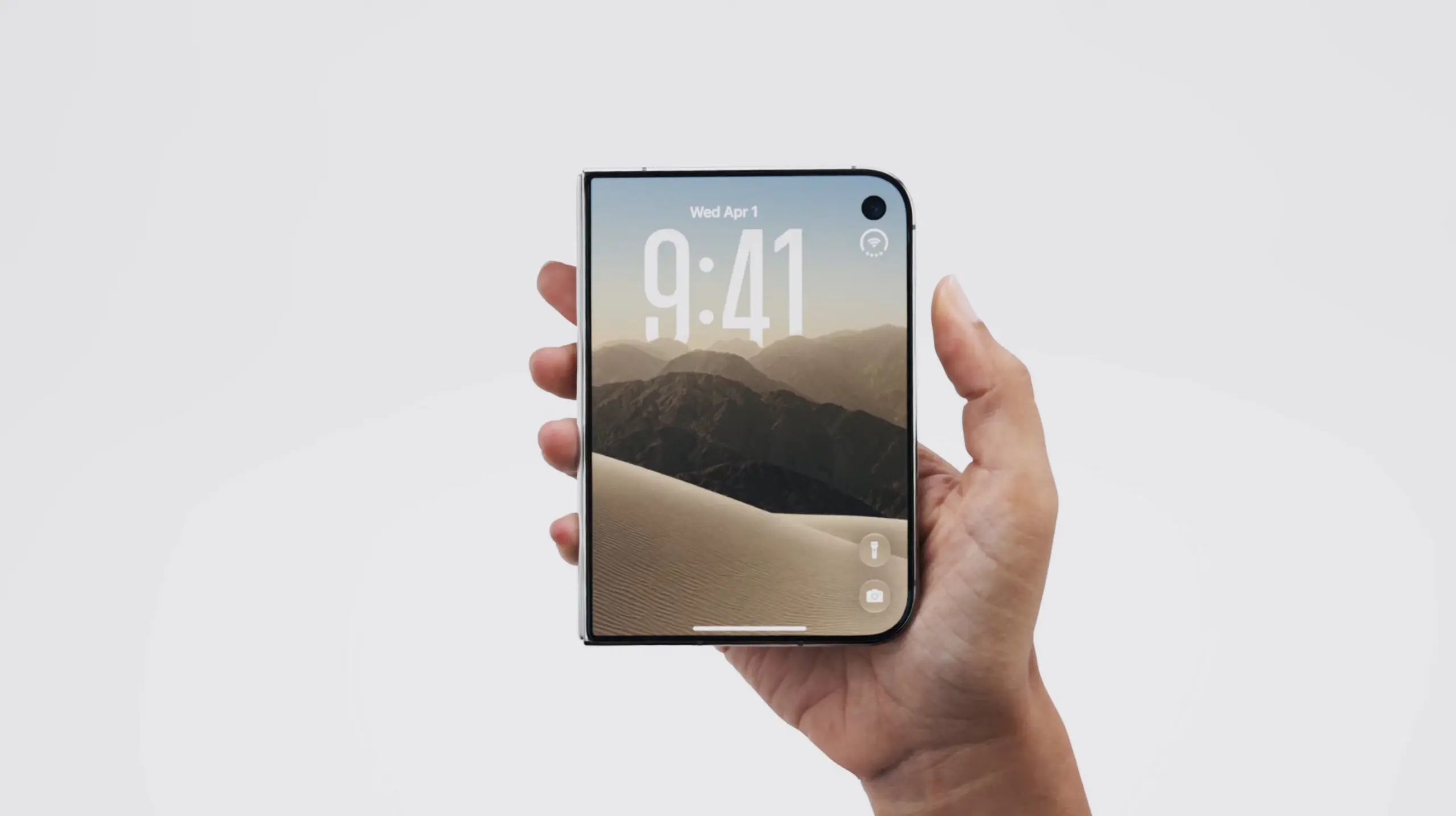
When closed, the Super Retina XDR outer screen measures 5.4 inches (5.36 inches measured as a rectangle), accounting for 90 percent of the screen area of an iPhone 18 Pro. When open, that becomes 7.6 inches (7.58 inches), which according to Apple is 50 percent more than an iPhone 18 Pro Max. Both screens share the same aspect ratio, so that apps scale proportionally when unfolding, a choice that distinguishes Apple from Samsung’s narrow outer screen. Both panels offer ProMotion, Always On, and 3,000 nits peak brightness.
The inner screen features a nano-texture finish: a matte layer that dampens reflections and is primarily intended to hide the crease, the point on which every foldable device has been judged until now. The FaceTime camera is hidden under the inner screen. Support for Apple Pencil with USB-C on both screens will follow later this year.
Titanium, a 100-part hinge, and Touch ID
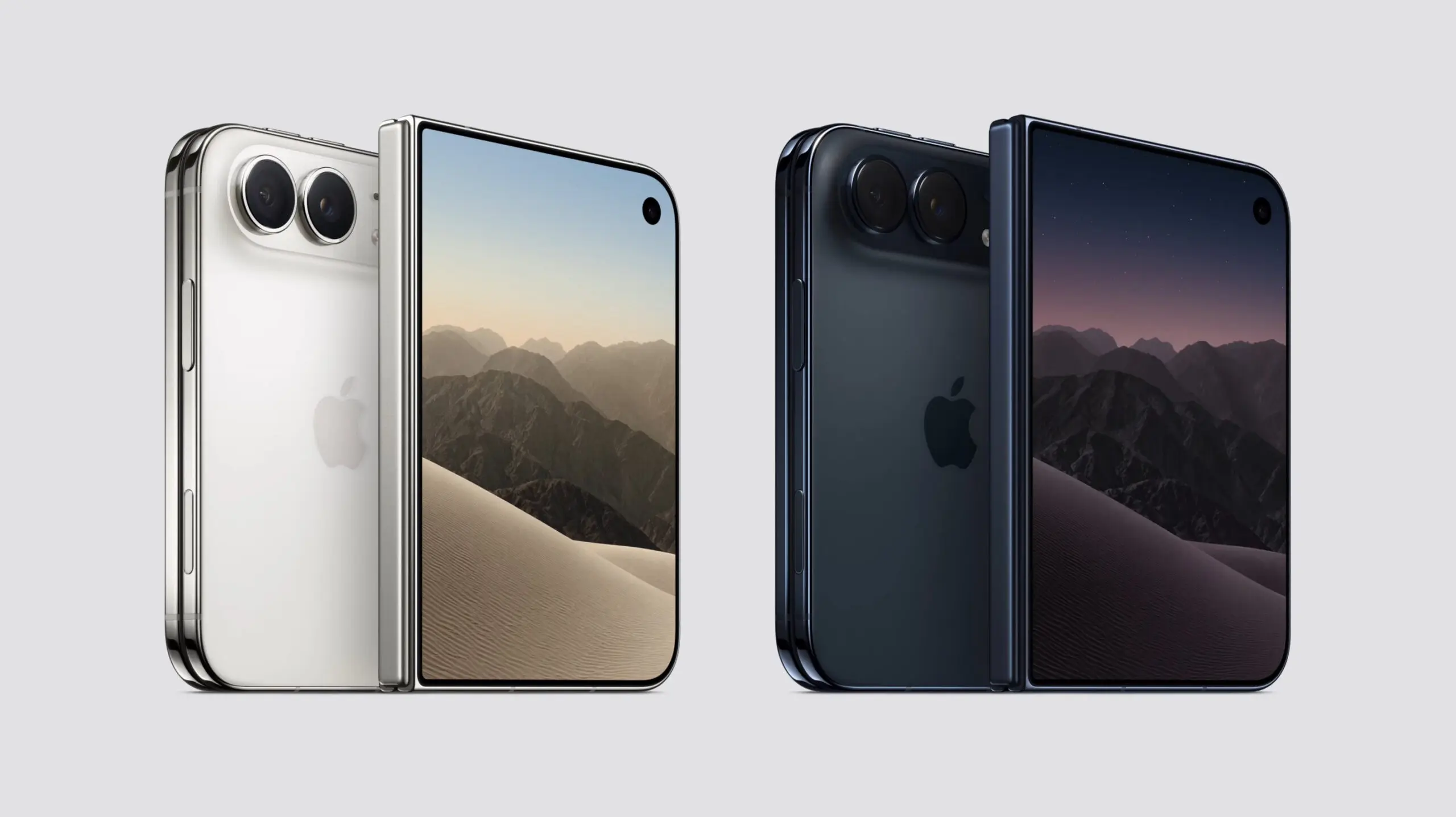
The housing is made of mirror-polished grade 5 titanium, the material that Apple replaced with aluminum for the iPhone 17 Pro last year. The hinge cover is 3D-printed from fully recycled titanium. The hinge consists of more than 100 parts, supports the center of the screen, and closes with a series of magnets. Ceramic Shield is on the back, while the front features Ceramic Shield 2 with three times better scratch resistance; the device is IP68-certified up to 6 meters.
The foldable screen itself receives a scratch-resistant coating and a polymer layer that Apple claims is up to 40 percent stiffer than what the industry currently uses, with glass layers that slide past each other “like the pages of a book.” Face ID is absent. Apple has built Touch ID into the side button so that the device unlocks the same way whether open or closed, and also allows unlocking via Apple Watch.
It is the first new iPhone without facial recognition since the iPhone SE, and at 2,339 euros, it is a notable concession to the thickness of the hinge section. Camera Control remains, including the new Siri Camera mode.
A20 Pro, two batteries, eSIM only
The Duo runs on the same 2-nanometer A20 Pro as the iPhone 18 Pro: a six-core CPU that is up to 20 percent faster than the A19 Pro, a seven-core GPU (+40 percent), a dual 16-core Neural Engine, and 50 percent more memory bandwidth. A new display engine drives both screens simultaneously. Here too, the chip is connected directly to a vapor chamber via a new packaging method; Apple claims 35 percent more sustained performance than the iPhone 17 Pro, slightly less than the 40 percent it specifies for the 18 Pro.
Each half of the device has its own battery; algorithms allow them to function as a single cell. Apple provides three figures: up to 31 hours of video on the inner screen, up to 44 hours on the outer screen, and up to 24 hours of use with equal use of both. Wired, the Duo charges to 50 percent in about 20 minutes, or in half an hour with MagSafe or Qi2, using separate 60W and 35W chargers respectively.
The Duo is eSIM-only worldwide. Apple uses the space from the SIM tray for the battery. For the Belgian and Dutch markets, where eSIM still faces hurdles with some operators and business subscriptions, this is a practical point of attention. The N1 chip provides Wi-Fi 7, Bluetooth 6, and Thread; the C2 is Apple’s second-generation in-house 5G modem.
Camera: no variable aperture, but plenty of folding tricks
There are two cameras on the back: a 48-megapixel Fusion main camera with an integrated 2x telephoto lens via sensor crop, and the same 48-megapixel ultra-wide angle as in the 18 Pro, with macro. The variable aperture that Apple used to market the iPhone 18 Pro earlier in the evening is missing, as is a true telephoto lens. Video can be recorded in 4K at 120 frames per second in Dolby Vision, Cinematic effects can be applied afterward, and Audio Mix can isolate music.
The added value lies in the folding: Duo Preview shows the subject their own image on the outer screen, Smart Take lets AI models on the A20 Pro automatically capture a photo when someone poses, Kid Cue plays Peanuts animations to get children to look at the lens, and Duo FaceTime allows a second person to join the conversation via the outer screen. Selfies are taken with the rear cameras, with a preview on the outer screen.
iOS 27.1 reimagined for two screens
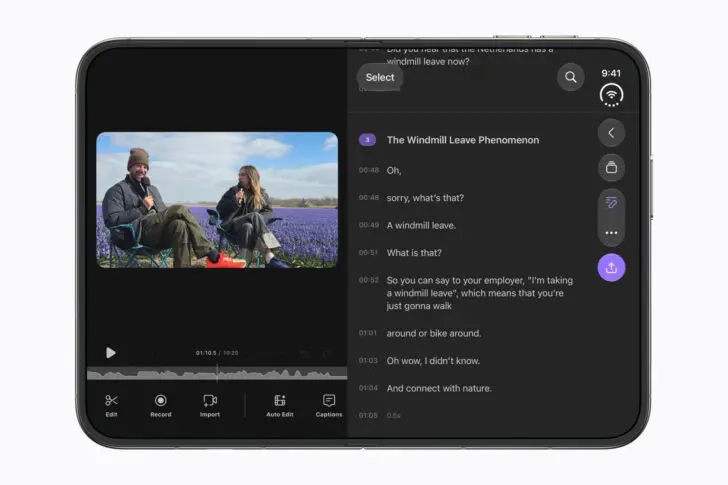
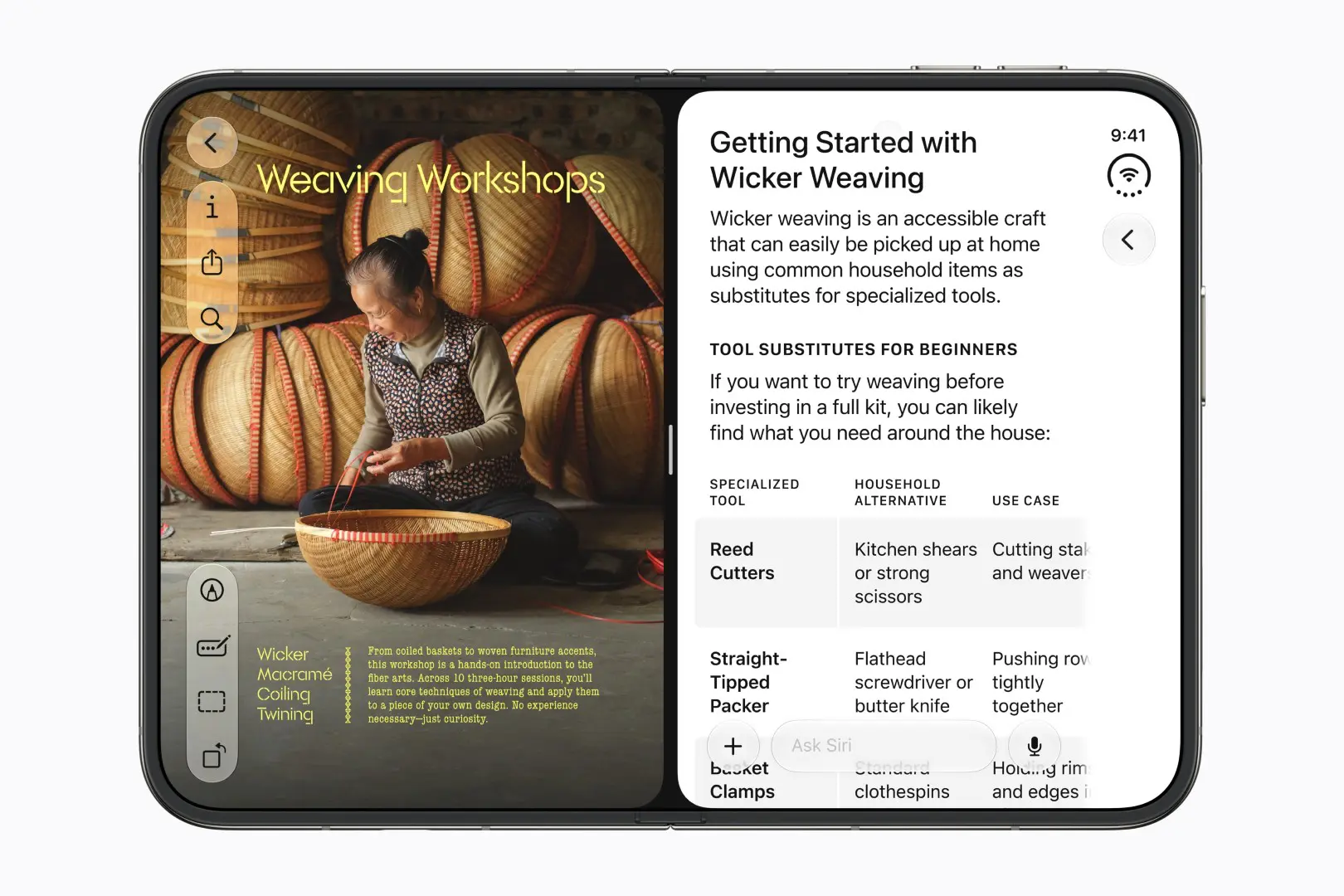
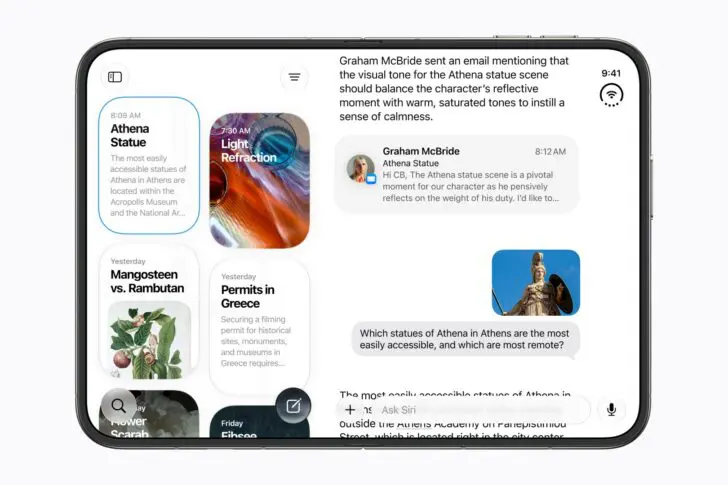
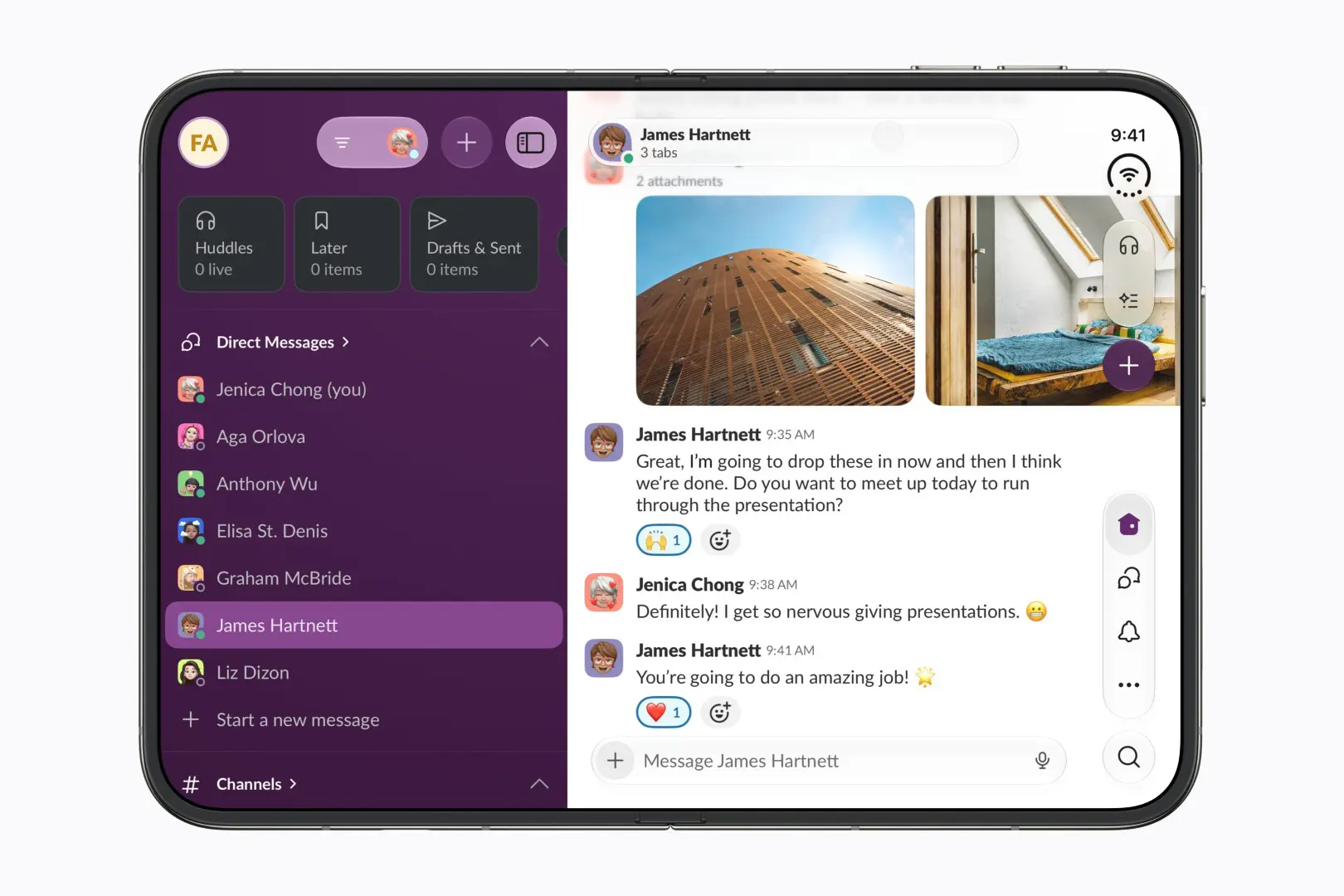
The Duo provides Apple with a reason to significantly rearrange iOS for the first time. Lock screen buttons, the Dock, and app navigation move to the side to gain vertical space. When unfolded, the home screen shows two pages with a vertical Today View on the left. The Dynamic Island is positioned vertically on the side, and the status bar nestles circularly in a corner. Split View brings two apps side-by-side on an iPhone for the first time, including two windows of the same app and saved app pairs. StandBy now also works without a charger, on both screens.
A notable detail in the fine print: the Duo ships with iOS 27.1, not iOS 27 which will be released on September 14. Netflix, Zoom, and Slack have already updated their apps; other developers will receive new APIs and Duo support in Device Hub in Xcode.
Price and availability
The iPhone Duo starts in Europe from 2,339 euros for 256 GB. That is 850 euros more than the iPhone 18 Pro Max and 340 euros above the European price of the Samsung Galaxy Z Fold 8. The most expensive iPhone Duo comes with 2 TB of storage and costs 3,849 euros. Prices include VAT. Pre-orders start Friday, October 16, and the device will be in stores on October 23.