

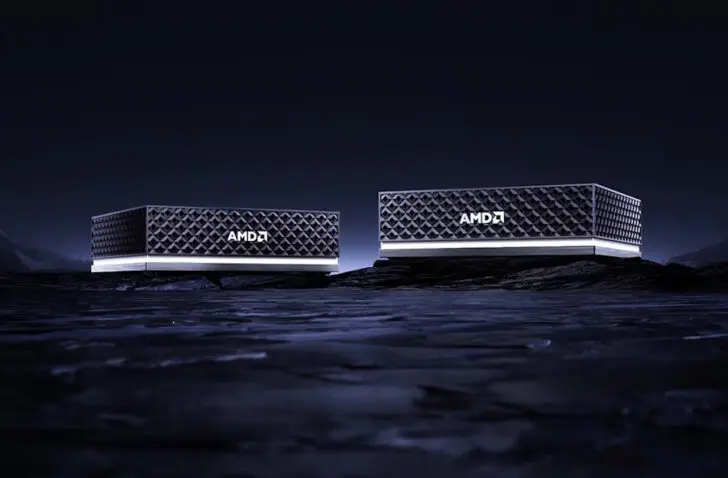
With Ryzen AI Halo, AMD is launching its own complete PC under its own name for the first time. The curated software stack around ROCm, not the hardware, is the trump card. The question is: who is AMD targeting with the Ryzen AI Halo?
At Computex this year, almost everything revolves around the so-called Agent Computer: a PC that understands prompts, plans actions, and performs tasks largely independently. AMD is jumping on that bandwagon with the Ryzen AI Halo, a mini-PC the company announced at CES in early 2026, which will be on shelves starting this summer.
This time, AMD isn’t selling a chip (AMD Ryzen AI Max+, better known as AMD Strix Halo) to a manufacturer to build the computer; it’s building it itself. Why is a chipmaker suddenly putting together a complete machine? We put that question to Rakesh Anigundi, Product Manager for Ryzen AI at AMD.
Why AMD is building a PC
The answer comes down to speed, according to Anigundi. “We wanted to make the best possible first impression. If we only made hardware and had to rely on an external partner for the right experience from the start, that wouldn’t have been the right choice in terms of agility.”
That agility is no minor detail. AMD releases a new ROCm version every six weeks and wants to update the software on the Halo box monthly. “It’s very difficult to maintain that pace when there’s a third party involved,” says Anigundi.
The strategy is therefore deliberately phased: AMD builds everything itself, launches, establishes a rhythm, and only then brings in partners to scale globally. “HP and Lenovo are already ready to follow, and other OEMs will join later,” says Anigundi.
Other manufacturers like Acer and HP have actually been experimenting with mini-PCs based on the same Strix Halo for some time. According to Anigundi, what distinguishes the AMD Ryzen AI Halo mini-PC from those devices isn’t the chip. “The secret ingredient here is the software stack. The magic is purely in the software.”
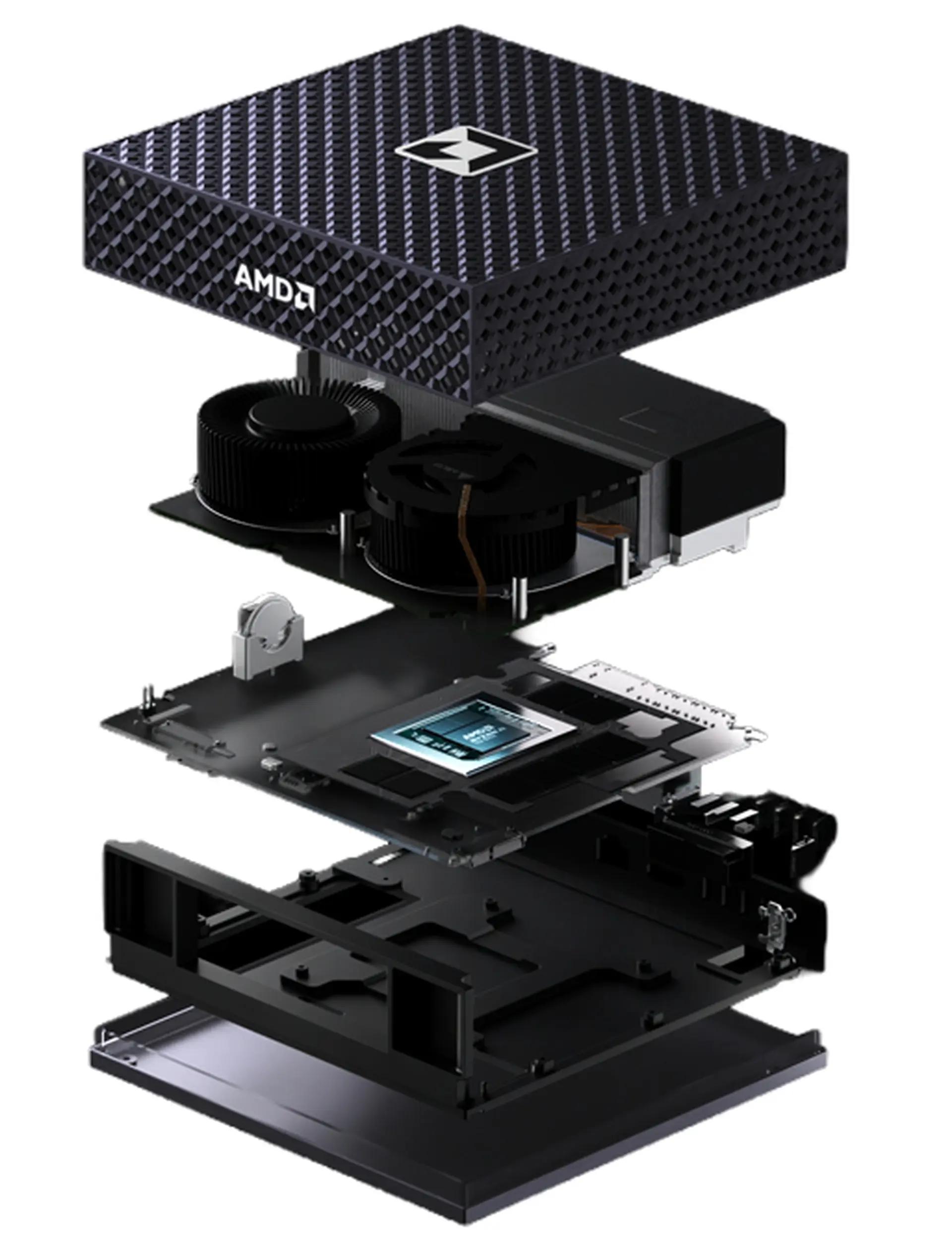
The software is the real star
That sounds like marketing, but there is a concrete philosophy behind it. The PC’s design mantra is: ‘from pressing the button to a running language model in minutes.’ Anyone who turns on the Halo sees a Developer Center that displays all pre-installed applications—ComfyUI, LM Studio, AMD’s own Lemonade, and more. One click is all it takes to update everything.
More importantly, what’s underneath: the correct ROCm version, drivers, PyTorch, and Python dependencies have already been figured out for you. ROCm, AMD’s answer to Nvidia’s CUDA, is historically the part that developers have been less enthusiastic about because Nvidia’s market share and corresponding software stack are much larger.
Playbooks and Lemonade
AMD adds Playbooks to the mix: a dozen AMD-validated recipes for the most important applications, from LLM inference and image generation to fine-tuning. And if you break the system, you can press a button to return to a ‘best known configuration.’
Lemonade is our secret weapon. It is a server that you install with one click and that can run any local language model behind an OpenAI-compatible API
Rakesh Anigundi, Product Manager for Ryzen AI at AMD
According to Anigundi, the next step is automation via skills. “We’re playing with the idea of skills, where an agent can read in all those validated instructions, so you and I can just say: set up the fine-tuning recipe on that AMD box.”
The piece of software Anigundi mentions most often is Lemonade. “Lemonade is actually our secret weapon,” he laughs. It’s a server that you install with one click and that can run any local language model behind an OpenAI-compatible API. “You don’t have to adjust your OpenAI API. Instead of a cloud model, you just let the same application talk to a local model.”
A new definition of ‘developer’
Who is all this intended for? This is where it gets interesting, because AMD is redefining the concept of a developer. “Our notion of who a developer is has changed drastically in six months,” says Anigundi. “I’ve never submitted a pull request on GitHub in my life. Now there are ten in my name, simply because it’s become so easy to code with your agent.”
The primary target audience is therefore not just the seasoned programmer, but also the emerging builder who wants to run AI agents without having all the technical knowledge in-house. At the same time, those experienced software professionals also seem to appreciate the preparation: they want to spend time on code, not on debugging ROCm, PyTorch, and Python dependencies.
Why all that memory?
The Halo runs on Strix Halo with 128 GB of unified memory, much of which can serve as VRAM. The most requested improvement from developers is more VRAM, and that will arrive with the Gorgon Halo successor in the third quarter: up to 192 GB of unified memory and up to 160 GB of VRAM. But why so much memory on a device where the GPU isn’t exactly the most powerful?
Anigundi points to three shifts. First, the mixture of experts architecture: a model with 200 to 300 billion parameters consists of smaller experts, only a fraction of which are active per query. You must be able to load the entire model into memory, otherwise you lose everything to latency between RAM and SSD. “Virtually all state-of-the-art models, including the frontier models from the big AI players, are mixture of experts.”
Secondly, people want to keep multiple AI agents in memory simultaneously. And thirdly, the most important: context. “The real killer application for more VRAM is context size. The larger the context, the better the quality of your answers.”
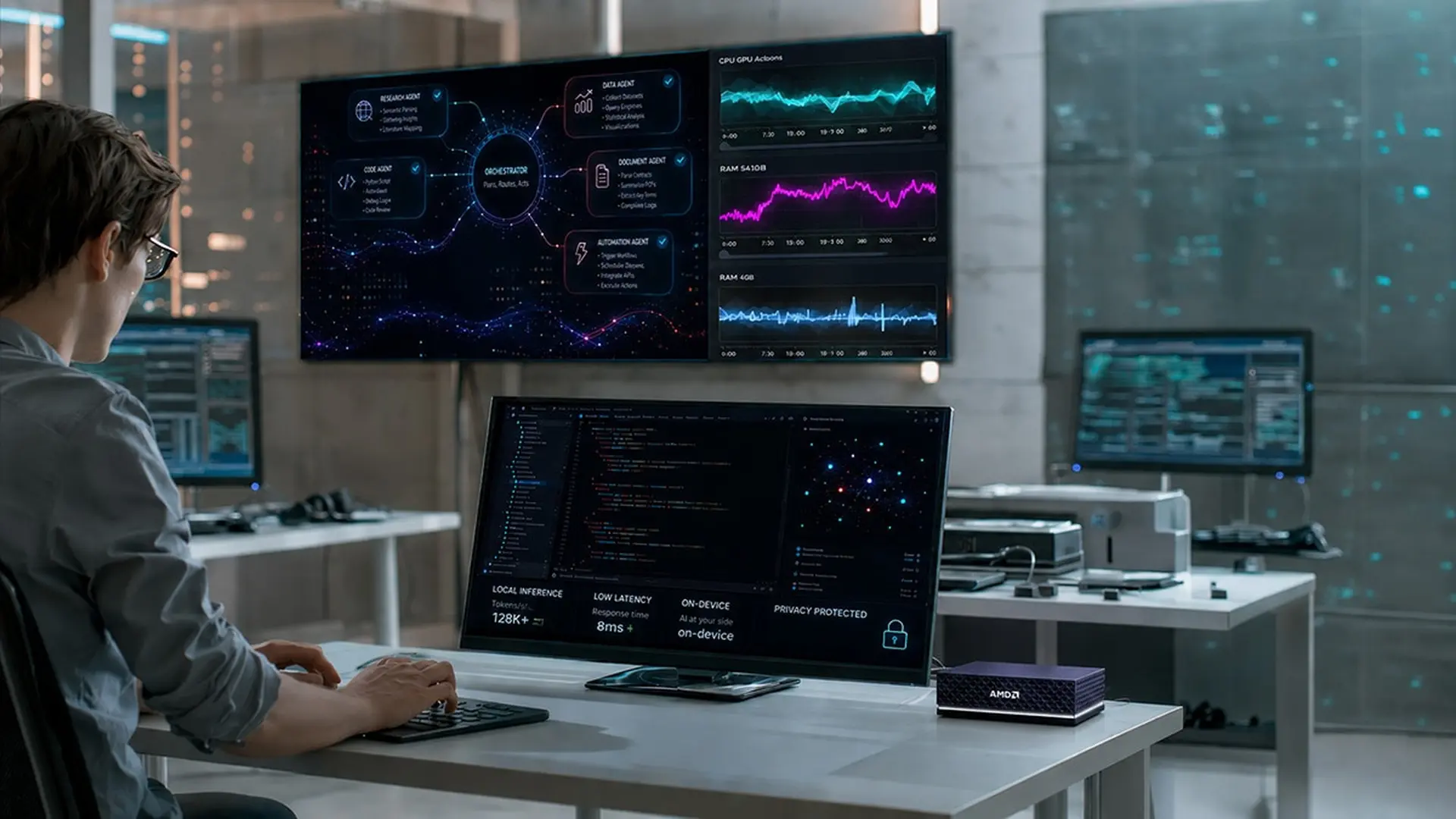
The cost factor makes it concrete. Anigundi first ran a briefing agent on Perplexity, which cost 50 to 100 credits per report. “That cost me one to two dollars each time. Now that same agent runs locally on my box with a Qwen model of about 30 billion parameters, and I’m very satisfied with the quality.” For agents that run continuously, every token on the cloud bill adds up.
Everyone wants to be the same
AMD’s approach sounds convincing, but it is almost identical to that of the competition. Nvidia has been selling its own PC for developers, the DGX Spark, for some time. At the same time, it launched RTX Spark plus NemoClaw at Computex—an agent platform that, yes, works with ‘playbooks’ and a ‘minutes-to-start’ experience, putting local models behind an OpenAI-compatible API.
The vocabulary is literally the same. The real battlefield is therefore not the hardware, but the maturity of the software stack, and there Nvidia has a years-long lead with CUDA over AMD’s ROCm.
Microsoft is also pushing forward. At Build 2026, the company presented Project Solara, a vision for an operating system for agents, and with the Aion 1.0 plan, local reasoning on chips from AMD, Intel, Qualcomm, and Nvidia.
Anigundi sees that layer as complementary: “The hardware remains the hardware, but this connects the whole.” As far as we’re concerned, that’s exactly the risk. If Microsoft moves the agent layer and sandboxing—a question Anigundi himself raises—to the OS, the physical box risks becoming a commodity where the real battle is fought elsewhere.
It’s all still early
The promise of boot to tokens in minutes stands or falls on whether those monthly updates effectively continue to tame the proliferation of models and frameworks. Anyone already using a Strix Halo PC knows that in practice, ROCm still often hits limits in a world where CUDA reigns.
What AMD does have is a credible second voice in a market that is only just forming. A second serious player alongside Nvidia is exactly what local AI development needs, and with the announced 192 GB of Gorgon Halo, AMD is putting a memory trump card on the table that Nvidia’s 128 GB currently doesn’t match.
The AMD Ryzen AI Halo will be released at the end of June. “We are seeding the market with our own AMD PC,” Anigundi summarizes the approach. “Move fast, seed the market, create a good hardware-software combination, and then bring in partners to scale broadly.” The OEMs will then take over distribution, while AMD continues to set the software pace. Whether the software promise scores as high as the marketing story remains to be seen in the coming months.