

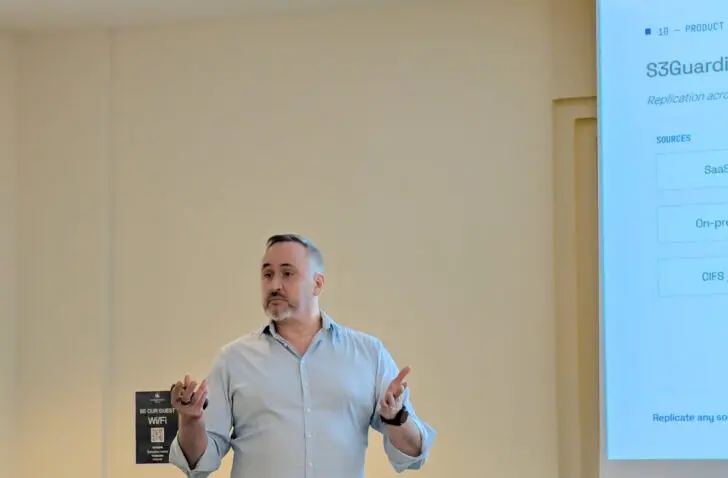
The French company StratoFoundry, only one month old, is using KARL to place a time machine with a notary on any S3 storage. The principle is simple: shift back the timeline and your data appears as it was then, complete with cryptographic proof. Founder Emmanuel Forgues built the software over several years at night alongside his job. Now, the first pilot projects and a bank visit must prove that one man with 10,000 euros in capital can launch a new category.
“Can anyone explain a decision made in a state that no longer exists?” With this question, StratoFoundry CEO Emmanuel Forgues opens his account. Usually, the answer is no: every new version of a file overwrites the previous one; every system shows only the present.
What does KARL do?
KARL Core is a thin software layer between your users and your S3 object storage. Users simply see a network drive. Everything that passes through it receives a full history: who touched the file, when, with which application, under what policy, and with whose approval.
At the top is a timeline. Slide it to yesterday at 9:03 AM and the entire file system displays as it was then. Forgues refuses to call this a backup or snapshot: not a single byte is copied; he only changes the time the storage displays. In a real encryption test, he restored 3.7 terabytes and six million files in three seconds this way.
The notary sits underneath. Every change is recorded in a signed journal with timestamps. This allows you to later demonstrate to an auditor that a file really was in that state at that moment. His demo example: a supplier was granted extended access on August 5. Today, the risk analysis says ‘high’, the policy is stricter, and the approver is gone.
Practically, it is remarkably light: a single 34 MB binary. There is no database, no extra servers, only S3.
Why the extension then? KARL shows the state from back then: analysis v7 said ‘medium’, policy 3.2 applied, approval APP-214 was active, validated by a human at 9:12 AM. After ransomware, it works the other way around: instead of blindly restoring the previous version, which might already be infected, you see who changed what and when, and choose the correct version.
Practically, it is remarkably light: a single 34 MB binary. There is no database, no extra servers, only S3. Retrieving a file’s context takes 12 milliseconds, regardless of the volume.
What do companies use today?
The building blocks of KARL all exist today. S3 versioning and object lock preserve old versions per object, but without context. Snapshots freeze fixed points in time and consume storage. Backup restores bytes but doesn’t say which version is the correct one. Audit logs reside in each tool separately and are only as reliable as the tool itself. Those who want proof for an audit buy expensive compliance software.
What is new is the combination: a single history across files, permissions, policies, and decisions, with proof that anyone can re-verify offline, on any S3, from AWS to Belgian providers. Forgues refused help from AWS to remain vendor-independent, and he patented the way KARL writes its history to S3.
At the same time, there are caveats to consider. Beyond the patents, it is a claim by a single developer that has not yet been confirmed by any customer. His statement that he has ‘no competitors’ specifically means that for a 200-terabyte replication project, he was cheaper than a quote of 300,000 euros.
Who is it useful for?
Three groups emerged in his presentation as potential targets for StratoFoundry’s KARL. First, medium-sized companies that must provide proof for NIS2, DORA, or the AI Act: KARL Audit shows in real-time ’65 percent compliant, sixteen documents without proof’ and generates a NIS2 report on the state of a chosen date in seconds, says Forgues.
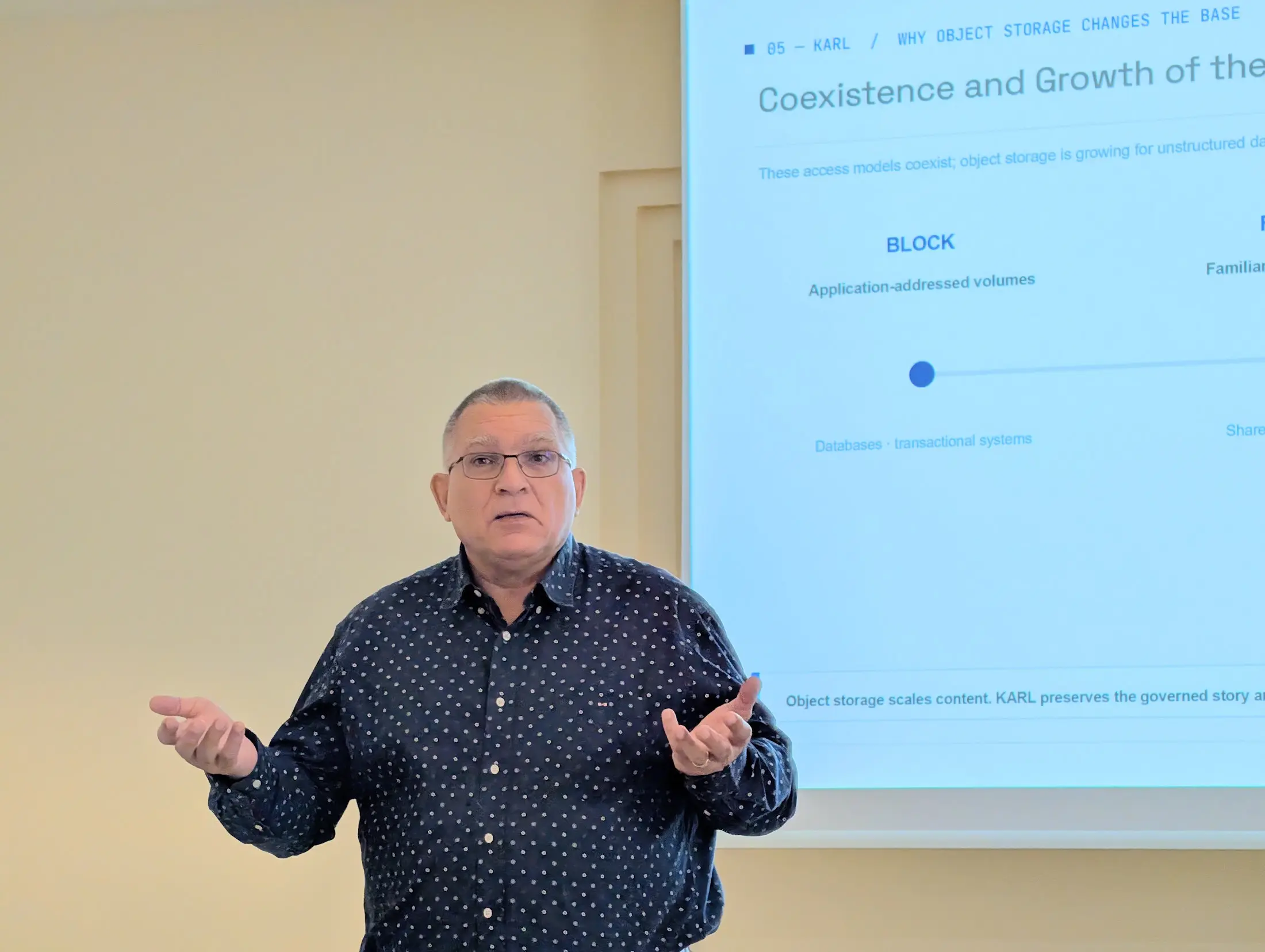
Another interesting group is organizations with petabytes of unstructured data that want to start with AI and first want to know what they have. “Your own Google on your own data, without exposing it,” as CTO Sami Fredj calls it; an initial PoC visually searches through a photo archive of several terabytes.
Finally, partners who build their own applications on KARL Core are also of interest. That is the actual strategy: StratoFoundry provides the engine and the APIs, and integrators build the car. A partner program is looking for a maximum of five paying pilot projects for this purpose.
Around that S3 core, Forgues built additional applications for cyber recovery (KARL Cyber), AI traceability (IA Studio), his own Git (Forge), and export (Transit). With these, he wants to show what the history layer can do, but everything is still in a demo stage.
Pricing is still open: only the replication tool S3Guardian (9,900 euros per year up to 50 TiB, 34,900 euros up to 200 TiB) and S3Proxy have a price. KARL’s pricing ‘is being finalized’.
Plenty of memory, no history yet
The concept is elegant and the demos look promising. We saw the encryption test live, and the question KARL answers is exactly the one every auditor asks. The fact that Forgues runs his own company entirely on KARL shows that he believes in his product.
The fact that StratoFoundry runs entirely on KARL shows that he believes in his product
At the same time, StratoFoundry has only existed since July 2024, with 10,000 euros in capital, entirely self-funded. The team is weeks old and is still looking for a sales director. The nine applications prove feasibility, not marketability.
The pilot projects start this month, followed by the bank visit. “I cannot continue alone,” says Forgues himself. The company that wants to become the memory of other organizations thus has no history of its own yet. Whether it gets one depends on what the proof-of-concepts yield this autumn and whether a bank (or investor) believes in a 34-megabyte time machine. The idea deserves someone giving it a try.