

With partnerships with NetApp, Cisco, and AMD, a full agentic AI stack, and a new bare-metal Kubernetes offering, CEO Rajiv Ramaswami is reshaping the company’s contours. The question is no longer whether Nutanix can become a platform player, but whether it can maintain the execution speed to actually deliver on that promise.
Ramaswami’s keynote at the Next conference is built around three themes:
- Agentic AI as the next infrastructure layer
- Modernizing applications with containers and cloud-native data
- The core platform that runs everything regardless of location
Much of that sounds like a familiar Nutanix story, but the scale of what was announced is not.
The most tangible evidence of this shift lies in the partner expansion. The collaboration with NetApp—pairing Nutanix Cloud Infrastructure with NetApp ONTAP storage via NFS—was unthinkable until recently. Nutanix storage was always the core of the HCI proposition. Now, that storage becomes optional.
Alongside NetApp, Dell PowerStore also appeared in early access, and a validated solution with Lenovo ThinkSystem servers and external storage was announced. The message: those running Nutanix don’t have to dump their existing storage investments.
This is no coincidence; it’s a strategic move toward the massive VMware installed base (around 300,000 customers according to Ramaswami).
AI: ambitious and down-to-earth at the same time
Nutanix’s AI story is deliberately modest in its ambitions, something we welcome. The company isn’t positioning itself as an AI application builder, but as the plumber providing the infrastructure on which enterprise AI must run.
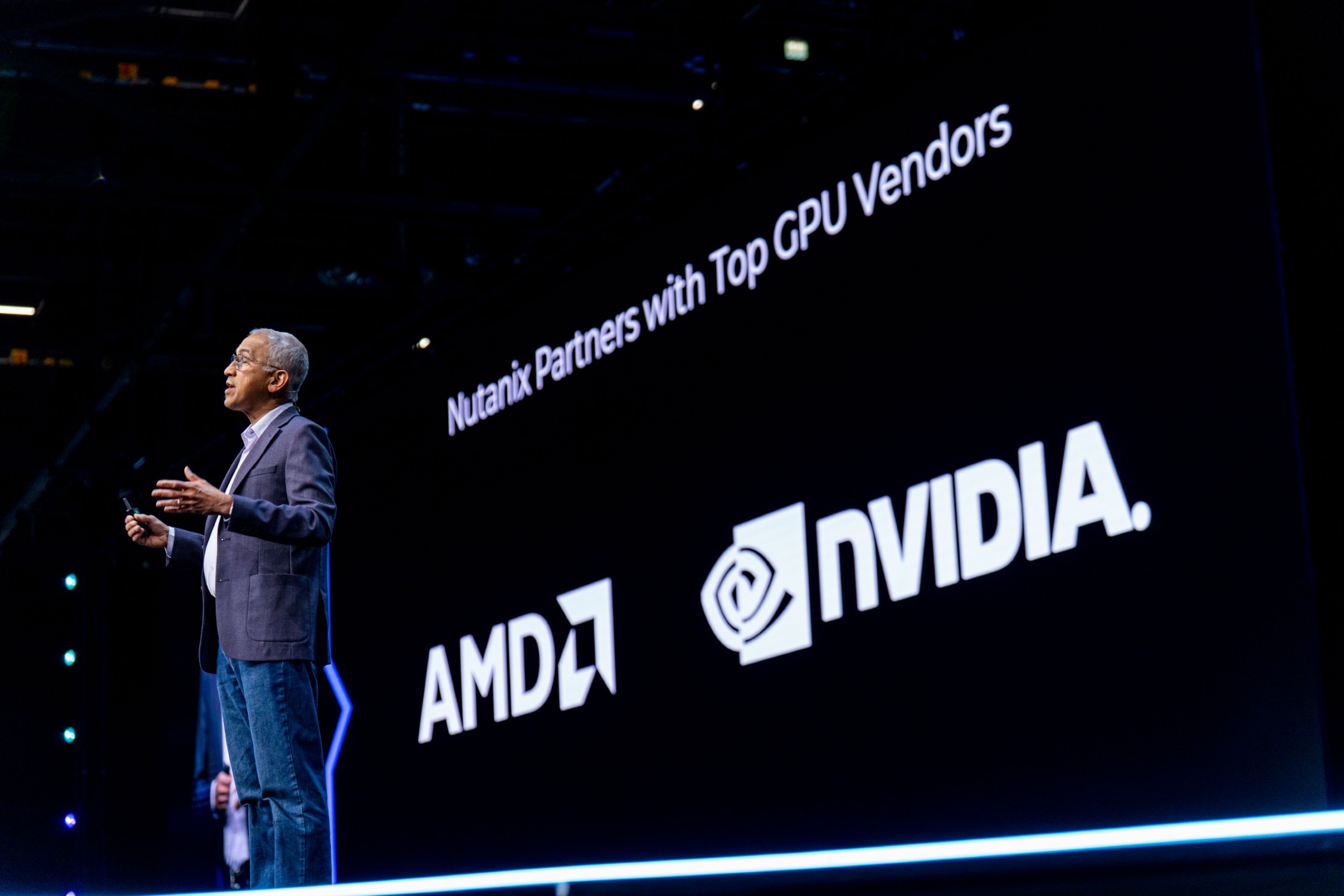
The complete agentic AI stack—the first components of which were announced at Nvidia GTC—has now been supplemented with an AI service catalog, an AI gateway with policy-based governance and token management, and the new Service Provider Central for multi-tenancy. Nutanix is capturing the entire chain: from GPU optimization at the hypervisor level to managing models, tenants, and agentic workflows.
But some sobriety is in order. Nutanix admits itself that the company currently has about 70 customers actively running AI workloads—a fraction of its 30,000 customers. The use cases are predominantly simple: document analysis, summaries, and chatbots.
Ramaswami was honest about this in a conversation with the press: “I expect it will take a few more years before we are truly in the agentic AI era. Adoption is quite early.” That is refreshing in a market where every vendor claims AI changes everything. It does indeed change everything, but not by next month.
Kubernetes as a quiet revolution
Perhaps the most architecturally significant announcement was NKP Metal. This allows you to run Kubernetes on both virtual machines and bare metal from a single environment. Nutanix calls this dual native and claims to be the only one in the industry offering both options with the same data services, network, and security policies.
The two primary use cases for bare-metal Kubernetes are AI clusters and edge applications.
Dan Ciruli, VP Cloud Native at Nutanix
Dan Ciruli, VP Cloud Native at Nutanix, hits the competition where it hurts. While some vendors want to run everything in VMs and others—a clear reference to Red Hat and KubeVirt—want to eliminate the hypervisor, Nutanix offers both options. Ciruli: “At every Kubernetes conference over the past decade, the same barrier comes up: the shortage of Kubernetes skills. If you then adopt a product that demands 100% of your workloads run in Kubernetes, you’re setting the bar very high.”
According to Ciruli, the two primary use cases for bare metal are AI clusters and edge applications. “Analysts predict that containerization at the edge will go from 20 to 80 percent in three years.” For the data center, Nutanix believes the virtualization layer remains the wisest choice. Not coincidentally, that is where the company makes the most money.

The architectural trump card
What makes Nutanix architecturally unique compared to the competition? CTO Rajiv Mirani cites two elements. First, the Lego-block architecture: every component—storage, compute, network, security, containers—is modular and interchangeable via open APIs.
Second, integrated state management: all services are centrally managed in a single database. While competitors assembled their stacks through acquisitions and have to integrate them afterward, Nutanix built that unity in from the start.
We currently have about 70 customers actively running AI workloads—a fraction of the 30,000 customers Nutanix serves.
Rajiv Ramaswami, CEO at Nutanix
That architectural choice has direct business consequences. Licenses are portable, pricing is modular, and customers can choose which components they purchase.
It also enables the rapid expansion of the platform—AI services, multi-tenancy, external storage—as adjacencies that build on the same core, rather than creating a new product every time.
Ambitions as a platform player
Nutanix presented a compelling story at its Next conference in Chicago. The company has evolved from an HCI specialist to a platform player that brings together compute, storage, networking, Kubernetes, AI infrastructure, and multi-tenancy in one modular stack.
The ecosystem growth is impressive, the architectural foundations are solid, and the VMware migration stream provides a structural tailwind that could last for years.
Nutanix’s greatest asset may be its pragmatism. In an industry overflowing with AI hype, this company says: we build the pipes that AI needs to flow through, and we make sure it works everywhere—on-premises, in the cloud, on bare metal, on any server.
That’s less sexy than agentic AI visions, but it’s exactly what businesses need.