

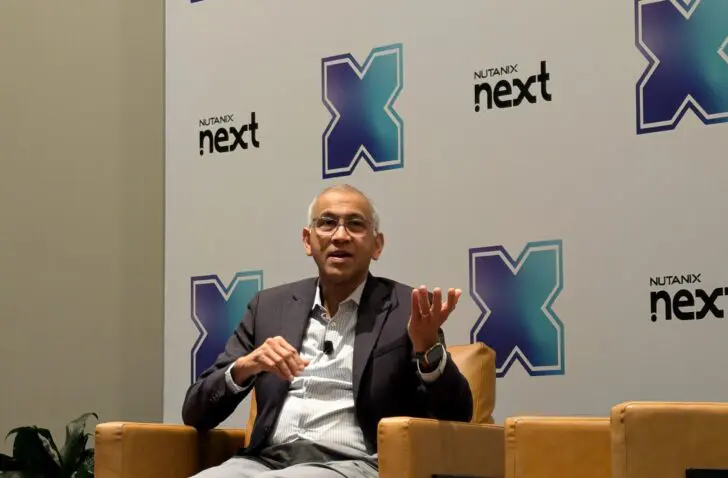
Nutanix CEO Rajiv Ramaswami puts the AI hype into perspective: enterprise adoption is still in its infancy and true agentic workflows are years away. Internally, AI is already delivering measurable productivity gains for Nutanix.
During the Next conference in Chicago last week, Nutanix announced a complete AI stack for enterprise AI. This includes an optimized hypervisor for GPU workloads, an AI gateway with policy-based governance, and the new Service Provider Central for multi-tenancy. So-called AI factories are also now welcome on the cloud platform.
The announcements were impressive in their breadth, but in an interview with Nutanix CEO Rajiv Ramaswami, he provides an unusually honest picture of where the market actually stands.
In its infancy
When asked how many customers are actually running AI workloads on the platform, Ramaswami deliberately remained vague about exact figures. Earlier in the day, we heard a figure of around 70 customers on the exhibition floor. Out of a customer base of over 30,000, that is a fraction.
Furthermore, the use cases are predominantly simple: document searching and summarization, chatbots, and in some cases, image analysis in the healthcare sector. “AI adoption is still in its infancy at companies,” Ramaswami stated bluntly.
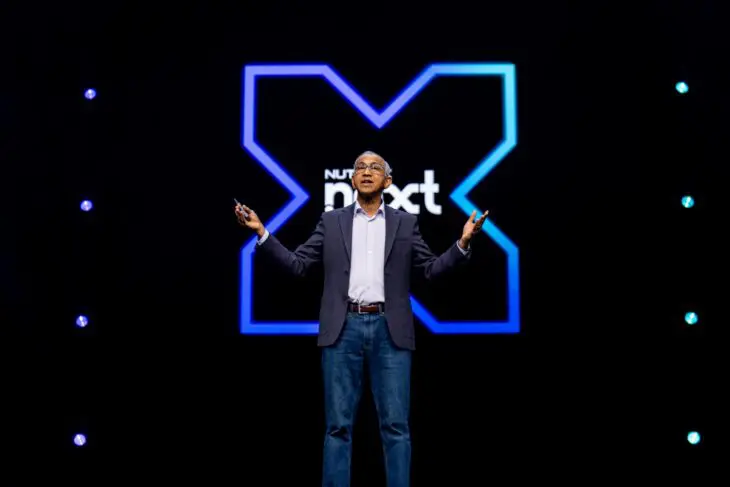
Regarding the timeline for true AI agents—the type of autonomous workflows the entire industry is buzzing about—he was equally direct.
“I expect it to take a few more years. We need to see more use cases of companies setting up multi-agent scenarios. It starts out as anecdotal, then it becomes a trend, and only then is it widely adopted.”
He added that the degree of autonomy depends heavily on how business-critical the application is. “The more mission-critical the task, the more cautious you have to be.”
AI usage within Nutanix
Where AI is already delivering concrete results for Nutanix internally is in its own software development. Ramaswami shared a remarkably specific KPI: the company is aiming for a 20 percent productivity gain per developer by deploying AI tooling throughout the entire development cycle, from product requirements and design to coding and testing.
Nutanix aims for a 20 percent productivity gain per developer by deploying AI tooling throughout the entire development cycle
Nutanix CEO Rajiv Ramaswami
“That effectively means we can deliver 20 percent more features per release with the same team,” said the CEO. This productivity gain translates directly to the margin: during a call with investors earlier this month, Nutanix indicated that AI efficiencies contribute to the bottom line margin.
It is a striking contrast. Nutanix is building a complete AI infrastructure stack for customers who are largely not yet ready for it, but is reaping all the benefits of AI itself as a productivity tool.
The honesty with which Ramaswami makes that distinction is refreshing in a sector saturated with AI hype. The platform is ready. The market not quite yet.