

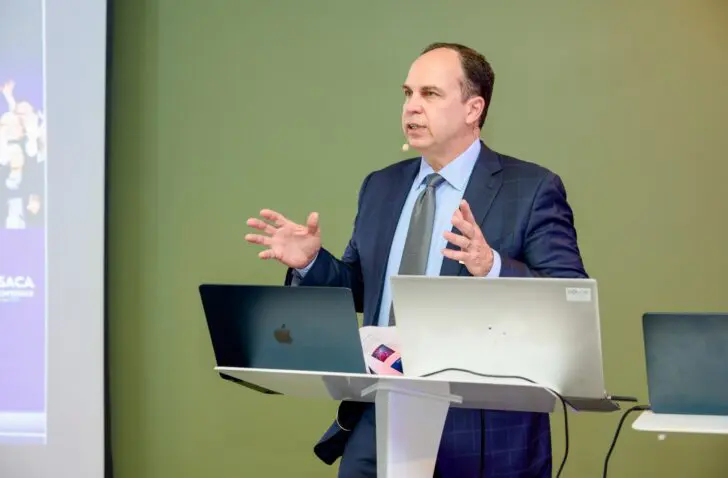
ISACA chief Erik Prusch is remarkably candid about the downside of the AI explosion: most organizations don’t even know how they would shut down their AI if things go wrong. In a conversation with ITdaily, he describes a world where risks are growing faster than controls, and where governments are mostly just watching from the sidelines.
At its core, ISACA is a professional membership organization that develops certifications, frameworks, and resources for professionals in IT audit, cybersecurity, risk management, governance, and privacy. Across all these domains, AI is the common thread.
According to CEO Erik Prusch, it is precisely this growing influence that creates the need for stronger governance, oversight, and controls at a time when almost everyone has their foot on the gas.
It is dangerous
Enormous amounts of capital are flowing into AI, and all the attention is focused on productivity. Much less energy is going into frameworks, or the detection and identification of risks along the way. “In the US, it is unbridled; it is almost encouraged, a free-for-all, as far as the money goes,” Prusch says, summarizing the American situation. There are hardly any boundaries, and so, in his view, we are currently collectively testing where the edge of that growth lies.
Prusch points to parties like Anthropic and the most advanced models they are making publicly available today as an illustration of the pace. “Every new leap in capability brings the question into sharp focus: is as much money going into protection as into chasing returns?
His judgment is unusually blunt for a CEO. “It is dangerous,” he repeats. “I am excited about the growth and the opportunities for our members, but I am afraid that, as countries, we have insufficient control over what is being put into those systems right now.”
The off switch that nobody knows
The most concrete signal of that loss of control comes from ISACA’s own member research. When the organization asked how many companies are prepared to shut down their AI, it turned out that only 10 percent had a documented and regularly tested process in place. A figure that Prusch calls downright dangerous.
He looks back to the mainframe era to make his point. In the past, when something went fundamentally wrong, you simply pulled the plug out of the wall. Not exactly the most elegant solution, he admits, but it worked.
It is no longer enough to know how deep AI is embedded in your own company. You must also know all the offshoots and all the connections entering the organization
Erik Prusch, CEO ISACA
“That emergency brake has disappeared today. It is no longer enough to know how deep AI is embedded in your own company. You must also know all the offshoots and all the connections entering the organization, and know exactly where they arrive. There is no off switch, nor is there a plan to untangle the problem if it occurs.”
Auditing AI remains a challenge
With this, Prusch touches on what is perhaps the core issue: organizations need more insight into and control over AI systems to manage risks effectively. “If you cannot subject an AI system to an audit and say with confidence what goes in, what trains the models, and what comes out, then risk inevitably accumulates. In the long run, a poorly managed risk will slow down the very growth that everyone is so eager for.”
This is where the organization’s pitch lies: according to Prusch, control is not a brake, but a prerequisite for growth. He points to ISACA’s 55-year history and a principle he carries over from his years in software. Thirty years ago, you built in security and audit practices after the fact, and that slowed everything down.
The lesson: you have to build those controls into the code itself. The uncomfortable part is that today, code is written daily and largely unchecked, by AI. “That is exactly why the audit function must be involved early and often in AI projects instead of showing up after the fact.”
One economy, fifteen standards
Prusch is a vocal advocate for harmonizing standards, and his argument is the supply chain. According to him, it matters little whether a company is based in Europe when the supply chain comes from Asia, or vice versa. “It is one global economy, and everyone influences each other. Fifteen different standards then help no one. The gain lies in getting as close to one as possible.”
What strikes him in this regard is the silence of many governments. According to Prusch, they simply don’t know what to do yet, and some are quietly hoping that the creators of the large language models will solve it for them. “The party that develops the technology and profits from it will not build in all the brakes and boundaries of its own accord. For that, he believes independent, non-profit organizations are needed that have only one motivation.”
Looking ahead without an emergency brake
The most honest part of this conversation is that Prusch does not claim a solution for the off-switch problem. “Our answer is not to turn back, because that is impossible, but to stand in front of it. We want to monitor at the front of the chain, audit where possible, and prepare the professionals who ask the right questions. It is prevention in the absence of an emergency brake.”
Who draws the line? And where is the switch for when things go wrong?
Erik Prusch, CEO ISACA
For European organizations, this leaves the uncomfortable question on the table that Prusch himself poses: who draws the line, and where is the switch for when things go wrong? At this moment, he acknowledges, no one has an answer. The fact that an organization with a commercial interest in more regulation states this so sharply does not make the question any less urgent. Quite the contrary.