

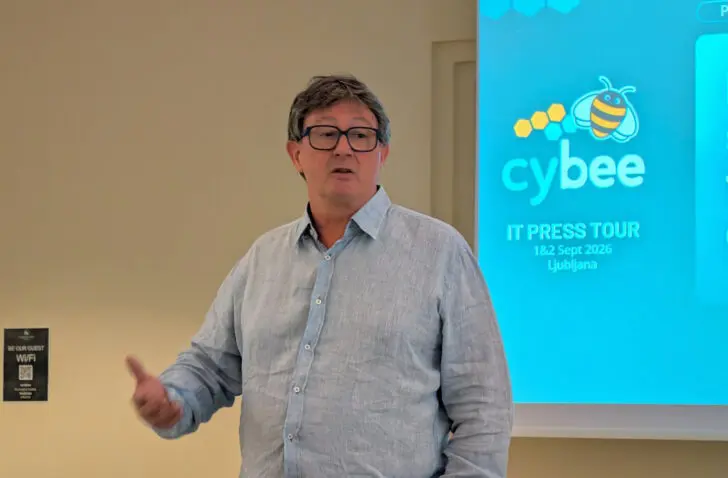
French company Cybee is building a European cloud backup service around the open-source backup engine Restic that recovers faster, stores more cheaply, and, above all, has no lock-in. The product has only been live since March and runs almost exclusively at sister company Nuabee. The positioning is clear: not to replace Veeam, but to add a European layer on top for extra resilience.
“Migration tools exist for hypervisors. None exist for backup formats.” With that argument, Eric Deronzier, founder and CEO of Cybee, opens his presentation. Those who want to move from VMware to Proxmox can find tools. Those who want to change backup providers are stuck with a closed format containing sometimes ten years of mandatory backups.
“A bank cannot simply leave those behind,” says Deronzier. European tenders are therefore increasingly demanding open formats, and DORA requires financial institutions to be able to switch providers. “An open backup format is no longer a nice-to-have,” says Deronzier. Importantly, his sister company Nuabee has been selling disaster recovery as a service for twelve years. Cybee was originally built for that service.
Restic as an open-source engine
Cybee starts with Restic, an open-source backup engine of German origin used by CERN, among others. “Excellent, but it was only an engine. There was nothing around it,” says Deronzier. Cybee built the rest: a single agent in Rust for both Windows and Linux, and image backup of Windows disks via VSS.
Restic itself only handles files, backup orchestration, integrity checks, and cleanup. The data goes deduplicated and encrypted directly from the server to European S3 storage, currently T-Systems’ Open Telekom Cloud in the Netherlands. Cybee’s own platform sees no data passing through. “Without immutable backup, cyber resilience is impossible.”
Cybee starts with Restic, an open-source backup engine of German origin used by CERN, among others.
The figures come from practical experience at Nuabee. Recovery runs up to 4 TB per hour per disk on the fastest cloud storage. “That is ten times what we see with traditional solutions,” says Deronzier. According to him, an 8 TB Windows file server with 63 million files went from ‘incremental backup longer than 24 hours, recovery impossible’ to a daily backup in three hours and a recovery time of ten hours.
Multiple players
No, and Deronzier says so himself. The American Zmanda is also building its new products on Restic. The Polish Storware and the French Plakar are also in the same space. Cybee claims to be the only one offering the full combination: open format, cloud-native, orchestration, a single agent, and European origin.
He draws the real contrast with the market leaders he encounters daily: Veeam, Commvault, Acronis, and at the top, Rubrik. These were born in the LAN era, he says, and it shows in the cloud. They deduplicate excellently on-prem, but place a non-deduplicated replica in the cloud.
“They only use one of the three storage classes every cloud offers, ‘hot’, which is two to three times the price of ‘warm’. And in a disaster involving several terabytes, they recover too slowly.”
“It’s not about doing the same thing better, but about doing it differently.” Crucial detail: 80 percent of new Cybee customers run Veeam on-prem, and Cybee does not discard it. It is added as an extra layer. Only after one to three years does a customer dare to let go of their local backup.
Who is it for?
Companies with 250 to about 10,000 employees, especially in regulated sectors. Think of the healthcare sector, finance, transport, industry, and local governments that must demonstrate regular recovery tests under NIS2. Cybee does not sell directly but through MSPs.
Today, only parent company Nuabee sells it, with about 150 companies as customers with 2,500 critical VMs and three petabytes. Orange Business will follow as a reseller in the first half of 2027, with other European MSPs in the second half. The price is ‘under consideration’: from 5 euros per VM per month, with storage separate or bundled with qualified European providers.
Those who want to back up at the hypervisor level have no business with Cybee yet.
Who is it not for? Those who want to back up at the hypervisor level. Cybee works with agents and deliberately does not support VMware or Hyper-V. Support for XCP-ng and Proxmox will follow in the second half of 2027. Databases will not get real modules until 2027. You cannot extract individual files from an image backup, so Cybee combines image for the system disk with file backup for the data. And the console only exists in French. The English demo ran via Google Translate, which was not exactly professional.
A layer on top, not yet a destination
Cybee’s reasoning is correct: an open format, European storage, and cloud-native deduplication are exactly the points where the LAN generation falls short. The figures it presents come from real environments, not a lab. Restic is proven technology, but Cybee is six months old. The product runs with one customer that happens to be the sister company, speaks only French, and lacks databases and hypervisors until well into 2027.
Those who preach openness should also expect the question of why Cybee itself is not open source; the answer, “in two to four years we will give a part back,” is quite thin. Today, Cybee is what it says it is: an escape route alongside Veeam, not a destination. Whether it becomes that will be decided in 2027.